 Dr. Lubna Farah
 Second meeting of the Strategic Political and Defence Committee of Makkah Joint Defence Agreement held in Islamabad; three nations pledge closer cooperation in defence industries, military training and strategic coordination.
Pakistan, Saudi Arabia and Türkiye have reaffirmed their commitment to deepening trilateral defence cooperation, enhancing strategic coordination and advancing the implementation of the Makkah Joint Defence Agreement. In a joint statement, the three countries strongly condemned Houthi attacks targeting civilians and civilian infrastructure in Saudi Arabia, reiterating their unwavering support for the Kingdom’s security, sovereignty and territorial integrity.
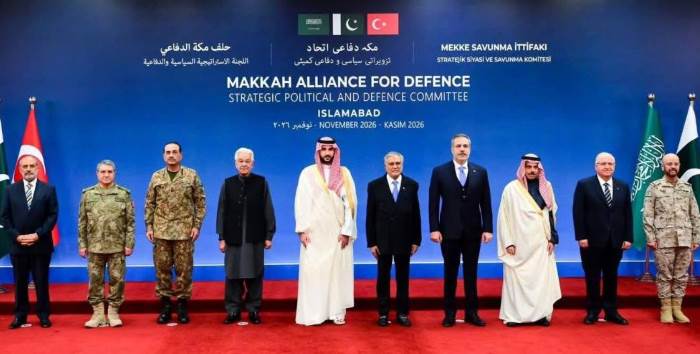
The consensus emerged at the conclusion of the second meeting of the Strategic Political and Defence Committee (S-PDC) of the Makkah Joint Defence Agreement, held in Islamabad on Friday, November 27.
Pakistan was represented by Deputy Prime Minister and Foreign Minister Senator Mohammad Ishaq Dar, Defence Minister Khawaja Muhammad Asif, and Chief of Defence Forces and Chief of Army Staff Field Marshal Syed Asim Munir. The Saudi delegation comprised Defence Minister Prince Khalid bin Salman bin Abdulaziz Al Saud, Foreign Minister Prince Faisal bin Farhan Al Saud, and Chief of the General Staff General Fayyad bin Hamed Al-Ruwaili. Türkiye was represented by Foreign Minister Hakan Fidan, Minister of National Defence Yaşar Güler, and Chief of the General Staff General Selçuk Bayraktaroğlu.
Institutionalising Collective Defence
Reaffirming their adherence to the core principles of the Makkah Joint Defence Agreement—specifically collective defence, mutual solidarity, and respect for one another’s sovereignty and territorial integrity—the committee reviewed the outcomes of its inaugural meeting in Istanbul on August 31, 2026, and the emergency session in Riyadh on October 5.
The delegates assessed progress in implementing prior decisions and welcomed steps toward establishing and operationalising the agreement’s permanent secretariat in Saudi Arabia. Designed to facilitate institutional coordination, ongoing consultations and administrative management among the three states, the secretariat marks a pivotal step in translating political intent into a structured, sustained framework for cooperation.
Saudi Security and the Yemen Context
The situation in Yemen and the persistent security threats facing Saudi Arabia featured prominently on the agenda. Strongly condemning continued Houthi strikes on civilian areas and critical infrastructure in the Kingdom, the three partners pledged to sustain and intensify their collective efforts to safeguard Saudi security under the pact.
This stance underscores the strategic weight of the Makkah agreement’s collective-defence clause, under which armed aggression against any member state is regarded as an act of aggression against all parties. Notably, however, the communiqué stopped short of announcing any specific military operation, troop deployment to Yemen or joint offensive against the Houthi movement. The outcome thus reflects a posture of collective security deterrence, defence coordination and diplomatic backing rather than an imminent military intervention.
Defence Industry, Technology and Training
Beyond immediate security concerns, the three countries agreed to expand collaboration in defence manufacturing, joint technological development, military training and capacity-building. By enhancing interoperability and operational readiness across their armed forces, the partners aim to respond more effectively to shared security challenges.
The alignment brings together complementary strengths: Pakistan’s extensive operational experience, Türkiye’s rapidly advancing defence-industrial and technological base, and Saudi Arabia’s strategic investment capacity. While this synergy creates substantial scope for technical exchanges and joint ventures, any specific weapons-development programme or co-production agreement will require separate formal announcements.