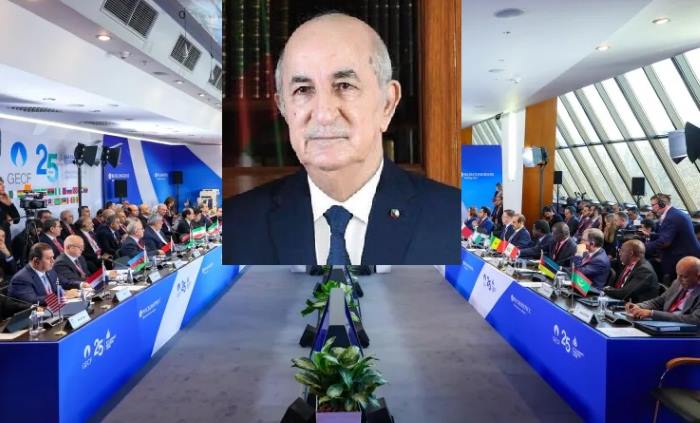
 President Abdulmadjid Tabboune | Message to the Participants of the Forum On the opening of the works of the eighth summit of the Heads of State and Governments of the Moscow Gas Source Countries Forum, October 27 (2026) President of the Russian Federation, Vladimir Putin, the heads of state and governments, The Secretary-General of the Forum of the Gas Source Countries were present at this occasion.
I am pleased to begin by addressing His Excellency the President Vladimir Putin with the highest expressions of appreciation and sincere gratitude for the warm reception and hospitality, which I have received from the delegation of Algeria since I set off on my journey to the venerable Moscow, which today hosts a new milestone in our joint work.
Two years have passed since Algeria was honored to host the seventh summit, and we are proud to see the “Declaration of Algeria” that established the strategic position of natural gas in the global energy security system, and we are pleased to see its principles have become a tangible reality.
And when Algeria hands over the torch of the presidency of the summit to the friendly Russian Federation, it wishes it all the best and success.
And we are proud of this achievement, and we are committed to celebrating a quarter century since its founding, in which the vision of Algeria as an international reference point and its voice heard in the global energy equation has become a reality.
The Forum has further strengthened its capabilities by establishing a research institute in gas, which Algeria did not have, as the host country, as a effort to provide all means to ensure its optimal course of service to all members.
We are meeting at a critical juncture for global energy markets. The successive crises have revealed the resilience of the gas industry, and have proven that natural gas is not a passing temporary option, but a solid pillar for the economies of nations.
However, this industry is now moving in a highly complex environment, driven by energy security requirements and climate transition needs, amid deep regulatory transformations and the redefinition of geopolitics.
As we emphasize that energy policy is a sovereign right for every country, we warn that volatile legislation is fueling market instability, curbing investment, and putting supply security at risk.
The billions of dollars spent on gas infrastructure require stable regulatory frameworks and fair gas pricing, especially within the framework of long-term contracts. From this platform, we call for a constructive dialogue that leads to a coordinated regulatory framework that ensures investment security and directs it to areas that need it most.
The energy transition we are calling for is only fair and gradual, does not exclude anyone, does not burden the poor with burdens they did not cause, and does not undermine their right to development in a healthy environment.
In this process, natural gas emerges as a natural partner for renewable energy, ensuring the stability of electrical systems, contributing to emission reduction, and preventing backflow into more polluting sources. It is not an obstacle to the transition, but a safe bridge to it.
Algerian prime minister calls for investment mechanism for infrastructure in gas sector
Global energy security is based on a balance that does not allow fragmentation: predictable demand, guaranteed supplies, and fair prices that reflect the value of the resource and the scale of investments, ensuring the sustainability of supplies and balancing the needs of economic and social development with the goals of climate change while taking into account the principle of shared responsibilities, even if they are diverse, and the different national capacities.
There is no way to win this bet without technology and innovation. Therefore, we call on our stakeholders, through the Gas Research Institute, to play a deeper role in spreading technologies for reducing emissions, capturing and using carbon, and improving energy efficiency, while utilizing digitalization and artificial intelligence.
Algeria was a pioneer in the production of gas since its construction on its land, in 1964, the first complex for the sale of natural gas in the world. Today, it is among the top ten global gas producers, the second largest source for the European Union through pipelines, and supplies gas to many countries around the world.
This is nothing but a fruit of reliability that has not been shaken even in the worst circumstances, and a steadfast commitment to our commitments; Algeria has been and will remain a safe and reliable source. Algeria is taking steady steps toward realizing an ambitious energy transition strategy, placing clean and renewable energy as a cornerstone for achieving sustainable economic growth.
In order to ensure success between our sovereignty and the growing global market requirements, Algeria has launched major infrastructure projects, including the Gara Jbelat project, one of the largest iron reserves in the world, and the integrated phosphate project, which value our gas resources, enhance our export capabilities, and serve global food security.
On the continental level, the Desert Pipeline Gas Project, with export capacity estimated at thirty billion cubic meters annually, embodies a shared vision for a unified Africa, a leader in decision-making, and a south-south cooperation that makes gas a lever for eradicating energy poverty and achieving sustainable development. Algeria is committed to harnessing its expertise to achieve this.
Algeria is firmly committed to a just and organized energy transition, which will align with the needs of the climate, national sovereignty, and energy security. Our ambition is clear: we do not submit to energy transition, but rather shape it with our own hands, by reducing carbon footprint and limiting methane emissions and emissions, and by capturing carbon.
This is reflected in the national program for the production of fifteen thousand megawatts of renewable energy, with a cap of twenty-two billion euros in the horizon of 2035.
Algeria also aspires to be a major player in the field of hydrogen, through the South2 Corridor, which we are developing with our European partners and our sister country Tunisia, so that our country can export gas, electricity, ammonia, and hydrogen, and consolidate its position as a transcontinental energy hub.
The current context calls for consolidating the role of our stakeholders and enhancing cooperation among its members to ensure market stability and supply security in the face of geopolitical tensions.
From this platform, I call for the unification of the forum’s voice in defense of our common interests and to expand the presence of gas in new markets within the framework of South-South cooperation.
We celebrate four decades of joint work, and we will carry a unified vision for the coming contracts, titled: safer and cleaner gas, a more stable market, and a stronger forum with a lasting impact. The responsibility we share does not stop at our present generations, but extends to generations who have the right to leave it on a healthy planet, available energy, and a safe future.
The 8th Summit of Heads of State and Government of the Gas Exporting Countries Forum (GECF) took place in Moscow, Russia, on October 27, 2026, preceded by its ministerial meetings. Instagram·biznakenya +1
Key Highlights from the Moscow Summit
• Putin’s Warning on Market Exclusion: Russian President Vladimir Putin stated that efforts to exclude Russia from the global gas market lead to exorbitant costs for end consumers, businesses, and households globally, particularly in Europe. Awani International
• Call for Route Optimization: Putin urged member states to optimize supply routes, expand swap arrangements, and enhance mutual operations to counter recent regional gas supply disruptions. Interfax +1
• Potential US Arctic Cooperation: Putin mentioned that Russia is open to technological exchange and potential joint energy projects with American partners, including in the Arctic and Alaska. Facebook·Georgia Today +1
• High-Level Attendance: The summit brought together major gas-producing leaders, including Qatari Emir Sheikh Tamim bin Hamad Al Thani, Iranian President Masoud Pezeshkian, Mozambican President Daniel Francisco Chapo, and Equatorial Guinean President Teodoro Obiang Nguema Mbasogo. YouTube·DWS News +3
• Global Market Share: The 12 GECF member countries (Algeria, Bolivia, Egypt, Equatorial Guinea, Iran, Libya, Nigeria, Qatar, Russia, Trinidad and Tobago, UAE, and Venezuela) collectively represent roughly 70% of the world’s proven gas reserves, 38% of production, 42% of exports, and 47% of LNG exports.