 Russia Ukraine Monitoring Desk Islamabad – By Editor Tazeen Akhtar
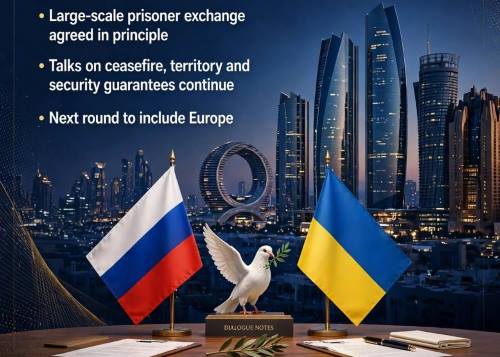
 After nine months of silence, Russia and Ukraine sat face-to-face again in Abu Dhabi on 10-11 November 2026, in the third round of US-mediated trilateral talks hosted by the United Arab Emirates this year.The meeting did not end the war, now nearing its fifth year. It did, however, restart direct dialogue, produce one concrete humanitarian agreement, and reopen the question that has haunted every previous round: can a prisoner swap become a pathway to a ceasefire, or will it remain the only thing the two sides can agree on?
Witkoff and Kushner went to Moscow to brief Putin, then to Dublin to brief Zelenskyy on the sidelines of the European Political Community Summit.No ceasefire, no territorial deal, no signed document: The two days ended without a breakthrough on ending the war, without agreement on territory, and without a final text on security guarantees.
Why Abu Dhabi, Why Now?
The talks were the first direct Russia-Ukraine meeting since February 2026 in Geneva, and the first US-mediated meeting in nine months.They were held at the Emirates Palace Mandarin Oriental, in the presence of UAE Deputy Prime Minister and Foreign Minister Sheikh Abdullah bin Zayed Al Nahyan, who welcomed the delegations and conveyed the greetings of UAE President Sheikh Mohamed bin Zayed Al Nahyan.
The UAE was chosen because it maintains working relations with Moscow, Kyiv, and Washington, and has already mediated 21 prisoner exchanges between Russia and Ukraine, totalling 6,305 captives exchanged through UAE efforts, including 350 captives, 175 from each side, in its latest mediation announced on 4 November.
The timing was also political. In Washington, President Donald Trump is under pressure after the 3 November midterm elections, with a new Congress hostile to his administration due to take office in January. US officials say they wanted to revive a peace process that had stalled since February.
Who Was at the Table?
Russia: Led by Presidential aide Vladimir Medinsky, with Deputy Foreign Ministers Sergey Ryabkov and Mikhail Galuzin, GRU Director Igor Kostyukov, and senior General Staff officials.
Ukraine: Led by Rustem Umerov, Head of Ukraine’s Foreign Intelligence Service, with negotiator David Arakhamia and other senior officials. President Volodymyr Zelenskyy did not attend in person but was briefed throughout.
United States: Led by Special Envoy Steve Witkoff and Jared Kushner, President Trump’s son-in-law. Secretary of State Marco Rubio did not attend but called the meeting “very productive” from Paris.
Europe – On the Sidelines, Not at the Main Table: Representatives of the UK, France, Germany, Italy, NATO and the European Commission met separately with the Ukrainian and US delegations in Abu Dhabi.
Russia initially objected to their participation in the trilateral format. Medinsky said Moscow had not held discussions with the Europeans and did not understand their status, insisting the negotiations were trilateral in nature.That issue became one of the key follow-ups.
After Abu Dhabi, US envoys flew to Moscow on 12 November to brief President Vladimir Putin, and then to Dublin to brief President Zelenskyy. Putin subsequently agreed, according to Witkoff, that Europeans would be part of the upcoming meeting.
Why India trying to broker a Russia-Ukraine Black Sea food corridor?
Talking Points: What Was Discussed?
a) Humanitarian Issues – The Core Agenda
Zelenskyy said the first day was largely about humanitarian issues: prisoner exchanges, return of Ukrainian civilians in captivity, and return of Ukrainian children taken from the country.
b) Prisoner Exchange
Both sides discussed a large-scale swap. Zelenskyy had earlier indicated a possible 1,000-for-1,000 or even 1,500-for-1,500 format. Russian sources suggested more than 1,000 from each side.
c) Security Guarantees
Security guarantees for Ukraine, and the broader post-war European security architecture, were central. Russia’s Foreign Minister Sergey Lavrov said collective security guarantees would only become effective after a complete and comprehensive settlement.
d) Territory – The Hardest Issue
Russia continues to demand that Ukraine withdraw from areas in Donbas still under Kyiv’s control, and insists any peace agreement recognize its claims over four Ukrainian regions it declared annexed in 2022, despite never fully controlling them. Ukraine firmly rejects this. Russia currently controls about one-fifth of Ukraine’s territory. A US official briefing reporters said both sides had privately shown some flexibility on territory, but no public narrowing of the gap was reported.
e) Ceasefire and De-escalation
Practical measures were discussed, including deconfliction, mechanisms to monitor a ceasefire, and steps toward major de-escalation post-war. Ukraine and its European allies want a ceasefire first, to create conditions for dialogue. Russia advocates linking cessation of hostilities to broader security arrangements.
f) Black Sea, Energy Infrastructure, and Reconstruction
Kyiv’s priorities, set out before the talks by Foreign Minister Andrii Sybiha, included security guarantees, de-escalation in the Black Sea, an agreement to cease attacks on energy infrastructure, release of children, and prisoner exchanges. US mediators also expanded discussions to include reconstruction of Ukraine and broader European security arrangements.
g) The Role of Europe and NATO
Putin reiterated Moscow’s longstanding demands: opposition to NATO’s eastward expansion, opposition to any deployment of European troops in Ukraine after a ceasefire, and revival of Russia’s 2021 proposals for NATO to withdraw deployments from Central and Eastern Europe.
51 UN Member States Call on Russia to Agree to Full, Immediate, Unconditional Ceasefire in Ukraine
Outcome: What Was Agreed?
1-The One Concrete Agreement: A Large-Scale Prisoner Exchange
2-Both sides agreed in principle on a large-scale prisoner swap. Medinsky called it a “fundamental agreement.” Umerov called it the “main result.” Kushner called it potentially the “biggest humanitarian release of prisoners” of the war.
TASS reported the exchange should happen in two to three weeks.To be the largest of the war, it would need to top the 1,000-for-1,000 swap of May 2025. The last exchange after Geneva in February was 200-for-200.
Progress, But No Breakthrough on Peace:
Mutual understanding on some issues: Medinsky said mutual understanding had been achieved on some issues.
Path forward: Kushner said the talks produced “meaningful progress in understanding both sides’ concerns, identifying possible solutions, and establishing a path forward.”
Next round expanded: Both sides agreed to expand the next round to include European partners. Zelenskyy welcomed this, saying Europeans would have “an equal seat at the negotiating table.” Arakhamia said the next talks should be multilateral, not trilateral.
The UAE’s Role: Neutral Convenor
For the UAE, the success was not in imposing a solution, but in providing a trusted, neutral space where both sides could meet after nine months, and where humanitarian progress could be made even when political progress was impossible.
Assessment: Was the Dialogue Successful?
Yes, as a humanitarian and process success. No, as a peace success.
What worked:
Direct contact was restored after nine months.
A major prisoner exchange was agreed in principle.
A mechanism for the next round, with European participation, was created.
Practical work on ceasefire monitoring and deconfliction began.
What did not work:
Fighting continued even during the talks.
After the talks ended, Russia and Ukraine traded accusations over overnight airstrikes, with at least six people killed.
The core gap on territory and security guarantees remains unchanged.
Trust remains almost absent.
Kushner himself admitted on 11 November:
“There is no trust right now between the sides, and that is to be expected after a conflict like this.” As one analysis put it, Abu Dhabi produced “not peace, but a narrow opening.”
Conclusion
The Abu Dhabi dialogue should be judged for what it was: a first step, not a final settlement.It proved that Russia and Ukraine can still talk, that the US can still mediate, and that the UAE can still provide a neutral platform trusted by all sides. It proved that humanitarian agreements are still possible even when political agreements are not.
But it also proved that the war will not end with a prisoner swap alone. The next test will be in the next round, in the UAE or Switzerland as Zelenskyy suggested, where Europe will now have a seat, and where the real questions must be answered:
Who controls Donbas?
What guarantees will Ukraine receive? And will Russia accept a ceasefire without first securing its territorial and security demands? Until these questions are answered, Abu Dhabi will be remembered as a humane pause in a war that is still far from over.