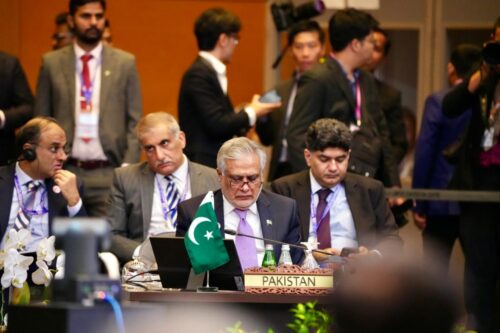
 Statement by Deputy Prime Minister/Foreign Minister at 32nd ASEAN Regional Forum (ARF) meeting in Kuala Lumpur, Malaysia
1. My heartfelt sincerest appreciation and thanks to you, Government and people of Malaysia, for very warm hospitality and leadership in convening this important 32nd meeting of ARF. We also congratulate Malaysia on successfully hosting the 46th ASEAN Summit and extend our best wishes for the upcoming 47th Summit.
2. Pakistan values ASEAN’s central role in shaping a stable and cooperative Asia-Pacific. We commend the vision articulated in the Kuala Lumpur Declaration on ASEAN 2045. As a Sectoral Dialogue Partner and ARF member, Pakistan reaffirms its full support for ASEAN’s strategic goals of integration, sustainability, and peace.
3. ARF remains a critical platform for trust-building and regional dialogue. At a time when fragmentation threatens multilateralism, ARF’s role in promoting peace and cooperation is more relevant than ever.
4. Pakistan welcomes ASEAN’s initiative to develop a post-2025 Plan of Action. We hope the new Plan will prioritize non-traditional security threats such as climate change, pandemics, cyber risks, scamming, maritime security, and disaster response.
5. The Plan must reflect ASEAN’s principles and include measurable goals, timelines, and effective follow-up. Preventive diplomacy, enhanced mediation capacity, and respect for sovereignty and international law must remain its important elements. These are not abstract ideals; they are the pillars of durable peace and security, regionally and beyond.
6. Our own region, South Asia, continues to face security challenges associated with unresolved disputes, top among these is the Jammu and Kashmir dispute which lies at the heart of regional instability. Pakistan has consistently advocated a just and peaceful resolution of the Jammu and Kashmir dispute in accordance with the United Nations Security Council resolutions and the aspirations of the Kashmiri people.
7. Following the incident in Pahalgam in the Indian Illegally Occupied Jammu and Kashmir on 22 April 2025, India blamed Pakistan without credible evidence or investigation. On 26 April, Pakistan proposed an impartial inquiry. India instead opted for aggression, launching an unprovoked attack on 7 May that killed civilians and damaged essential infrastructure.
8. In response, Pakistan exercised its right of self-defence under Article 51 of the UN Charter. Our calibrated Air-Force and military response on 07th and 10th May targeted only air force and military assets, demonstrating restraint and responsibility.
9. Pakistan’s response was guided by the imperative to uphold its sovereignty and to deter aggression. The unlawful notion of a so-called “new normal”, founded on impunity, unilateralism, and the use of force, is neither credible nor acceptable. The only legitimate norm is one rooted in mutual respect, peaceful coexistence, and practicing fundamental principles of international law. Pakistan reserves the right to respond to any future aggression with resolve and responsibility, in accordance with its right to self-defence.
10. India’s recent decision to unilaterally hold in abeyance the Indus Waters Treaty further underscores its disregard for international commitments. The Treaty contains no provision for any unilateral action. India’s actions threaten millions reliant on the Indus Basin and violate international norms. The international community must take serious note of such behaviour, which undermines the global legal order.
11. Pakistan continues to uphold the ceasefire between India and Pakistan. We remain committed to its implementation and appreciate the role of international partners who facilitated the conclusion of the ceasefire. We also welcome their offer to help facilitate a peaceful resolution of the Jammu and Kashmir dispute. Over one-fifth of humanity resides in South Asia. Another cycle of conflict would be catastrophic for the region.
12. Pakistan urges the international community to support a peaceful settlement and the realization of the right to self-determination of the Kashmiri people.
13. Pakistan has made unmatched sacrifices in the global fight against terrorism. In this struggle, we have lost over 80,000 precious lives and incurred enormous economic cost of over US$ 150 billion. Our approach to counterterrorism is comprehensive. It is focused on kinetic operations, counter-radicalisation, education reforms, and institutional resilience.
14. We have improved border controls, cyber monitoring, and intelligence coordination. There is a need to address terrorism’s root causes, which include poverty, injustice, occupation, and the denial of self-determination.
15. At the same time, Pakistan remains a target of cross-border terrorism. We have submitted a dossier to the UN Security Council with detailed evidence of external support to terrorist groups operating against Pakistan.
16. The instrumentalization of counterterrorism narratives to stigmatize entire communities, particularly Muslims, is a disturbing trend. When such narratives are coupled with state-driven Islamophobic policies, the result is the erosion of fundamental rights, and the exacerbation of alienation and radicalization. This practice must be unequivocally condemned by all.
17. In recent months, Pakistan has taken several steps to strengthen engagement with Afghanistan, including my 19th April visit to Kabul and the 20th May trilateral of China-Pakistan-Afghanistan in Beijing. We believe that a peaceful, stable, united and prosperous Afghanistan is in our vital interest. Having made sincere efforts in Afghanistan’s interest, it is our legitimate expectation that the Afghan Interim Government would take all steps necessary to ensure that Afghanistan’s soil is not used for terrorism against any state, particularly Pakistan.
18. Pakistan welcomes the ceasefire between Iran and Israel. Iran’s efforts to avoid wider conflict are commendable. Since the outset of this crisis on 13th June, Pakistan has advocated Iran’s right to protect its sovereignty and to self-defence. We hope Iran’s nuclear issue will be addressed through diplomacy and dialogue, and not coercion.
19. The on-going Israeli invasion of Palestinian territories remains a source of great distress for us. The root cause of the conflict in the Middle East is the persistent occupation of Palestinian territories. Immediate international action is imperative to end Israeli aggression, ensure unhindered humanitarian access, and hold the illegally occupying power accountable for its atrocities.
20. We reaffirm our unwavering and principled support for the inalienable right of the Palestinian people to self-determination and the establishment of an independent, viable, and contiguous State of Palestine with Al-Quds Al-Sharif as its capital.
21. On the South China Sea, Pakistan supports all efforts for regional peace and dialogue. We value our ties with all Asia-Pacific states and urge that disputes be resolved through diplomacy with mutual respect.
22. Peace in this vital region requires non-interference, restraint, and engagement. Pakistan reiterates its firm support for the “One China Policy,” recognizing the People’s Republic of China as the sole legitimate authority over Taiwan.
23. Pakistan upholds the core principles of the UN Charter: self-determination, non-use of force, peaceful settlement of disputes, and respect for sovereignty. Like other developing states, Pakistan has faced indirect fallout, rising food and energy insecurity, as a result of the conflict in Ukraine. We hope for an immediate negotiated settlement of this conflict based on the UN Charter and dialogue.
24. Climate change is an existential threat, disproportionately impacting developing nations like Pakistan. From floods to droughts, we face recurring disasters with constrained resources.
25. Pakistan has updated its Nationally Determined Contributions and adopted robust mitigation and adaptation strategies. But climate justice demands that developed countries deliver on their commitments for climate finance, technology access, and capacity-building. Only through global solidarity can we avert a climate catastrophe.
26. Pakistan attaches great value to the ARF’s role in promoting dialogue and cooperation. We stand ready to contribute meaningfully to its objectives.
27. Let us reaffirm our collective commitment to building a peaceful and inclusive Asia-Pacific, grounded in mutual respect and sovereign equality.