 PARIS, 24 November 2026 — The Government of the Republic of Tajikistan convened two international scientific conferences at UNESCO Headquarters in Paris on 23–24 November, dedicated to the intellectual legacies of Abuali ibn Sina and Omar Khayyam. The gatherings provided a platform for scholarly dialogue on their contributions to world civilization and the continuing relevance of their ideas to science, education and intercultural understanding.
The conferences, entitled “Abuali ibn Sina and His Contribution to the Formation of a New Scientific Worldview” and “Omar Khayyam’s Scientific and Literary Legacy: Global Significance and Contemporary Research”, reflected Tajikistan’s commitment to promoting its rich intellectual and cultural heritage and strengthening international cooperation through research and cultural diplomacy.
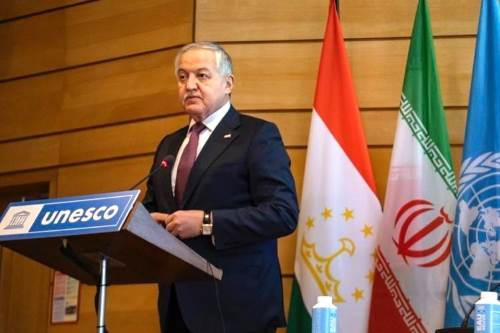
Opening the gathering dedicated to Omar Khayyam on 24 November, the Minister of Foreign Affairs of the Republic of Tajikistan, Sirojiddin Muhriddin, described the thinker as a figure whose achievements united scientific precision, philosophical inquiry and poetic expression.
He emphasized that Khayyam’s legacy, deeply rooted in Persian-Tajik civilization, had transcended cultural and geographical boundaries to become a shared treasure of humanity.
“Knowledge is the common wealth of humanity; culture is the language through which nations understand one another; and respect for both is the foundation of lasting peace,” the Minister stated.
Mr. Sirojiddin Muhriddin highlighted Khayyam’s contributions to mathematics, including the study of cubic equations and their geometric solutions, as well as his astronomical work and role in reforming the Jalali calendar. He also drew attention to the humanistic significance of Khayyam’s quatrains, which explore the value of time, freedom of thought, justice and personal responsibility.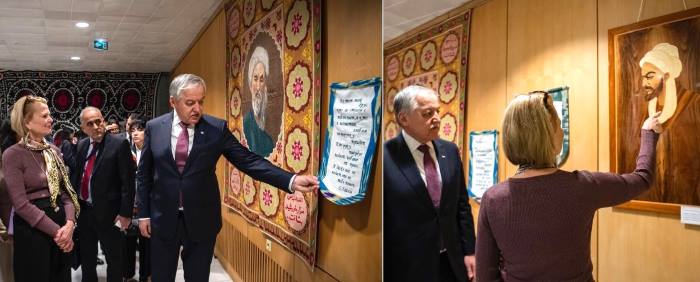
The Minister underlined the intellectual links between Khayyam and Ibn Sina, noting Khayyam’s engagement with the philosophical heritage of his distinguished predecessor. He described the commemoration of the two thinkers on successive days at UNESCO as an expression of the continuity of this intellectual tradition and Tajikistan’s sustained efforts to advance dialogue among civilizations.
The conference dedicated to Ibn Sina on 23 November was designed to examine his philosophical, medical, natural-scientific and social thought, and its significance for contemporary research. Its thematic framework encompassed medicine and psychology, scientific methodology, ethics, education and the interaction of Eastern and Western intellectual traditions.
Particular attention was envisaged for major works including The Book of Healing and The Canon of Medicine, alongside the translation, study and publication of his writings.
The Khayyam conference focused on three interconnected fields: philosophy, language and literature, and the exact and natural sciences. Its objectives included encouraging new scholarly approaches, supporting the translation and publication of his scientific and literary works, advancing bibliographic research, and introducing his achievements to wider international audiences.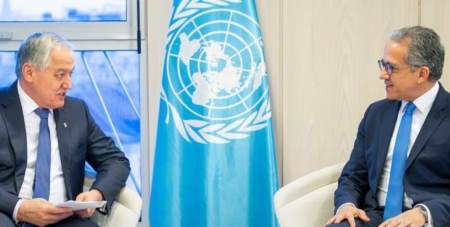
In his address, Mr. Sirojiddin Muhriddin also acknowledged the contribution of researchers and translators to Khayyam’s international recognition. He expressed appreciation to Dr. Massoud Mirshahi, President of the Rudaki Association of France, for his scholarly work and the publication of “Khayyam, a Great Figure of Persian Science and Literature”.
The Minister emphasized that, under the leadership of President Emomali Rahmon, Tajikistan regards safeguarding cultural heritage, advancing science and education, and strengthening international cooperation as mutually reinforcing priorities. He highlighted the special place of cooperation with UNESCO in these efforts.
Looking ahead, Mr.Sirojiddin Muhriddin called for practical cooperation through joint manuscript research, scholarly editions and translations, digitization of written heritage, academic exchanges and greater engagement of young people in the history of science.
Such initiatives, he stressed, would help ensure that the intellectual achievements of the past continue to inspire creativity, mutual understanding and future generations.