 ECO Monitoring Desk Islamabad
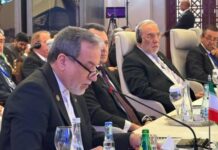
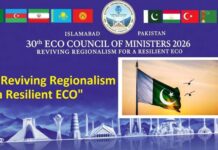
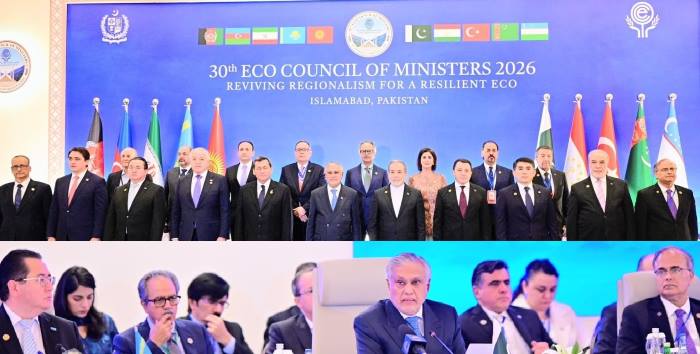
The 30th Meeting of the ECO Council of Ministers kickstarted in Islamabad today with the welcome address by the host Deputy Prime Minister/Foreign Minister of Pakistan, Senator Mohammad Ishaq Dar. He said, Pakistani Chairmanship theme, “Reviving Regionalism for a Resilient ECO,” builds upon these efforts and reflects both the challenges before us and the possibilities that lie ahead of us.
Secretary General, ECO,Secretary General, OIC,Secretary General, CICA,Deputy Secretary General, SCO,Heads of affiliated institutions of ECO were also present at this occasion.
Pakistan remains firmly committed to the principles, objectives and vision enshrined in the ECO Charter. As a founding member, we attach great importance to regional cooperation as a means of advancing prosperity, peace and stability, guided by the principles of sovereign equality, mutual respect, non-interference and mutually beneficial cooperation.
Our region occupies a unique position at the crossroads of South Asia, Central Asia and West Asia. It brings together important markets, abundant natural resources and historic routes of commerce. Geography has given us a distinct advantage. Our collective endeavour must be to translate this advantage into stronger economic connections and shared prosperity for us all.
Pakistan is honoured to serve as ECO Chair for the years 2026–2027, the first term under the new two-year arrangement. We thank Member States for their confidence and look forward to working very closely with all of you to make this period productive and meaningful.
He also expressed appreciation to Kazakhstan for its Chairmanship in 2025. Its focus on “Advancing Regional Transport Connectivity and Sustainable Development” helped sustain cooperation across important sectors and provided a valuable foundation for our future work.
At a time of geopolitical uncertainty, economic pressures and rapid technological change, the case for stronger regional cooperation has become even more compelling. Many of the challenges confronting our countries transcend national boundaries and call for closer coordination and collective responses.
Reviving regionalism does not require reinventing the wheel. It is about building upon the foundations already laid, bringing renewed purpose to existing commitments and making regional cooperation more responsive to the needs of our people.
Our resilience will depend not only on how effectively we respond to challenges, but equally on how well we prepare for them and on the strength of the partnerships we build.We have already had important groundwork towards this vision.
The ministerial and sectoral engagements held within ECO during the year have helped sustain momentum across important areas of cooperation. The roadmap approved by ECO Trade Ministers in November 2025 has provided a basis for advancing regional trade arrangements, while our informal Council meeting in New York in September this year reaffirmed our shared commitment to deeper economic integration and connectivity.
The work undertaken towards finalising the Strategic Goals of Economic Cooperation 2026–2035 has further helped define the direction of our future efforts.
These developments provide a sound foundation for the next phase of our work. The priority now is to build upon this progress through practical initiatives that strengthen economic linkages and bring lasting benefits to our region and its people.
Our region’s resources, energy reserves, agricultural capacity and strategic location provide considerable scope for closer economic cooperation. Yet, realising this potential requires more than geographical proximity. It calls for functioning transport corridors, efficient border procedures and predictable arrangements that businesses can use with confidence and ease.
For businesses and communities across our region, closer cooperation can open new markets, lower trading costs, attract investment and create new opportunities for employment and enterprise.
Pakistan’s Chairmanship will focus on five priorities.
First, expanding trade and investment. We will support wider market access, stronger regional value chains and greater private-sector participation, particularly by small and medium-sized enterprises. Closer interaction among our business communities can help translate commercial potential into greater trade and investment.
Second, strengthening connectivity. We will work with Member States to improve transport and transit links between Central Asia, South Asia and Pakistan’s ports on the Arabian Sea. Harmonised customs procedures, efficient border management and predictable transit arrangements are essential for making these routes commercially viable. Building upon existing ECO transport and transit mechanisms will be important to facilitating the movement of goods across our region.
Third, advancing the ECO Trade Agreement. The Negotiating Strategy and Roadmap approved by ECO Trade Ministers in November 2025 provide an agreed basis for modernising the Agreement. Pakistan will support sustained engagement among Member States towards a more effective, inclusive and digitally enabled regional trade framework.
Fourth, strengthening regional resilience. Climate change, natural disasters and increasing pressures on water and energy resources pose serious challenges to our economies and livelihoods. Closer cooperation in disaster preparedness, early warning systems, sustainable water management and climate-resilient infrastructure can strengthen our capacity to address these shared challenges.
Fifth, investing in our people. Our region’s young population represents one of its greatest strengths. Greater cooperation in education, research, innovation and vocational training can equip our youth with the skills required by changing economies. Promoting entrepreneurship and professional exchanges can further strengthen the human foundations of regional integration.
These priorities are mutually reinforcing. Stronger connectivity facilitates trade, greater investment creates economic opportunities, and cooperation in resilience and human development helps sustain these gains.Their success will ultimately depend upon how effectively we pursue all these goals together.
Pakistan looks forward to working with Member States and the Secretariat to advance focused initiatives in trade facilitation, transit connectivity and disaster preparedness. Existing ECO mechanisms can help maintain follow-up and continuity between our meetings.In advancing these priorities, the ECO Secretariat and affiliated institutions will continue to play a very important role.
The host DPM/ FM acknowledged their valuable contributions and the continuity they provide to our collective work. Pakistan looks forward to working with the Secretariat, the Council of Permanent Representatives and relevant sectoral forums to strengthen coordination and support agreed priorities.
As we pursue this economic agenda, we must also recognise the wider conditions upon which its success depends.Peace and development reinforce each other. Economic cooperation creates shared interests in stability, while insecurity can undermine even the most promising development initiatives.
We remain deeply concerned about conflict and instability in our region. Their consequences extend beyond national boundaries, disrupting trade routes, energy supplies, investment and the economic prospects of our peoples.
Pakistan has consistently advocated the peaceful resolution of disputes through dialogue and diplomacy, in accordance with international law and the United Nations Charter.In pursuit of this approach, Prime Minister Muhammad Shehbaz Sharif, Field Marshal Syed Asim Munir, Chief of Army Staff and Chief of Defence Forces, and the Foreign Office of Pakistan have remained closely engaged with brotherly countries and international partners to facilitate peaceful outcomes. Pakistan will continue these diplomatic efforts in support of dialogue, de-escalation and lasting regional stability.
This commitment to peace and regional cooperation also informs our approach towards Afghanistan.
Pakistan desires a peaceful, prosperous and stable Afghanistan, fully integrated within the ECO framework and at peace with itself and its all neighbours. Such an outcome would serve not only the Afghan people but also the wider region, opening important avenues for trade, transit and economic cooperation.
At the same time, meaningful progress requires the Afghan authorities to address the legitimate security concerns of the neighbouring countries, particularly the threat of terrorism. A secure and stable environment is absolutely essential for sustained regional economic partnerships.These considerations are central to our wider connectivity agenda.
Regional connectivity rests on more than the routes that link us. It depends upon trust between States and confidence that international commitments will be honoured. Unresolved disputes, and the non-fulfilment of international obligations can erode that trust and impede economic progress. Peaceful dialogue, respect for international law and treaties are essential to enduring economic partnerships.
Pakistan regards ECO as a vital platform for regional cooperation and an important instrument for advancing our shared aspirations.We must translate geographic proximity into connectivity, connectivity into commerce, and commerce into lasting prosperity for our people.
As we meet here today in Islamabad, we have an opportunity to give renewed regionalism practical direction and strengthen our capacity to face challenges together. The true measure of our success will lie not merely in the commitments we make, but in the progress, they bring to the lives of our people in the region.
Pakistan stands ready to work with all Member States, in a spirit of partnership and mutual respect, to turn this common resolve into sustained progress for our region.