 ECO Monitoring Desk Islamabad
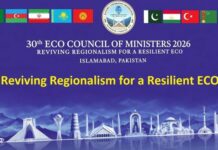
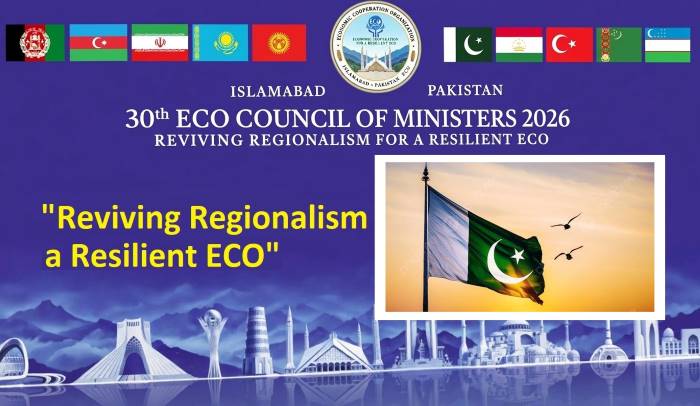
Pakistan is the host of the 30th Meeting of the Council of Ministers (COM) of the Economic Cooperation Organization (ECO) in Islamabad on 15–16 November 2026. The Council of Ministers is ECO’s highest decision-making body and comprises the Foreign Ministers of its Member States.
The meeting is expected to bring together Foreign Ministers and senior representatives of ECO member states, alongside invited heads and representatives of international and regional organizations. Participation by the Secretary General of the Organization of Islamic Cooperation (OIC) and CICA is also anticipated.
As Chair of ECO for 2026–2027, Pakistan will seek to advance practical cooperation in trade, transport, investment, and sustainable development within ECO region. The gathering will also provide opportunities for bilateral engagements with participating countries and organizations.
Expected Outcomes and Key Documents
A central expected outcome of the meeting is the adoption of the Islamabad Declaration, articulating shared priorities and political commitment to stronger regional cooperation.
The meeting is also expected to adopt the Strategic Goals of Economic Cooperation—2035 (ECO Vision 2035).The document was finalized after formal consultations among member states, and is intended to provide the organization with a comprehensive and forward-looking framework for regional connectivity, economic integration, trade, investment, and sustainable development over the next ten years.
The new framework will succeed ECO Vision 2025, adopted at the 13th ECO Summit in Islamabad on 1 March 2017 and subsequently extended on an interim basis. Its expected adoption will reinforce Islamabad’s association with shaping ECO’s long-term regional agenda.
Pakistan will also pursue meaningful and result-oriented discussions on the ECO Trade Agreement (ECOTA) and the Transit Transport Framework Agreement (TTFA). More effective implementation of these instruments can help reduce trade barriers, facilitate transit, and improve cross-border movement of goods.
Highlighting Pakistan’s Regional Connectivity Role
Pakistan’s ECO chairmanship offers an opportunity to position the country as a regional connectivity hub, a facilitator of logistics and supply chains, and an agenda-setter for regional trade. Its geographical location offers landlocked Central Asian countries short routes to the Arabian Sea through existing and proposed road and rail corridors.
The framework agreement signed in July 2025 on the proposed Uzbekistan–Afghanistan–Pakistan (UAP) railway project provides a basis for advancing this agenda. Subject to further development and implementation, the proposed railway could strengthen links between Central Asia and Pakistan’s seaports.
Building on the momentum of bilateral trade agreements with Uzbekistan, Tajikistan, Kyrgyzstan, Azerbaijan, and Kazakhstan, Pakistan will engage ECO partners on practical measures to expand commerce, improve transit arrangements, and strengthen regional supply chains.
Pakistan’s Sustained Contribution to ECO
Pakistan is a founding member of ECO, alongside Iran and Türkiye. The Organization traces its origins to Regional Cooperation for Development (RCD), established in 1964, and assumed its present form in 1985. Following its expansion in 1992, ECO comprises ten Member States. Pakistan has consistently supported ECO by hosting high-level meetings and contributing to its institutions.
Major events hosted by Pakistan include:
3rd ECO Summit: Islamabad, 14–15 March 1995.
13th ECO Summit: Islamabad, 1 March 2017, under the theme “Connectivity for Regional Prosperity”; it adopted the Islamabad Declaration and ECO Vision 2025.
COM meetings: The 3rd COM in Quetta in February 1993, a Special COM in Islamabad in March 1995, and the 22nd COM in Islamabad in February 2017.
ECO Institutions in Pakistan
Pakistan hosts several important ECO institutions and institutional arrangements:
ECO Science Foundation, Islamabad: Promotes scientific, technological, and research collaboration among Member States.
ECO Reinsurance Company, Karachi: Established to strengthen regional reinsurance capacity; it remains non-operational.
PAECO Interim Secretariat: The National Assembly of Pakistan houses the interim Secretariat of the Parliamentary Assembly of ECO Member States.
ECO Trade and Development Bank: Maintains a functional representative office in Karachi.
The current ECO Secretary General, H.E. Ambassador Asad Majeed Khan, is a career diplomat from Pakistan. He is the 14th ECO Secretary General and the third Pakistani to hold the position, serving from August 2024 to August 2027.
Lahore-ECO Tourism Capital for 2027
Lahore has been designated the ECO Tourism Capital for 2027, providing an opportunity to showcase Pakistan’s cultural heritage, tourism potential, and hospitality. A five-day programme is planned for March or April 2027, with an inauguration at Lahore Fort expected to be presided over by the Prime Minister. An ECO Tourism Ministers’ Meeting is also envisaged.
Diplomatic Significance and the Road Ahead
The 30th Meeting of the ECO Council of Ministers in Islamnaba will help project Pakistan’s image as a constructive regional partner and a capable host of high-level international gatherings. Bilateral engagements on its sidelines will offer opportunities to advance cooperation in trade, investment, transport, and other areas of mutual interest.
The event will also provide valuable operational experience for major diplomatic engagements envisaged for 2027 such as ECO and SCO Summits. Pakistan’s chairmanship can help translate regional commitments into practical outcomes: better connectivity, more efficient logistics, expanded trade, and stronger institutional coordination.