 Middle East Monitoring Desk Islamabad
The US and Iran talks in Switzerland on a peace deal to settle the issue of the Islamic Republic’s nuclear program and permanently reopen the Strait of Hormuz were unexpectedly halted when Iranian delegation refused to sit on negotiations table on the threats of President Donald Trump who said earlier that strikes would be carried out against Iran if Hezbollah keeps attacking Israel. While the actual situation is different that Israel is continuously vilating ceasefire agreement.
Things got off to a confusing start Sunday when Iranian media reported that Iran halted talks over Trump’s latest threat.
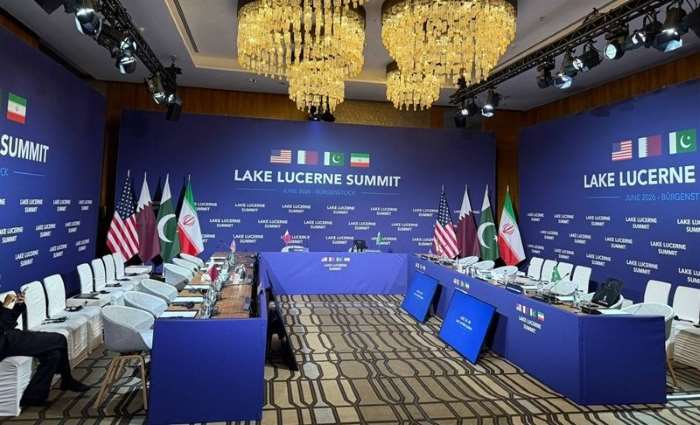
The first high-level meetings of US, Iranian, Qatari and Pakistani representatives opened in the Swiss resort of Bürgenstock, with US Vice President JD Vance and Iranian Foreign Minister Abbas Araghchi among attendees.
As the meetings got underway, Trump said in a social media post that he would strike Iran again if it doesn’t “immediately stop their highly paid PROXIES in Lebanon from causing trouble.”
He also warned Iran that the US might start collecting tolls if there’s no deal. Speaking Sunday to Fox News,Trump said he told Iranian leaders directly that if they close Hormuz, “You won’t even make it back” to Iran, using an expletive.
American delegation and the organizers of the meeting planned that at the beginning of talks, there would be a handshake scene and a joint photo ceremony between the Iranian and American delegations.
The head of the Iranian negotiating team and members the team opposed these formalities and announced that they would not be present at the photo-op with the American delegation, the source said.
Following the Iranian negotiating team’s opposition and their absence from the ceremony, the live broadcast and photo-op were stopped and after that the Iranian delegation entered the meeting venue, according to the source.
The American delegation had asked the Iranian team for five minutes for the journalists to leave the negotiations venue, the source said, adding that the ceremony was held before the negotiations without the presence of the Iranian delegation.
Iran’s Foreign Ministry spokesman has said Tehran’s participation in a new round of talks in Switzerland is aimed at ensuring implementation of the Islamabad MoU, stressing that negotiations on a final agreement cannot begin unless the document’s five key points are put into effect.
In comments on Sunday, Esmaeil Baqaei, also the spokesperson for Iran’s negotiating delegation led by Parliament Speaker Mohammad Baqer Qalibaf, said the meetings in Switzerland are focused on monitoring implementation of commitments made under the Islamabad memorandum of understanding signed on June 18.
The one-day program included separate morning meetings between the Iranian delegation and Qatari and Pakistani mediators, followed by a quadrilateral meeting in the afternoon involving representatives of Iran, the United States, Qatar, and Pakistan.
Iran began pursuing implementation of the memorandum immediately after its signing, emphasizing that “implementing any document is more important than signing it.”
“The diplomatic process to reach an outcome is one issue, but the far more important issue is ensuring implementation,” he stated.
Baqaei said the Switzerland meeting reflects Iran’s determination to demand and follow up on the other side’s commitments, adding that Tehran never intended to sign an agreement and assume it would automatically be implemented.
“We have absolutely not forgotten previous experiences,” he said, stressing that the current round is centered on securing implementation of the understanding.
Article 13 of the memorandum explicitly states that negotiations toward a final agreement are conditional upon implementation of five specified provisions, including the first clause concerning a halt to the war on all fronts, including Lebanon.
He said Tehran believes that provision has not yet been implemented and accused Washington of either being unable or unwilling to ensure compliance, while saying the Israeli regime continues to violate commitments.
Baqaei noted that several other provisions also require preparatory measures, particularly the release and accessibility of Iran’s blocked assets and the issuance of the necessary authorizations for Iranian oil and petrochemical exports.
Baqaei added that Iran seeks guarantees regarding implementation of US commitments, particularly those related to access to frozen Iranian assets and facilitating oil and petrochemical sales.
Closure of of Hormuz on Saturday, June 20, in response to the breach of the Islamabad MoU following Israeli strikes against Lebanon.
“In light of the United States’ clear breach of its commitments regarding the first article of the memorandum of understanding on ending the war, and in response to the continuous and relentless violations of the ceasefire by the Zionist regime in southern Lebanon, which have resulted in the brutal killing and displacement of hundreds of thousands of innocent people in that territory, as well as considering the failure of the occupying Zionist forces to withdraw from southern Lebanon, it is announced that the Strait of Hormuz will be closed to vessel traffic,” Iran’s Khatam al-Anbia Central Headquarters said in a statement on Saturday.
The headquarters emphasized that “this is the first step of response to the enemy’s breach of trust”, warning that if the aggression continues, further measures will be planned and taken to compel the enemy to adhere to its commitments.
The Islamabad Memorandum of Understanding between Iran and the United States was signed in the first minutes of June 18, 2026, by Iranian President Masoud Pezeshkian and US President Donald Trump through a simultaneous digital process without an in-person ceremony.
Iranian officials described the document as a political framework designed to end the imposed US-Israeli war of aggression against the Islamic Republic of Iran and create a pathway toward a comprehensive final agreement. The memorandum was finalized after weeks of negotiations and signed in both Persian and English.
The agreement’s first article provides for the immediate and permanent termination of military operations between Iran, the US, and their respective allies across all fronts, including Lebanon, and commits the parties to refrain from future military action or threats of force. The memorandum also stresses respect for Lebanon’s territorial integrity and sovereignty, while negotiations on a final agreement are scheduled to conclude within a maximum period of 60 days and are expected to culminate in a binding United Nations Security Council resolution.
The memorandum establishes a phased economic and maritime mechanism under which Washington undertook to begin lifting restrictions affecting Iran, including measures related to oil exports, banking transactions, insurance, transportation, access to frozen assets, and the removal of the naval blockade according to agreed timelines. In parallel, Iran committed to facilitating secure commercial navigation through the Persian Gulf and the Strait of Hormuz and to coordinating future maritime arrangements with Oman and other regional littoral states in accordance with international law.
On the nuclear issue, the memorandum reaffirms Iran’s stated position against pursuing nuclear weapons while opening a negotiation track on enrichment, sanctions relief, and arrangements concerning enriched materials under a mutually agreed mechanism and International Atomic Energy Agency supervision. Pending the final agreement, Iran is to maintain the current status of its nuclear program, while the US is to refrain from imposing new sanctions or deploying additional military forces in the region.
Iran will stop any negotiation if the Israeli regime does not withdraw from Lebanon, according to information obtained by the Tasnim news agency.
According to information from Iranian sources if Article 1 of the Islamabad Memorandum of Understanding (MoU) signed by the US and Iranian presidents is not met, any negotiations between Iran and the US on all other subjects will be stopped.
Article 1 of the MoU says,
“The Islamic Republic of Iran and The United States of America and their allies in the current war are signing this MOU to declare the immediate and permanent termination of military operations on all fronts, including in Lebanon, and undertake from now on not to initiate any war or any military operation against each other, and to refrain from the threat or use of force against each other, and ensuring the territorial integrity and sovereignty of Lebanon. The final deal will confirm the permanent termination of the war on all fronts, including in Lebanon and other provisions of this paragraph.”
According to Tasnim information, this is a clear agenda that no action should be taken by Iran without implementing all the provisions necessary to start negotiations, and specifically observing Article 13.
According to Article 13, “After signing this MOU, and subject to the beginning of the implementation of paragraphs 1, 4, 5, 10 and 11 of this MOU, and the continuing implementation of these measures, the Islamic Republic of Iran and the United States of America will start negotiations regarding the final deal exclusively on the other paragraphs.”
Some analyses indicate that by delaying in negotiations and leaving Israel’s hands free in Lebanon, the US intends to prevent Iran from taking tough measures against Israel and the US as part of an effort to manage time in favor of the Zionist regime of Israel.
But, Iran will enter the phase of tough reaction given the continuation of Israel’s occupation and crimes in Lebanon.