 By Tazeen Akhtar, Editor, Pakistan in the World – Media Group, Islamabad
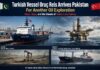
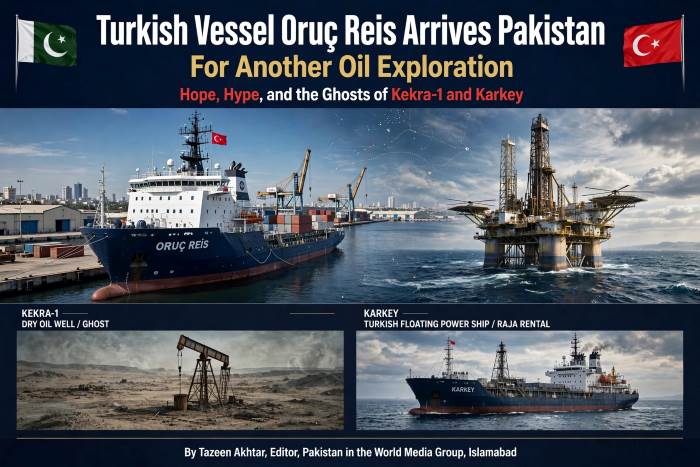
 After a 19-day voyage from Taşucu, Türkiye, the Turkish seismic research vessel Oruç Reis docked at Karachi Port on Thursday, 19 November 2026, for its second intercontinental mission after Somalia. It was welcomed on Friday, 20 November, at a ceremony attended by Deputy Prime Minister Ishaq Dar, Sindh Governor, Sindh Chief Minister Murad Ali Shah, Petroleum Minister Ali Pervaiz Malik, and Turkish Energy Minister Alparslan Bayraktar as guest of honour. Prime Minister Shehbaz Sharif later hosted Bayraktar in Islamabad and thanked President Recep Tayyip Erdoğan for sending the vessel.
The official line:
“The arrival of this vessel takes our partnership from promise to execution.”
“Exploration of potential oil and gas reserves in Pakistan’s maritime boundaries is an important step for the country’s energy security and economic development.”Dar went further, claiming Pakistan’s natural resources – mines, minerals, hydrocarbons, gemstones – are conservatively worth $8 trillion to $10 trillion, against total government debt of about $100 billion, $130 billion including private liabilities.
That is the same language Pakistan has heard before. And that is precisely why this arrival must be examined critically, not celebrated blindly.
Exploration During Imran Khan Government – Kekra-1
The last major offshore attempt was Kekra-1, Indus G-Block, 280 km off Karachi coast.
Spudded: 13 January 2019, Operator: ENI (Italy) Joint Venture: ENI 25%, Exxon Mobil 25%, OGDCL 25%, PPL 25%, Target: Carbonate reservoir, proposed depth 5,660 metres, ultra-deep water, Drilled to: 5,492 metres after 4 months
Result: “Good quality reservoir but unfortunately water wet without any gas effect” – Ministry of Petroleum press release. It was Pakistan’s 17th offshore attempt. All had failed to find commercial reserves.Surveyors had compared Indus-G to India’s Bombay High (350,000 barrels/day) and to Kuwaiti fields. Initial estimates talked of 9 trillion cubic feet of gas plus oil.
“Good News” – And Then Silence
In March 2019, Prime Minister Imran Khan said: “We are hopeful of finding large reserves of gas and oil in the sea near Karachi. The nation should pray for this and I will soon share good news regarding this. God willing the reserves will be so large that we will not need to import any oil.””If found, the gas reserves would be enough to meet Pakistan’s needs for the next 50 years.”
On 18 May 2019, in Peshawar, on the same evening gas tariffs were to be raised by 47%, he again told the audience to expect good news. Hours later, on 19 May 2019, his own Special Assistant on Petroleum, Nadeem Babar, announced the well was dry and would be plugged and abandoned.
The Prime Minister never returned to explain: Who briefed him? Why was a 12% probability well presented as a near-certain national salvation? Why was the public asked to pray for a commercial outcome that geologists knew was a long shot? That silence became the controversy.
Controversy on Imran’s Silence
Later, at PPL’s 68th AGM, PPL Managing Director revealed: Prime Minister Imran Khan was misinformed about presence of oil and gas at Kekra-1. There was an 86% chance there would be no oil, only 12% chance of success.In other words, the Prime Minister was either:
a) Deliberately misled by officials / JV partners who had commercial interest in continuing drilling, or
b) He chose to hype a low-probability well for political relief at a time of IMF talks, inflation and tariff hikes.
Critics at the time said it plainly: “It’s so sad that we still continue leaping into these multi-million dollar exercises, almost blindfolded, often to facilitate lucrative businesses for multi-national and local private companies… It’s OGDCL and PPL which have paid through their nose.”
“The idling Italian deep sea drilling rig got a lucrative business, and both ENI and Exxon would go home laughing.”
The government never published:
The full geological risk assessment given to PM, The internal briefing papers, Who authorized the public “good news” narrative, The lesson was not that exploration failed – exploration fails 80-90% of the time worldwide. The lesson was that political hype turned a normal technical failure into a national credibility failure.
Dar himself, in 2026, tried to correct that mistake, saying:
“Offshore exploration is complex, capital-intensive and inherently uncertain. A seismic survey cannot guarantee a commercial discovery, but no discovery can be made without seismic and exploration.”That caution was absent in 2019.
How Much Did Kekra-1 Cost Pakistan?
Here the figures themselves are controversial, because three different numbers were given: Over $100 million, Official cost quoted by Nadeem Babar / Petroleum Division at time of abandonment. The $100 million drilling project will be plugged in and abandoned.
Rs 14 billion (~ $100m at 2019 rate)Cost of drilling to 5,470m reported in Pakistan Today, plus additional $100m claimed for extra steel/cement to drill in another direction – which would double it.
Rs 124 billion PPL MD’s figure at AGM for total digging + machinery + associated resources. The drilling and machinery cost of the project was Rs 124 billion. EI, Exxon, OGDCL, and PPL will split the cost.
What is the truth?
The $100m / Rs 14bn is the direct drilling cost of Kekra-1 well alone, split 25% each among ENI, ExxonMobil, OGDCL, PPL.
So Pakistan’s state companies – OGDCL + PPL – paid roughly $50 million directly, i.e. half.
The Rs 124bn figure appears to include all prior seismic, preparatory, rig mobilisation, and associated costs for the block over years, not just the 4-month drilling. It was never reconciled publicly.
In either case: Pakistan’s public companies bore half the loss for a well with 12% success chance, Foreign partners bore half, but also earned rig / service contracts, No commercial return, no gas, no oil – only data.
Officials defend it: “Data received will be useful for future exploration.” That is technically true. But in a country where PPL was already selling gas at 159 MMCFD instead of 250 MMCFD due to circular debt, and had Rs 227bn in receivables, spending $50m on a 12% well was a political choice, not a purely technical one.
Critical question for 2026: Will the government publish a full, audited cost breakdown this time, or will we again get three different numbers after the fact?
Why Again? Why Now, When Previous Attempt Failed?
The government gives three reasons, and they are not without merit:
a) This is NOT Kekra-1 again. Kekra-1 was Indus G-Block, ultra-deep, carbonate, high-risk.
Oruç Reis is surveying Indus-C Block and Makran Blocks – different geology, shallower, different play types. PPL’s own 2D/3D surveys estimate Indus-C may contain 1.5-2 trillion cubic feet of gas, according to PPL’s 2D and 3D surveys. That is not a discovery, it is a prospect estimate – but it is a different prospect.
b) The 18-year gap is itself the problem. Pakistan launched its first offshore bidding round in 18 years in January 2025, offering 40 blocks. After nearly two decades, Pakistan is set to restart its oil exploration efforts. Without new seismic, Pakistan will never know what it has. No seismic = no discovery, ever.
c) The geopolitics have changed. This is not just geology. This is Makkah Agreement energy. Petroleum Minister Malik explicitly linked the vessel’s arrival to “following the signing of the Makkah Agreement.”
Pakistan, Türkiye and Saudi Arabia signed collective defence in Makkah on 7 August 2026. Energy is now the economic pillar of that security pact. Türkiye needs overseas hydrocarbons (Somalia, now Pakistan). Pakistan needs a non-Western, non-Chinese partner with technology. Saudi Arabia needs a stable Pakistan-Türkiye axis. So Oruç Reis is as much a strategic signal as a scientific mission.
The critical counter-argument:
If the geology was so promising, why did ExxonMobil and ENI walk away after Kekra-1 and never return? Why did no major Western major bid in the 2025 round? Why is Türkiye, which itself has limited deepwater discovery record except Black Sea Sakarya, the only serious operator?
The answer may be: Because the risk is still high, and only a state-to-state, politically-driven partner will take it. That does not make it wrong. But it means Pakistan must not sell it as a guaranteed $8-10 trillion jackpot.
What is the Detail of This Joint Venture? Will Turkish Vessel Charge?
This is the most opaque part – and the most important for accountability.
What IS officially disclosed (20 Nov 2026):
Eastern Offshore Indus-C Block: Operator: Turkish Petroleum Overseas Company (TPOC), wholly-owned subsidiary of TPAO – 25%PPL – 35%OGDCL – 20%Mari Energies – 20%
Work Programme:
Phase 1 – Marjan 3D Seismic Project: 670 sq km in Indus-C, ∼50 days, 3D data / Phase 2 – Makran Blocks: 2,353 km of 2D survey lines, ∼25 days / Total acquisition + interpretation: ∼5-6 months, completed within 6 months / Target: Drilling operations in Q4 2027, if data justifies
Overall Programme (Offshore Bid Round 2025):
Companies have committed around $80 million in initial exploration expenditure over 3 years for first phase. / If drilling proceeds, total investment could rise to $750 million to $1 billion. / TPAO secured 5 blocks total – 3 offshore (Indus + Makran) + 2 onshore.
Minerals side-deals signed same day (20 Nov): PMDC + Türkiye’s MTA International – shareholders agreement for antimony in Pishin, Balochistan. Mari Minerals + MTA IC – JV for copper, gold in Chagai, Balochistan. Geological Survey of Pakistan + MTA + MTA IC – tripartite MoU.
What is NOT disclosed: How much is Oruç Reis charging?
No government statement, or Turkish Energy Ministry release gives a day-rate, total charter cost, or who pays – TPOC as operator, or JV split pro-rata, or Turkish government subsidising as strategic gift?
In normal industry practice, seismic vessel day-rate is $150,000 – $400,000/day for 3D vessel, plus mobilisation. For 75 days, that is $11m – $30m alone, before processing. Is Türkiye charging Pakistan at commercial rate, at cost, or bearing it as part of its 25% share? The public does not know.
Who owns the data? Seismic data is the real asset. If TPOC acquires it, does Pakistan get full, unrestricted copy? Can Pakistan re-process, re-sell, or use it to attract other bidders? Not stated.
Drilling commitment – is it binding? Bayraktar said: “Based on the data we collect, we aim to begin drilling operations at the designated sites next year.” Aim is not a commitment. If data is mediocre, TPAO can walk away, as ENI/Exxon did.
Fiscal terms ; What royalty, tax, production-sharing terms apply if a discovery is made? Under 2025 Petroleum Policy? Not published for this block.
Critical demand: The Petroleum Division must publish the JV agreement (redacted for commercial confidentiality if needed), the seismic contract value, and the cost-sharing formula. Otherwise Oruç Reis risks becoming Kekra-1 Part 2 – public hype, private accounting.
History: Turkish Electricity Ship in Pakistan During PPP Government / Raja Rental – The Original Sin
This is where the story turns from geology to scandal, and why many Pakistanis distrust Turkish energy deals. In 2008-09, PPP government, facing 12-18 hours loadshedding, launched Rental Power Plants (RPP) Policy 2008. 12 companies awarded contracts, 9 firms (local + international) for quick power.
One of them: Karkey Karadeniz Elektrik Uretim (KKEU), Turkish company.
Contract: PEPCO signed $564.6 million contract with Karkey, April 2009, 5-year Rental Services Agreement, in collaboration with Lakhra Power Generation Company / Plant: Ship-based floating power plant, 232 MW installed capacity, anchored at Karachi / Promise: Quick power, no long construction / Reality: Plant produced only 30-55 MW, at a cost of Rs 41 per unit – at that time, one of the most expensive in Pakistan. Government had to pay $9.4 million monthly to Turkish company, whether it produced or not.
The man in charge: Raja Pervaiz Ashraf, then Minister for Water & Power, later Prime Minister. He earned the nickname “Raja Rental”.
On petition by Faisal Saleh Hayat (PML-Q) and Khawaja Asif (PML-N), Supreme Court under Chief Justice Iftikhar Chaudhry in 2012 declared all RPP agreements illegal, null and void for lack of transparency, and ordered termination. Karkey’s ship was detained. Pakistan stopped payments.
Fine on Pakistan and How Dispute Was Resolved
Karkey invoked Pakistan-Turkey Bilateral Investment Treaty (BIT) 1995 and filed at ICSID – International Centre for Settlement of Investment Disputes, World Bank.
Claim filed: 2013Hearings: 23-26 March 2018 / Award: 22 August 2017 / 2018 (reported as 2017 in most Pakistani press) – ICSID awarded Karkey $760-780 million + interest, total with interest $1.2 billion / Interest alone: $5.5 – $5.6 million per month.
Karkey then started enforcement in US, UK, Germany, France – threatening to seize Pakistani assets abroad, including PIA properties, bank accounts. Pakistan hired Allen & Overy (£90,000 + hourly), BLP (£200,000, total £1.4m agreed), then GST – spending millions in legal fees, losing anyway.
Resolution – 4 November 2019: PM Imran Khan tweeted:
“PTI Govt, with the help of President Erdogan, has amicably resolved the Karkey dispute and saved Pak USD 1.2 billion penalty imposed by ICSID.”What actually happened, according to cabinet briefing: Pakistan paid $0 in penalty – the $1.2bn was waived, Karkey withdrew all enforcement cases, Pakistan agreed NOT to prosecute Karkey directors, agents, employees in NAB RPP case, No action against foreigners, in accordance with agreement.
Pakistani officials involved in Karkey Rental case pleaded guilty.
Action to be taken against then minister and secretary, report to NAB. The team that gathered evidence – Brig Rana Arfan Shakeel Ramay, Lt Col Farooq Shahbaz, Ahmed Irfan Aslam – collected bank documents from Swiss, Lebanese, Dubai banks, Panama, BVI, proving corruption / kickbacks. One suspect, Laeeq Ahmed Sheikh, confessed to receiving $350,000 kickback for brokering deal.
That evidence was used as leverage in revision proceedings under ICSID Article 51 (new facts decisively affecting award). Pakistan was saved not by law, but by politics – Erdoğan’s intervention + evidence of corruption + backdoor diplomacy.
Raja Pervaiz Ashraf was later discharged / acquitted by accountability court in Sharaqpur, Bhakki and Karkey references in 2025-2026. NAB’s Rs 22bn corruption estimate in Karkey reference never resulted in conviction. Karkey company had also filed Rs 200bn claim.
The lesson: A Turkish energy deal that starts as “brotherly help” can end as a $1.2bn ICSID award, with Pakistan’s assets seized abroad, if contracts are opaque, guarantees are sovereign, and oversight is political.
CONCLUSION: What Must Be Different This Time?
Oruç Reis is not Karkey. It is a seismic vessel, not a rental power ship. TPAO is a state oil company, not a private rental firm. The JV includes PPL, OGDCL, Mari – Pakistan’s best companies – not PEPCO alone.
But the pattern is dangerously familiar:
Hype first, data later: 2019 – “good news, no need to import oil.” | 2026 – “$8-10 trillion resources.” | Both are political numbers, not geological reserves | Opaque cost: 2019 – $100m vs Rs 124bn confusion. | 2026 – No published cost for Oruç Reis, no published JV fiscal terms.
Sovereign guarantee risk: 2009 – Government guaranteed Karkey, then Supreme Court cancelled it, then ICSID fined Pakistan. | 2026 – What sovereign guarantees, stabilisation clauses, or ICSID exposure are in the TPAO agreement? Not disclosed.
Brotherhood as substitute for due diligence: 2009 – “Brotherly Türkiye will solve loadshedding.” | 2026 – “Brotherly Türkiye will solve energy security.” | Brotherhood helped resolve Karkey, but brotherhood also created Karkey. For Oruç Reis to succeed where Kekra-1 and Karkey failed, the government must do five things NOW, before drilling:
Publish the JV and seismic contract – cost, data ownership, cost-sharing, exit clause,
Publish the geological risk – what is the probability of success in Indus-C? 12% like Kekra-1, or higher? Let the public know.
No premature “good news” announcements – PM and ministers must not announce discovery before DST / testing
No sovereign guarantee without Parliament – Any ICSID-exposed guarantee must be debated
Independent audit – Auditor General / third-party audit of all payments to TPOC / Oruç Reis, published annually
If those are done, Oruç Reis could be a genuine turning point – Pakistan’s first systematic offshore mapping in 20 years, with a partner that has real seismic capability.
If they are not done, Oruç Reis will be remembered as Kekra-1 with a Turkish flag – another expensive photo opportunity at Karachi Port, another “good news” that never came, and another file for the next ICSID tribunal.
Pakistan does not need another miracle. It needs a boring, transparent, technically sound exploration programme – and the political courage to tell the public when a well is dry, before the next election, not after.
Editor’s Note: Figures for Kekra-1 cost differ in official reporting ($100m drilling cost vs Rs 124bn total project cost). This article presents both and flags the discrepancy, as no official reconciliation has been published.