 Tazeen Akhtar | Islamabad
The official visit of United Nations Secretary General H.E. Mr. António Guterres to Pakistan was a landmark in Pakistan-UN relations. As one of the largest contributors to UN peacekeeping and a leading voice for climate justice, Pakistan’s engagement with the UN chief holds special significance.
The visit included comprehensive meetings with the President, the Prime Minister, and the Deputy Prime Minister / Foreign Minister Ishaq Dar, a prestigious award ceremony at Aiwan-e-Sadr, and a keynote address to the diplomatic corps in Islamabad. The visit sent a strong message of solidarity and cooperation at a time of global challenges.
Pakistan is one of the largest contributors to UN peacekeeping missions, with over 200,000 Pakistani peacekeepers having served in 46 missions around the world.
It is also a country on the frontline of climate change, despite contributing less than 1% to global emissions – a point the Secretary General has repeatedly acknowledged since the devastating 2022 floods.
Meeting with Foreign Minister ;
The Core Diplomatic Engagement:The most substantive working session took place at the Ministry of Foreign Affairs with Deputy Prime Minister and Foreign Minister Senator Mohammad Ishaq Dar.Foreign Minister Dar warmly welcomed the Secretary General and presented Pakistan’s perspective on foreign policy priorities.
This meeting was crucial as it covered the technical and diplomatic roadmap for Pakistan-UN cooperation.Key points discussed:
1. UN Security Council Reforms and Kashmir: Dar reiterated Pakistan’s principled position that the Jammu and Kashmir dispute must be resolved as per UN Security Council resolutions and the aspirations of the Kashmiri people. He stressed that UN’s credibility lies in implementation of its own resolutions.
2. UN Peacekeeping: Pakistan briefed that it has contributed over 200,000 troops to 46 UN missions and 181 Pakistani peacekeepers have made the supreme sacrifice. Dar assured that Pakistan will continue to be a reliable partner for UN peacekeeping.
3. Climate Finance and Economic Support: As former Finance Minister, Dar forcefully raised the issue of reform of the international financial architecture. He called for debt relief for developing countries, fulfillment of climate finance commitments, and support for Pakistan’s post-flood reconstruction.
4. Afghanistan and Regional Stability: Dar highlighted Pakistan’s role in hosting over 4 million Afghan refugees and the need for sustained humanitarian assistance for Afghanistan to prevent economic collapse.
5. Islamophobia and UN Initiatives: He appreciated the UN Secretary General’s initiative against Islamophobia and the appointment of UN Special Envoy.The Secretary General appreciated Foreign Minister Dar’s vast experience and his articulate presentation of developing countries’ concerns. He agreed that the global financial system is morally bankrupt and needs urgent reform to serve the vulnerable.
Meeting with the Prime Minister:
The Secretary General held detailed talks with the Prime Minister of Pakistan at the Prime Minister House. At the Prime Minister House, the Secretary General and the Prime Minister held wide-ranging talks on climate change, sustainable development, and regional peace.
The Prime Minister highlighted Pakistan’s vulnerability to climate change despite contributing less than 1% to global emissions, and stressed the need for operationalization of the Loss and Damage Fund agreed at COP. The situation in Afghanistan and the Jammu and Kashmir dispute were also discussed.
The agenda covered:Climate Change and Climate Finance: The Prime Minister briefed the Secretary General on Pakistan’s climate vulnerability, post-flood rehabilitation and the need for fulfillment of Loss and Damage Fund commitments.
Sustainable Development Goals (SDGs): Discussion on poverty alleviation, education, and health through programs like Benazir Income Support Programme and Pakistan Bait-ul-Mal.
Regional Peace and Security: The situation in Indian Illegally Occupied Jammu and Kashmir (IIOJK), Afghanistan’s humanitarian situation and peace in South Asia.
UN Reforms: Pakistan reiterated its support for multilateralism and reform of the UN Security Council to make it more representative.
The Secretary General appreciated Pakistan’s constructive role and assured continued UN support for Pakistan’s development and climate resilience agenda.
Meeting with the President and Award at Aiwan-e-Sadr:
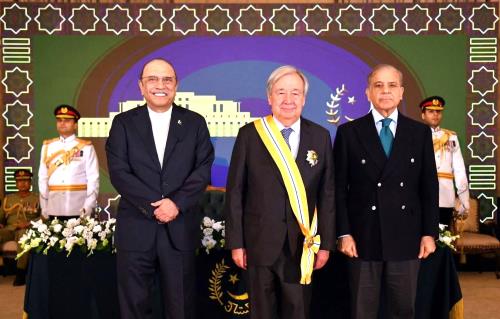
At the Presidency, the President of Pakistan received the Secretary General and conferred upon him Pakistan’s high civil award (Nishan-e-Pakistan / Hilal-e-Pakistan) in recognition of his services for global peace, his advocacy for climate justice for Pakistan, and his principled leadership of the UN.
The award at the Presidency reflected Pakistan’s gratitude, while the meetings with the President, Prime Minister and the diplomatic corps demonstrated a shared vision for a peaceful, just and sustainable world.
In his speech, the President said the award symbolizes the deep affection the people of Pakistan have for the UN. The Secretary General dedicated the award to UN staff and Pakistani peacekeepers who laid down their lives for peace. He said that Pakistan values the United Nations as the guardian of international peace and international law. He highlighted the UN’s role in resolving long-standing disputes, including Jammu and Kashmir, as per UNSC resolutions.
The Secretary General, in his acceptance speech, dedicated the award to the UN staff and Pakistani peacekeepers who lost their lives in the line of duty. He said Pakistan’s hospitality and resilience remain an inspiration to the world.
Meeting and Address to the Ambassadors in Islamabad:
A key diplomatic engagement was the Secretary General’s meeting with Ambassadors / High Commissioners based in Islamabad, organized by the Ministry of Foreign Affairs / Foreign Office.This was a candid and interactive session.
In his address to the ambassadors, Mr. Guterres touched upon four major themes:
a)Multilateralism Under Stress: He warned that the world is facing a deficit of trust and the UN Charter is being challenged. He called upon ambassadors to promote dialogue over division.
b)Climate Emergency: He once again termed Pakistan as a victim of climate chaos, urging developed nations to honor their $100 billion+ climate finance pledges.
c)Global Financial Architecture: He stressed the need for reforming international financial institutions to help debt-burdened developing countries.
d)Peace and Humanitarian Action: He praised Islamabad as a hub for diplomatic dialogue on Afghanistan and commended Pakistan for hosting millions of Afghan refugees for over four decades.The ambassadors appreciated his frank assessment of global issues.
Conclusion:
The UN Secretary General’s visit to Pakistan was successful in both symbolic and substantive terms. It reaffirmed Pakistan’s importance as a responsible member of the international community, strengthened Pakistan-UN cooperation, and highlighted issues of climate justice and regional peace at the highest level. The visit is a recognition of Pakistan’s pivotal role in international peacekeeping, humanitarian assistance, climate advocacy and regional stability. It marked a significant chapter in Pakistan-UN relations.
Such high-level engagement is essential to remind the world that global challenges like climate change, poverty and conflicts cannot be solved without strong multilateralism, and Pakistan will continue to be at the forefront of that effort.