 Nazim Mustafa,
Doctor of Philosophy in History
The settlement of Armenians in the territory around Iravan began in 1441 after the seat of the Armenian Catholicos center was moved from Cilicia to the Uchmuazzin (Uchkilsa) Church in the village of Valarshabad.
The social and economic development of Iravan city as a centre dates back to the periods of Chukhursad Beylerbey and Iravan Khanate. The city of Iravan, located between the Zangi and Gedar rivers, was surrounded in the Middle Ages by mountains and hills on the north-west and north-east sides and fertile valleys on the south and south-west sides. The fortress of Iravan was built on a steep hill located on the left bank of the Zangi River.
Since the beginning of the 15th century this region was ruled by the leaders of the Saadli tribe, which was included in the tribal association of Garagoyunlu, and because of its geographical location was known as Chukhur-Saad, i.e. “the valley belonging to Saad”.
The fortress had three gates: the Tabriz Gate on the south side, the Shirvan (or Meydan) Gate on the north side and the Bridge Gate (Korpu). In 1679, a bridge named Girmizi Korpu (Red Bridge) was built across the Zangi River, linking the Meydan Gate with the Old City.
The city of Iravan consisted of 4 neighbourhoods (mahalla): Gala (fortress, inner city), Sheher (Outer city), Tepebashi (now Kond) and Demirbulag (now Karakhank). Between the fortress and other residential neighbourhoods were the Bazaar Square and gardens.
The Sheher quarter covered the northeastern part of the city and stretched along the right bank of the Girkhbulag River to the Iravan fortress.
The central city market and all the squares, most of the caravanserais, hamams (baths) were located in this area. Tepebashi neighbourhood (mahalla) was located on a hill between the Zangi River and Sheher. It was separated from Shahri neighbourhood by numerous gardens of noble people of Iravan.
The famous Khan’s Garden and Summer Pavilion belonging to Huseyngulu Khan were located here. Demirbulag neighbourhood was located to the south east of the Old City, in the eastern part of the Iravan fortress.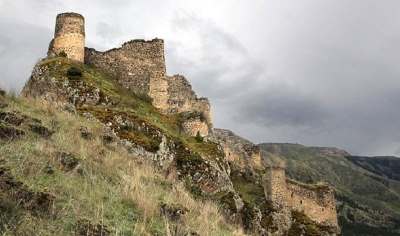
The assassination of Nadir Shah Afshar in 1747 led to the formation of a number of independent khanates. The city of Iravan had become the centre of the khanate of the Iravan khanate.
At the beginning of 19th century there were 7 caravanserais in Iravan. There were 851 shops in the caravanserais of Julfa, Gurji, Zarrabi Khan (Sarrafkhana), Tahir, Sulu, Susuz and Haji Ali.
In the centre of the town there was a Square named Boyuk Meydan and measuring 400×400 m.
There were other squares in the city: Khan Baghi, Zal Khan, Huseyn Ali Khan and Fehle bazaars. The territory of Panah Khan Makinski mansion was called Panah Khan Square until recently. Nowadays the square is named after A. D. Sakharov.
There were nine baths in Iravan built in Oriental architectural style – Sheher, Zal Khan, Sheikhulislam, Mehdi bey, Haji Beyim, Tepebashi, Haji Ali, Haji Fatali, Kerim bey. At the center of present Iravan Republic Square, once exsisted Zal Khan bath-house complex with underground tea house and a special room for an eastern melody assembly (mugamat majlisi).
In the late 19th to early 20th century, there were dozens of streets in Iravan with Azerbaijani names.
The most popular streets in old Iravan were: Shariat, Caravanserai, Gala (Fortress), Sultan, Cholmakchi, Nakhchivan, Bazar, Dashli, Pasha Khan, Gariblar-ojaghi, Deyirmanli, Mosque, Fakhla bazaars, Tepebashi, Kabirstan, Naib, Mir Jafar, Rustamkhan, Mamri, Korbulag, Bey, Ketan, Dukanli, Sallahlar, etc.
1473 gardens were laid out in Iravan and its neighbourhood. 772 of them were inside the city. Such gardens as Sardar Baghi, Abbasderesi, Abuhayat, Keshagli, Gizilgala, Dara Baghi, Savzikara, Khosrovabad, Soyudlu, Gul Deresi, Kenkan, Kerpichkhana were famous far beyond the borders of Iravan.
Some dried fruits from Iravan gardens were exported to Europe. Historical literature mentions the presence of 15 mosques and two Armenian churches in Iravan.
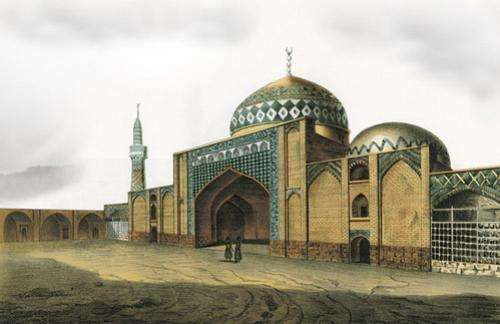
The minarets of Goy Mosque (or Huseyn Ali Khan Mosque), Tepebashi, Zal Khan (or Shakhar), Sartib, Haji Novruz Ali Bey, Fortress Mosque (Sardar or Abbas-Mirza Mosque), Demirbulag Mosque, Haji Jafar, Rajab Pasha, Mohammed Sartib Khan, Haji Inam Mosques indicated that Iravan was a Muslim city.
Cultural Genocide: Armenian atrocities in the liberated territories of Azerbaijan
In 1902, “Edelson” printing house of Iravan provincial statistical committee printed “Memory book of Iravan province for 1902”. It stated that there were 310 mosques in Iravan province, seven of which were located in the city itself.
The mausoleum of Emir Saad in the village of Jafarabad near Iravan was built in 1413 by Pir Huseyn, son of Emir Saad, one of the emirs of Garagoyunlu. At the end of 2001, improvement works were carried out around the tomb of Emir Saad at the expense of the Embassy of Turkmenistan in Armenia. The mausoleum of Emir Saad is currently included in the list of historical monuments protected in Armenia as a “mausoleum belonging to the family of Turkmen emirs”.
Travellers and explorers from Europe and Russia include Jean Tavernier, Jean Chardin, James Maurier, Ivan Chopin, Dubois de Monpere, Countess Praskovya Uvarova, Henry Lynch, academician Nikolai Marr and others. All of them visited Iravan at different times, including the Khan’s Palace, its Hall of Mirrors, Summer Pavilion. In their works they all described the mosques, caravanserais, pools and baths which they saw in the castle and the city.
Khan’s Palace or Sardar’s Palace, considered a unique architectural jewel of the East, was built by the Sardar of Iravan, Amir Guna Khan Qajar (1605-1625), and in 1760-1770, Iravan’s Huseyn Ali Khan (1762-1783) rebuilt the palace. In 1791, Huseyn Ali Khan’s son Muhammad Khan (1784-1805) built the Mirror Hall known as Shushaband and the Summer Building of the palace.
The Sardar Palace was destroyed in 1914, and the 2×1 metre portraits painted by Mirza Gadim Iravani on the walls of the palace in the second half of the 19th century were removed from the walls and given to the Military History Museum in Tbilisi.
In 1865, Armenian merchant Nerses Tahiryan bought a part of the fortress and built a winery (now a cognac factory) there. In the 1930s, the castle walls were completely destroyed by Armenians.
The famous Russian archaeologist, Countess Praskovya Uvarova, visited Iravan in 1880. She compared the “Sardar” mosque located near the Khan’s Palace to a painting that was created by Vereshchagin.
On 29 May 1918, the National Council of Azerbaijan ceded the city of Iravan as the capital to Armenians on condition of not claiming the territory of Nagorno Karabakh.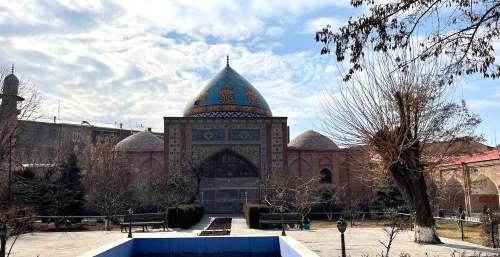 After the establishment of Soviet power in Armenia, Armenian vandals began to destroy all mosques or changed their purpose:
The Blue Mosque, which was the largest in the South Caucasus, housed the Iravan Historical Museum, and the Zal Khan Mosque was turned into an exhibition hall for artists. Only the Demirbulag Mosque served its purpose until 1988, but now it also has been razed to the ground and a high-rise building has been erected in its place.
In October 1995, via an agreement signed between the states of Iran and Armenia, the Iranian government assumed all the costs of the restoration job of the Goy Mosque. The reconstruction works were entrusted to the Iranian charitable foundation “Bonyad-e Mostazafan va Janbazan” (“Veterans and Shehids of War”) and were completed in 2006.
Reconstruction works were carried out only in the south-western and northern parts of the mosque complex. The 24-metre high minaret of the Goy Mosque, 28 cells, library, large hall, dome and courtyard were reconstructed. Currently, Armenian officials present the Goy Mosque to foreign visitors as a “Persian mosque”.
The reconstruction of the city of Iravan, carried out in 1924 according to the project of Alexander Tamanyan, essentially served to erase traces of the historical and cultural heritage of the Azerbaijani people.
As a result, apart from the Goy Mosque, not a single historical architectural monument more than 250 years old remained in present day Iravan.
Today, the Tepebashi quarter is the only area of the modern city of Iravan that has preserved traces of Azerbaijanis. The traces of Azerbaijanis in this quarter are still preserved in the Haji Imamverdi Mosque, the estate of Abbasgulu Khan of Iravan, Akhund quarter, Shehulislam, Asad bey, Imarat, Adalar and Dashli streets.
At present, the Armenian government wants to completely erase our traces by demolishing the historical quarter of Tepebashi and constructing modern-style buildings in its place.
The deliberate destruction of historical and architectural monuments belonging to Azerbaijanis in the territory of Western Azerbaijan and the appropriation of Azerbaijani property by Armenians are gross violations of international humanitarian law, especially the Geneva Conventions of 1949 and the UNESCO Conventions of 1954 and 1970.
Unfortunately, the Armenian state continues its policy of barbaric destruction of the material and cultural heritage of Azerbaijanis, taking advantage of its impunity.
Mass slaughter the Azerbaijani population committed by Armenians in 1905-1906, the genocide of 1918-1920s, the deportations of 1948-1953 and 1988-1989 completely changed the image of the Azerbaijani city of Iravan. Armenians, having wiped off the traces of the material and cultural heritage of Azerbaijanis in Iravan, and after that, having achieved the destruction of the ethnic heritage of Azerbaijanis.
Thus, they succeeded in creating a mono-ethnic Armenian city. Not content with this, Armenians are now trying to exclude any mention of Azerbaijanis from their books and textbooks.
The position of Armenians is to falsify history and give the names of “Persian”, “Turkmen”, “Mongolian” monuments belonging to Azerbaijanis in the territory of Iravan, thus concealing the real owners of this cultural heritage.