 Ambreen Umar
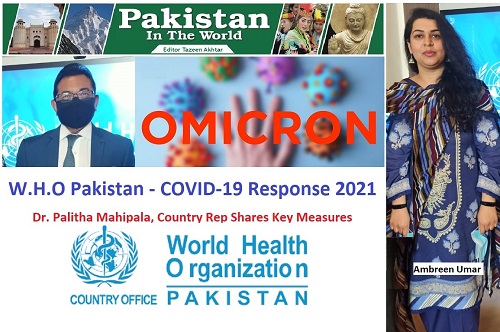
Country Representative World Health Org Pakistan, Dr. Palitha Mahipala has praised the administration of COVID-19 vaccination though out the length and breadth of country and shared that the vaccine is present even in the remote areas like tharparker Sindh and Pak-China border areas in Gilgit Baltistan region. He expressed his satisfaction on the use of the vaccine in Pakistan terming it about 90 %. He has said that any type of vaccine that is manufactured in the world is present in Pakistan.
Dr Mahipala was sharing the details with journalists in a press brief especially called in connection with COVID-19 response key measures taken in 2021 at his office in Islamabad on 11 Feb 2022. Large number of press and media people attended the briefing and asked questions. Country Representative replied to their satisfaction.
He appreciated efforts of Pakistan in controlling the COVID-19 cases saying that Pakistan had shown an effective response in fighting against the pandemic as a good number of the Pakistani population had been vaccinated. Pakistan had developed an efficient vaccination system, with ensuring the availability of the vaccine in stock.
He siad Omicron variant was just the flu but people should still be cautious. Pakistan had faced fewer hospitalizations during the fourth wave of the pandemic as it was making the vaccine accessible to everyone. He said a sufficient number of vaccines had been administered to the citizens partially and completely across the country. He added the donor agencies and the media had played a strong part in fighting against COVID-19.
“WHO supported government of Pakistan to develop vaccine deployment plans, including quantification of vaccine needs, refurbishing and branding vaccination centers. WHO contribution resulted in the vaccination of over 188 million people. ” Dr Mahipala stated.
He said that WHO supported government to train healthcare workers on identification and management of adverse event following immunization, provision of IT equipment, HR to DRAP for monitoring adverse events following immunization. As a result, over 58 thousand adverse events following immunization were identified and followed up.
WHO supported government to start the process of building capacity for the indigenous vaccine production at the national level. Operational support and logistics included donation of 41 ambulances, 16 double cabins, and 175 motorbikes to support pandemic response.
WHO also supported COVID-19 laboratories with laboratory testing consumables amounting to over 50 million. In Addition, WHO also trained over 100 thousand health care workers and provided information technology support costing approximately 17 million.
Country Representative notes that WHO supported the review of PPRP 2020 and the development of the COVID-19 strategic preparedness and response plan from July 2021 to June 2022. Mobilized over 30 million funds to support partners response to COVID-19. Supported coordination of health partner support to COVID-19 response. Involved in technical working groups for adopting guidelines for COVID-19.
WHO worked on Risk Communication, Community Engagement and Infodemic Management. Participated in behaviour change activities via social media, community influencers, radio and TV talk shows, provision of public information through 1166 and creation and distribution of IEC material. As a result, over 70m were reached with COVID-19 related messages.
Conducted over 20 campaigns across Pakistan to improve uptake of COVID-19 public health measures with specific emphases on mask-wearing, hand hygiene and social distance.
Launch of “We Care” program to protect health care workers. Launch of the campaign “Wear a Mask, Protect Pakistan” nationwide to promote COVID-19 preventive health measures.
Surveillance, Epidemiological investigation and Contact Tracing was another field in which WHO contributed a lot. Provided technical and financial support to Government to enhance COVID-19 surveillance and reporting through leveraging the PEI network hiring of surveillance staff, provision of surveillance tools, training of surveillance officers and establishment of 242 SARI and ILI sentinel sites. As a result, over 25 million suspected COVID-19 cases were identified.
“Testing is most important to see into how many positive cases are in the society. For that WHO continues to support the strengthening of Lab capacity from under 500 tests per day as of the first quarter of 2020 to over 80,000 tests per day asof Dec 2021 through the provision of technical support, provision of equipment, PCR machines (32 PCR machines), safety cabinets, regents, supplies and trainings on COVID-19 diagnostics, lab-quality, lab accreditation and biorisk management.” Dr Mahipala continued.
Regarding maintaining of essential health services, WHO conducted a health facility readiness assessment in 2020 and used the findings to develop and disseminate guidelines for the continuity of essential health services. WHO also supported the deployment of telemedicine services for RMNACH services.
WHO also supported to develop a national contingency plan for the resumption of
EPI services which resulted in the vaccination of more than 20 million children.
WHO supported the Government of Pakistan to develop vaccine deployment plans, including quantification of vaccine needs, refurbishing and branding vaccination centres. WHO contribution resulted in the vaccination of over 188 million people.
WHO supported genomic sequence by providing virus detection kits, establishing next-generation genomic sequence, training, etc. As a result, over 1200 variants of concern (VOC) and over 2500 genomic sequences were conducted.
Point of Entry (POE), International Travel and Mass Gathering Conducted assessment at POE (Land, AIR & Sea) to provide info for planning. Findings from this assessment guided WHO response at POEs which included the provision of human resources for data entry on travellers, provision of IT equipment, guidelines and training. As a result, data on travellers at POE were collected, analyzed and shared with NCOC for planning and COVID-19 response.
WHO supported the rapid assessment of IPC capacities in all COVID-19 treatment
facilities , established IPC model in health facilities, developed the standardized training curriculum for healthcare workers, trained health care workers using the standard curriculum, notified IPC committees at national, provincial, district and health facility levels.
Dr. Mahpala gave a detail presentation to the press on multi media for their better understanding and knowledge.