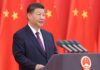
“Friends of Silk Road- 3rd Plenary Session of the 20th Central Committee of the CPC” – Minister , Parliamentarians Hail President Xi’s Vision @ APC by Pak China Institute
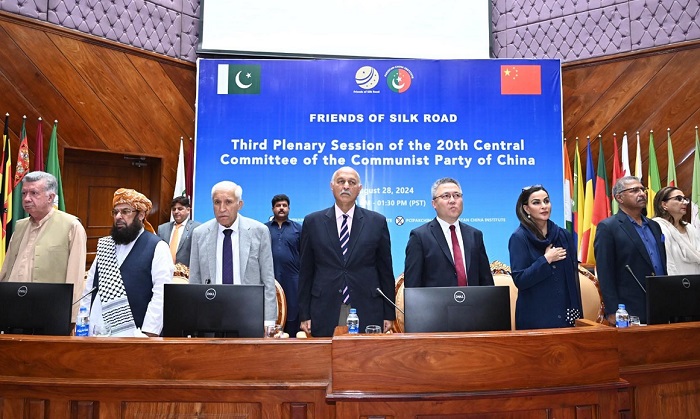
Islamabad: August 28, 2024: Federal Minister for Maritime Affairs, Mr. Qaisar Ahmed Sheikh was chief guest in the special event program organized by Pak-China Institute in COMSTECH Auditorium.
Pak China Monitoring Desk
ISLAMABAD: 28 Aug 2024 – Federal Minister for Maritime Affairs Qaisar Ahmed Sheikh, on Wednesday said that philosophical shift in China’s development model, which emphasizes “seeking truth from facts” underscores the need for reforms to be people-centric, balancing economic growth with social stability and national security.
Chairperson, Senate Standing Committee on Climate Change, Senator Sherry Rehman on Wednesday underscored China’s meteoric rise as a ‘global power’, a power that not only influences the world but also profoundly shapes the mindset of nations, particularly in the Global South.
They were speaking at the All Parties Conference “Friends of Silk Road- 3rd Plenary Session of the 20th Central Committee of the CPC”organized by Pakistan China Institute. Former Senator Mushahid Hussain Syed, Afrasiyab Khattak of ANP, Senator Abdul Ghafoor Haidari of JUI, Barrister Ali Zafar of PTI and representatives of other political parties were also present at the occasion. Deputy Head of Mission of China Embassy also attended the event.
The minister Qaisar Ahmed Sheikh said that the leadership in China recognizes the complex international environment and the domestic challenges the country faces, and this shift reflects a strategic response to these realities. For Pakistan, this approach offers valuable lessons. As we work to balance market freedom with necessary regulation, China’s experience shows us the importance of maintaining a strong state presence in key sectors while fostering private sector growth.
He also spoke that as a Minister for Maritime Affairs he will support Chinese officials regarding Gawadar Port and other shipping related matters. He also talked about the security of Chinese investors in Pakistan especially in Balochistan; on this matter, he said that federal cabinet is taking action against all those elements who want to disturb the law-and-order situation of Balochistan. He has presented the idea to develop a special think tank for the issues of Balochistan because this province has a lot of potential.
Moreover, the minister added that China’s development model, characterized by strategic long-term planning and effective governance, offers a viable alternative to the short-term, often inequitable models promoted by some Western nations. For Pakistan, China’s approach to development and reform has been transformative.
He said that the deepening of reforms in China is expected to further strengthen our partnership, particularly in areas like industrial development, infrastructure, and poverty alleviation.
“Our partnership with China is not just about economic gains; it’s about learning from a development model that prioritizes national sovereignty and long-term prosperity. As China continues to advance initiatives such as the Belt and Road Initiative (BRI), Pakistan stands to benefit enormously from China’s continued emphasis on peaceful development and international cooperation.
In addition, he appreciated China’s competitive strategy in critical sectors such as semiconductors, artificial intelligence, and renewable energy. Pakistan must look to China’s example in fostering technological innovation as a pathway to sustainable economic growth. Through strategic partnerships and initiatives like CPEC, we can access cutting-edge technologies that will propel our industries into the future.
As we confront the realities of climate change, Pakistan can draw inspiration from China’s integration of green development into its broader economic strategies. China’s ambitious targets—peaking carbon emissions by 2030 and achieving carbon neutrality by 2060—set a global standard for environmental stewardship. Pakistan, too, must prioritize green development, not only to meet our international commitments but to ensure a healthier and more sustainable future for our people.”
Qaisar Ahmed Sheikh further said that the reaffirmation of the socialist market economy as central to China’s modernization efforts sends a clear message: China is committed to its unique model of development, which blends market dynamism with state guidance. This model has been instrumental in China’s rapid economic rise, providing stability while fostering innovation. For Pakistan, this offers a blueprint for our own economic reforms.
At the end, he thanked all the participants and hope that Pak-China relations will prosper, and all the bilateral projects including CPEC will be completed with the help of China.
Senator Rehman highlighted the significance of the Third Plenary Session of the 20th Central Committee of the CPC, under the leadership of President Xi Jinping, emphasizing its crucial role in shaping global history.
She reflected on the deep-rooted and historic relationship between the Pakistan Peoples Party (PPP) and the CPC, nurtured by the visionary leadership of Zulfikar Ali Bhutto, Shaheed Mohtarma Benazir Bhutto, and Asif Ali Zardari. “The PPP has the oldest relationship with CPC, curated and nurtured by our leadership,” she stated.
Discussing the China-Pakistan Economic Corridor (CPEC), Senator Rehman lauded China’s commitment to the project, calling it a “spectacular opportunity” that has propelled Pakistan onto a historic pathway of development.
Senator Rehman emphasized the environmental aspects of the project, particularly the Green CPEC Initiative, which aims to decarbonize and green Pakistan’s future.
She noted, “The CPC’s Third Plenum placed a premium on pushing green development through carbon reduction, pollution reduction, and improvement of environmental governance systems.”
Highlighting the Karot Hydropower Projectas an example of this vision, Senator Rehman pointed out its significant environmental and economic contributions.
“The Karot Hydropower Project is built with modern hydropower technology and will reduce CO2 emissions by 3.5 million tons annually. Every year, it supplies Pakistan with over 3.2 billion kWh of clean energy, guaranteeing electricity for five million people and creating almost 4,500 decent jobs annually. Projects like these define China’s agency and commitment to sustainable development.”
Beyond CPEC, Senator Rehman highlighted China’s broader global initiatives that align with Pakistan’s goals. She praised China’s Global Security Initiative (GSI), Global Civilization Initiative (GCI), and Global Development Initiative (GDI) as visionary frameworks that emphasize common, comprehensive, and sustainable security and development.
“China’s foreign policy, embodied in initiatives like the GSI, GCI and GDI, is about taking countries and people along the path to progress, fostering cooperation over conflict, and promoting win-win outcomes rather than zero-sum games. These initiatives resonate deeply with Pakistan’s aspirations for peace, security, and development in our region.”
She expressed hope that the outcomes of the Third Plenary Session would continue to strengthen the unbreakable brotherhood and strategic ties between China and Pakistan, yielding fruitful results in the years to come.
In conclusion, she called on all parties to stand together in progress and cooperation, expressing confidence that the CPC’s strategic blueprint for reform and modernization would inject new momentum into the development of Pakistan-China relations.