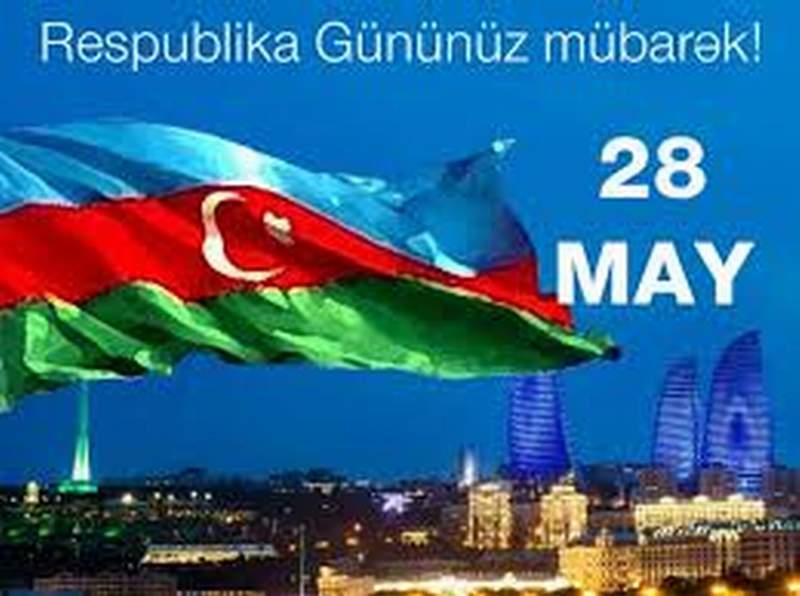
28 May Republic Day of Azerbaijan

0
898

Azerbaijan, an ancient country of rich culture and civilization, representing beautiful combination of the East and the West, had been struggling to gain its freedom since it became a part of the Russian Empire because of Gulustan (1813) and Turkmanchay (1828) treaties.
This fight reached its culmination with the declaration of the Azerbaijan Democratic Republic (ADR) on 28 May 1918, reflecting logical result of long lasting passion of freedom of Azerbaijani nation. To establish sovereignty over entire Azerbaijan, the founders of ADR created a new army with the help of Ottomans Turks, which liberated the Azerbaijani territories from Bolsheviks, Armenian ultra nationalist groups (Dashnaks) in the summer of 1918 and finally victoriously entered Baku.

Being first democratic republic in the whole East and Islamic world, ADR was able to establish main state institutions. Within 6 months, the ADR also constituted a parliament, which reflected all ethnic and religious groups in the country. Old schools were replaced by new ones. Baku State University, the first modern university, was inaugurated in 1919. In spite of financial hardships, the Azerbaijani authorities could send 100 young students to the different educational institutions in Italy, France, Germany and the UK.

One of the significant successes towards democracy was the abolition of censorship, a remnant from Tsarism. Ensuring women suffrage was another significant achievement of ADR, which was a pioneer in this matter, getting ahead of the United States (1920) and France and Italy (1945).

ADR formulated an active foreign policy. In addition to building bilateral ties, setting up and hosting numerous diplomatic missions, the ADR government also sought international recognition as well. In the course of the Paris Peace Conference, an Azerbaijani delegation met with world leaders in May 1919. The Allies and the Entente at the Paris Peace Conference issued a resolution on de facto recognition of the Azerbaijani government in January 1920.Although ADR’s existence was interrupted by the occupation of Soviet Russia in April 1920, ideals of nationalism and patriotism, which were placed in the hearts of Azerbaijanis,survived and ignited people’s dream of freedom on the eve of USSR’s collapse. Restoring its independence in 1991 based on patriotism, moral and national values, the Republic of Azerbaijan declared itself a successor state of the Azerbaijan Democratic Republic.

Independent Azerbaijan in 1993-2003

In 1993, Heydar Aliyev was elected the president of the independent Azerbaijan. Under his leadership, Azerbaijan ensured its political-economic stability and started the development in the different fields of social and economic life, as well as on human rights and democracy.

Political Stability:

Despite persisting hardships, Heydar Aliyev was able to achieve political stability in the country, eliminating unlawful armed and consolidating the state authority.

Adoption of Constitution and democracy: New Constitution of Azerbaijan drafted by special committee was adopted by referendum in 1995. It was the first constitution of independent Azerbaijan,prioritizing the principles of human rights, rule of law and separation of powers as the main directions.In August 1998, all kind of censorship over media was abolished on the decree of President Heydar Aliyev. Laws on political parties, non-governmental organizations and mass media were adapted to international standards.

Foreign Policy:

Under Heydar Aliyev’s foreign policy was updated in accordance with the realities related to the global and regional circumstances. Tension created in ties with some countries was eliminated, and balanced foreign policy line in relations with global and regional countries provided. Azerbaijan’s relations with neighboring countries were enhanced. Now, Azerbaijan declares its position in all international platforms and defends its rights successfully.

Economy:

Due to Armenian aggression against Azerbaijan, and internal political instability since the early 1990s, production in major sectors of economy had significantly dropped. After Heydar Aliyev implemented productive privatization policies, Azerbaijan’s economy started improving remarkably.

Contract of Century:

Signature of “Contract of century” with 11 transnational oil companies of 7 powerful countries played very important role in enabling Azerbaijan to increase production of its energy resources and export to the world, and in creation of economic stability inside the country. 3 years after signing of “Contract of century”, in November 1997, Azerbaijan International Operation Company, which was composed of the parties of “Contract of century”, achieved oil gusher from first well of “Chirag”.In November 1999, in frame of OSCE Summit held in Istanbul, Presidents of Azerbaijan, Georgia and Turkey signed intergovernmental agreement with participation of US President on construction of Baku-Tbilisi-Ceyhan main export oil pipeline to transport Azerbaijan’s energy resources from Baku (Azerbaijan) to Ceyhan (Turkey). Despite numerous obstacles, this project was realized.

GDP growth increased from 1.3% in 1996 to 10% in 1998. Because of effective measures, 21 % GDP growth was achieved between 1992-2002. Inflation was also brought under control; while in 1991-1994 inflation rate had risen to into 1763%, as a result of economic reforms it declined to 8,5% in 1999, became stable in following years.Incomes of state budget for 2002 increased 85 times from 1993.

During the presidency of Ilham Aliyev since in 2003, political, economic and social reforms have been continued and expanded. Significant achievements and potential obtained under the leadership of Ilham Aliyev are:

* In the past 10 years:GDP grew by 2.4 times, non- oil GDP by 2.3 times, foreign trade by 2.4 times, strategic currency reserves by 16.3 times

*Foreign debt of Azerbaijan is only 17% of the GDP,the volume of currency reserves accounts to about 77% of the GDP(2019)

*37th most competitive economy among 140 countries (WEF Global Competitiveness Report 2016-2017)

*Safety, government and political stability are considered the strongest factors by international business community operating in Azerbaijan

*Investments worth 220 billion USD since 1995.

Attractive Investment Climate

-Attractive investment incentive schemes

-NO restrictions to foreign investments.National regime applied

-NO local content requirement

-NO business inspections by state authorities and agencies

-Party to all major multilateral instruments on protection and promotion of foreign  investment

-47 bilateral investment treaties and 51 double taxation treaties with foreign countries

-Over 450 e-services by state authorities

Skilled Labour Force

-About half of the population is economically active.Total labour force reached 4.84 million persons

-One of the highest employment rates in the region(95%)

-The main driver of employment is the private sector(74%)

-Extremely high literacy rate of 99.8%

-Around 30 thousand students graduate from universities and other higher education institutions annually

-Large number of Azerbaijani students studying in the best universities worldwide in the framework of the State Program on Education of Azerbaijani Youth Abroad in 2007-2015

-A large R&D center,the National Academy of Sciences with its 28 research institutes in parallel with 53 universities and 107 VAT schools ensures the scientific and HR component of economic development

Perfect Hub

-Located on the south-eastern border of Europe serving as the natural bridge between Europe and Asia

-Trans-Caspian East-West Corridor as a key route connecting two major global economies, China and Europe (4,200 km length,12-14 days transit period)

-Logistics hub for the Caspian region with the biggest airport, seaport and railway network

-Free access to CIS and Georgia markets of 270 million consumers and GDP worth 1.6 trillion USD

-Outreach to 50 countries with almost 50 % of world consumers with in 4-hours-flight-range (medium-haul-flight)

Fast Developing Structure

-The most state-of-the-art transport infrastructure in the region

-About 19,000 km of hard-surface roads, 8,000 km of which built and constructed in past 10 years

-6 international airports. Baku operates the largest international airport in the region

-A new international seaport with annual capacity of 10-11.5 million tons of cargo and 50 thousand TEU (to be increased up to21-25 mln tons of cargo and 1mln TEU). A new shipyard and the only one on the Caspian Sea commissioned in 2013

-Over 2,000 km of operational rail roads. The so-called “Iron Silk Way”,Baku-Tbilisi-Kars trunk-railway connecting European and Asian railway systems is under construction.

New Tourism and Visa Policy

Azerbaijan is in 39th place among 148 countries in tourism competitiveness indicators, according to Azerbaijan‘s Center for Economic and Social Development. The country had the world’s fastest-developing travel and tourism economy (a 46.1-percent increase) in 2017.

In January 2017, Government of Azerbaijan introduced its electronic visa for a single-entry visit of up to 30 days. The e-visa is available to tourists from 93 countries, who can apply on the e-visa website (evisa.gov.az). Pakistani citizens can get online e-visa to visit Azerbaijan.

Because of new approach towards tourism and visa, in 2018, a record high number of 2,849,600 foreign citizens visited Azerbaijan. The number of visitors from Pakistan to Azerbaijan also increased 10 times.

The Development of Islamic Values

Government of Azerbaijan attached great importance to the revival of Islamic values. During the USSR time under communist ideology, people of Azerbaijan were deprived of moral and spiritual values gifted by this religion. Thousands of mosques are built or renovated. Ilham Aliyev often visits Islamic places.Government does its best to provide necessary facilities for people’s practice of Islam.

Cultural Activities

Azerbaijan enjoys great role to culturally connect the West and the East. As a member of the Organisation of the Islamic Conference (OIC) and the Council of Europe, Azerbaijan is in active to organize forums and conferences on intercultural dialogues aiming to reduce confrontation and minimize hostility between various cultures. Fulfilling this purpose, the Government of Azerbaijan organizes annual World Forum on Intercultural Dialogue and International Humanitarian Forum in Baku. In June, 2015, 1st European Games was organized in Baku and on April 22-28, 2019, Azerbaijan hosted 1st Formula Grand Prix races.

Heydar Aliyev Foundation and Socio-Humanitarian Projects

Since Azerbaijan got its freedom, civil society activities have started. Social and humanitarian projects realized by Heydar Aliyev Foundation in Azerbaijan and abroad are the manifestation of this reality. First Lady of Azerbaijan Mrs. Mehriban Aliyeva,  President of Heydar Aliyev Foundation, Goodwill Ambassador of UNESCO and ISESCO is the president of the foundation.

A disastrous earthquake taking place in Pakistan in October 2005, which caused huge human loss, devastated a school in Rara territory of Muzaffarabad City. On the initiative of Mrs. Mehriban Aliyeva, the school was replaced with new one, being the first educational institution built by the Foundation abroad, symbolizing fraternal relations between the peoples of Pakistan and Azerbaijan.

Nagorno-Karabakh Conflict Between Armenia and Azerbaijan

For centuries, Armenians had been living freely and practicing all human rights in the countries ruled by Muslim Azerbaijani-Turkic dynasties, such as Kara Koyunlu, AkKoyunlu, Safavi and the khanates in spite of being religious minority. After occupation of Azerbaijan by Tsardom Russia in 1828, Armenians were resettled from Iran totaled 50 thousand and from Turkey totaled 90 thousand in Azerbaijani lands-the khanates of Irevan (now Yerevan), Karabakh and Nakhchivan.

Since then, Armenians has turned out to be more chauvinist and aggressive against Muslim Turkic peoples, including Azerbaijanis. In 1988, Armenian ultra nationalists started war with the help of their international supporters occupied Nagorno-Karabakh and other 7 adjacent districts. Azerbaijan never accepts the annexation of its native lands and requires occupying forces’ withdrawal from these territories in all platforms. Despite the fact that UN Security Council (822, 853, 874, 884), the Organization of the Islamic Conference’s (OIC) (12/21-P), The Parliamentary Assembly of the Council of Europe (1416 (2005)), The European Parliament 2009/2216(INI)), NAMhave adopted resolutions confirming Armenian occupation over Azerbaijani lands and demanding the withdrawal of its forces from all occupied territories of Azerbaijan, allowing the return of displaced Azerbaijani populations to their homes, Armenia does not obey international law and continues the occupation.

LEAVE A REPLY

Please enter your comment!
Please enter your name here