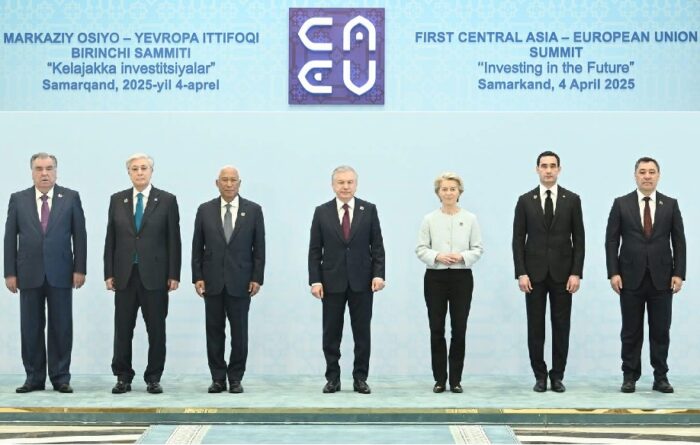
 SAMARKAND: 04 April 2025 – The first summit between leaders of the EU and the five countries of Central Asia (Kazakhstan, Kyrgyzstan, Tajikistan, Turkmenistan and Uzbekistan) took place in Samarkand, Uzbekistan.The leaders issued a joint declaration at the end of the summit.
The EU was represented by António Costa, President of the European Council, and Ursula von der Leyen, President of the European Commission. The summit was hosted by Shavkat Mirziyoyev, President of Uzbekistan.
In an evolving global and regional geopolitical landscape, the leaders reaffirmed their commitment to deepening cooperation between the EU and Central Asia and decided to upgrade the relationship to a strategic partnership.
The leaders of the EU and Central Asia are committed to respecting international law, and the principles listed above, within the framework of all international and regional fora. In this context, they emphasised the importance of achieving a comprehensive, just and lasting peace in Ukraine as soon as possible in accordance with the principles of the UN Charter.
They also reconfirmed the obligation of all states to refrain in their international relations from the threats or use of force, and underlined the need for the peaceful resolution of conflicts.
Joint Declaration : First European Union-Central Asia Summit @ Samarkand Uzbekistan
Multilateral and regional cooperation
The leaders expressed their shared concern over the situation in Afghanistan, including the security threats and possible spill-over risks to Central Asia and Europe. To that end, they resolved to work together to ensure regional stability.
The leaders also stressed that prevention of sanctions circumvention remains an important aspect in the EU-Central Asia relationship.
In terms of regional peace and prosperity, the leaders welcomed the signing on 13 March 2025 of the treaty on the state border between Kyrgyzstan and Tajikistan.
SAMARKAND SUMMIT : Central Asia – European Union: Towards a Strategic Partnership
Security challenges
The EU and Central Asia are ready to address common security challenges, and explore new possibilities for engagement between the regions.
In that regard, the leaders expressed their readiness to strengthen cooperation on:
- cybersecurity and hybrid threats
- chemical, biological, radiological and nuclear threats
- preventing and countering radicalisation and terrorism
- strengthening border security
- preventing drug trafficking and human trafficking
- initiating a dedicated dialogue on counter terrorism and violent extremism and building societal resilience against disinformation.
Economic ties, trade and investments
Strengthening trade and investment ties between Central Asia and the EU is essential for economic growth and to further develop and diversify trade. To advance towards that goal, the leaders committed to organising regular economic events and furthering cooperation in line with the Global Gateway strategy.
The leaders also agreed that the deep and comprehensive regional cooperation sought should be based on the full implementation of the current and future bilateral enhanced partnership and cooperation agreements (EPCAs). Those agreements establish legal frameworks for more effective bilateral cooperation across a broad range of areas. While an EPCA between the EU and Kazakhstan has already been in force since 2020, leaders welcomed the signing of the EU-Kyrgyzstan EPCA in June 2024 and looked forward to the signing of the EPCA with Uzbekistan and Tajikistan.
The EU is the second largest trading partner for Central Asia (22.6% of combined foreign trade in 2023), as well as the largest investor, with over 40% of investments in the region originating from the EU.
Climate, energy and connectivity
The leaders further agreed to continue to implement innovative approaches in water-energy cooperation geared towards protecting and efficiently using water resources, and agreed to strengthen cooperation and continue their partnership to improve the situation in the Aral Sea region and its basin.
In terms of sustainable transport connectivity, the leaders underlined that the mobilisation of €10 billion from the Global Gateway Investors Forum in January 2024 is key to setting up transport corridors, logistics, networks and value chains. The leaders also agreed to support the coordination platform for critical infrastructure projects along the Middle Corridor, such as the trans-Caspian transport corridor. This project would establish a modern and efficient transportation route linking Europe and Asia in 15 days or less, while enhancing connectivity, fostering cooperation, and promoting economic growth among Central Asian nations.
The leaders also acknowledged that enhanced cooperation on critical raw materials is strategically important, and endorsed :
- the EU-Central Asia declaration of intent on critical raw materials
- the 2025-2026 roadmap under the EU-Kazakhstan memorandum of understanding on critical raw materials, batteries and green hydrogen
The growing involvement in the region of the European Investment Bank (EIB) and the European Bank for Reconstruction and Development was acknowledged. In particular, the leaders welcomed the future establishment of an EIB regional representation for Central Asia, strengthening the bank’s presence in the region, and encouraged the establishment of EIB country offices in Central Asian capitals. They also welcomed the positive cooperation between the Central Asian countries and the EIB in the areas of sustainable transport, water management, energy efficiency and critical raw materials.
In the margins of the EU-Central Asia summit, Presidents Costa and von der Leyen participated in the opening session of the Samarkand international climate forum.
New Economic Prospects to Open in Samarkand On the Upcoming EU–Central Asia Summit
Human rights
The leaders reiterated that promotion and protection of the rule of law, human rights and fundamental freedoms is a common fundamental value. Accordingly, ensuring freedom of expression and association, an enabling environment for civil society and independent media, protection of human rights defenders and respect for the rights of women, the rights of the child and labour rights are at the core of EU-Central Asia relations.
In that context, the leaders agreed that the EU-Central Asia civil society forum is a key platform for dialogue and for strengthening the resilience and prosperity of societies.
People-to-people contacts and mobility
The leaders confirmed their commitment to intensifying joint efforts to deepen cooperation on education and science. This includes:
- using opportunities under the Erasmus+ and Horizon Europe programmes
- implementing projects to introduce advanced European educational methods
- cooperating in fundamental and applied research
EU-Central Asia relations
In recent years, the EU-Central Asia relationship has gained increased strategic importance and high-level meetings have intensified. Two leaders’ meetings have previously taken place, in October 2022 in Astana, Kazakhstan, and in June 2023 in Cholpon-Ata, Kyrgyzstan.
The EU strategy on Central Asia was first adopted in 2007 and subsequently updated in 2019. It aims to foster a stronger partnership with the countries of Central Asia to help the region develop into a sustainable, resilient, prosperous and closely interconnected economic and political area.
A joint roadmap was established on 23 October 2023, identifying 79 specific action points in five key areas to deepen the ties between the regions through dialogue and practical cooperation.
The summit was preceded by the 20th European Union-Central Asia ministerial meeting on 27 March 2025 in Ashgabat, Turkmenistan.