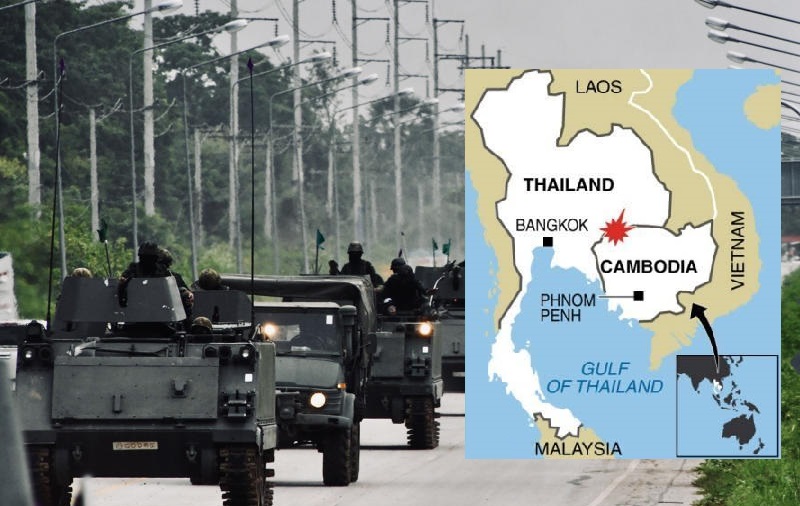
 ISLAMABAD : Monitoring Desk – A long-running border dispute between Thailand and Cambodia escalated dramatically on Thursday, with Thailand launching airstrikes on Cambodian military targets and accusing Cambodia of firing rockets and artillery.
At least 11 Thai civilians, including an eight-year-old boy, and a Thai soldier were killed in the violence. It is not yet clear if there are Cambodian casualties. Thailand and Cambodia accused each other of opening fire first. Artillery and rockets have been fired from Cambodia, and Thailand has deployed fighter jets.
While officials in Bangkok have blamed the attack on Cambodian aggression, Cambodian Prime Minister Hun Manet says Thailand launched a pre-mediated assault.
Nearby countries have called for a de-escalation, with Malaysia’s Prime Minister Anwar Ibrahim saying he would speak to both countries by the end of the day.
What about US China in Cambodia Thailand?
China has trade relations with both countries but Cambodia is considered more closer to China while Thailand is said to be near US.
China’s “secret pearl” Ream Naval Base is on the coast of Cambodia. It gives permanent access to Chinese warships which is of concern to the United States, Thailand. US takes this base as China’s first naval base that is part of its plan towards the Indian Ocean.
Thailand borrows F-16 jets, weapons. Military exercises from the US Cobra Gold are annual joint US-Thailand military exercise (Asia’s largest). Both countries have agreement on intelligence sharing.
The US may not fight directly, but it can exert “proxy influence” against China through the Thai military. The clash between Thailand and Cambodia is taking place in the area where China has big influence. Therefore the Thai attacks are putting China under diplomatic and military pressure.
The dispute between Thailand and Cambodia dates back more than a century, to when France, which occupied Cambodia until 1953, first mapped the land border. The dispute over the border, which stretches across more than 508 miles (817km), has repeatedly erupted over the years, fanned by nationalist sentiment.
The most recent episode began in May, when troops briefly exchanged fire at a contested area, killing a Cambodian soldier. This led to a series of tit-for-tat actions by both governments: Thailand imposed border restrictions with Cambodia, while Cambodia banned imports of fruit and vegetables, broadcasts of Thai films, and cut internet bandwidth from Thailand, among other measures.
Tensions escalated further on Wednesday when five Thai military personnel were injured by landmines while on patrol. Thai officials, who have alleged the landmines were freshly laid, closed their north-eastern border crossings with Cambodia, withdrew their ambassador and expelled the Cambodian ambassador in protest.
Cambodia said it was downgrading diplomatic relations with Thailand to their lowest level and recalling all Cambodian staff from its embassy in Bangkok. It has denied laying new landmines.
Cambodia earlier asked the international court of justice (ICJ) to resolve the border dispute. However, this is unlikely to lead to a resolution as Thailand does not accept the court’s jurisdiction.
Anwar Ibrahim, the prime minister of Malaysia, which now chairs the regional bloc Association of Southeast Asian Nations (Asean), called on Thailand and Cambodia to “stand down”.
However, it is improbable, that ASEAN, known for its non-interference policy, would be capable of trying to mediate the dispute – or willing to try.
China is the only viable external mediator because it has direct leverage over Cambodia and also Thailand.
However, while China has strong economic ties with both countries, it is considered to be more closely aligned with Cambodia. This may create unease among officials in Bangkok. Neighbouring countries, which are already concerned about China’s dominance in the region, may also feel uncomfortable about Beijing playing such a role, added Sanglee.
Thailand’s caretaker prime minister, Phumtham Wechayachai, said fighting must stop before negotiations could take place. There had been no declaration of war and conflict was not spreading into more provinces, he said on Thursday.
Hun Manet has requested the UN security council convene an urgent meeting to discuss the crisis, accusing Thailand of “unprovoked military aggression”.