 Special Report
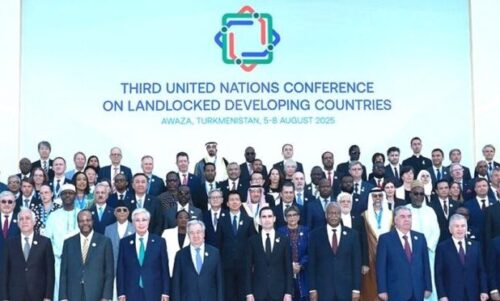
The Third UN Conference on Landlocked Developing Countries took place in the Avaza National Tourist Zone of Turkmenistan under the chairmanship of President Serdar Berdimuhamedov on 05-06 Aug 2025. The conference is expected to open up new opportunities for inclusive and sustainable development for over 570 million people living in 32 landlocked countries.
The Avaza Action Plan adopted in the conference for the next ten years includes measures to be taken at the national level, efforts to develop regional partnerships and a global strategy aimed at promoting landlocked developing countries along the path of sustainable development. It is intended to become a future-oriented Roadmap for transforming vulnerabilities into opportunities for residents of landlocked countries.
The Forum was attended by heads of state and government, high-ranking officials from over 100 countries, about 50 international organizations, and representatives of over 20 leading companies. Over 160 media representatives from about 40 countries gathered in Avaza to widely cover the current significant event.
The participants gathered to sum up the results of joint work and to identify further steps to ensure more sustainable interconnectedness.
As noted, the main conditions for ensuring sustainable development in landlocked developing countries are attracting investment in transport and transit corridors, diversifying the economy, and expanding the production of goods with high added value, in particular, innovative products.
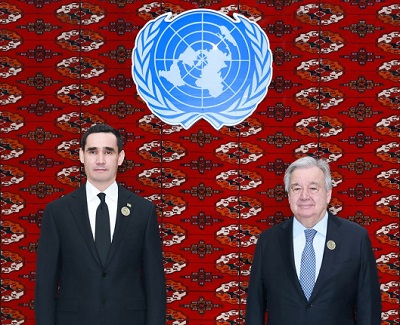 The Secretary-General of the United Nations, Mr. António Guterres as the current Chairman of the Forum, declared the Conference open and delivered a welcoming speech. Then, in accordance with the order of the Conference, President Serdar Berdimuhamedov was elected its Chairman by voting.
President Serdar Berdimuhamedov, expressed heartfelt gratitude on behalf of Turkmenistan to the delegates for their participation in the Forum.
The UN Secretary-General António Guterres, who expressed sincere gratitude to President Serdar Berdimuhamedov and the people of Turkmenistan for their hospitality and proactive position in organizing this important Conference.
Focusing on the Avaza Agenda for Action, António Guterres noted that the United Nations supports the efforts of LLDCs in this direction and specified key vectors of joint action for the next ten years.
Chairman of the 79th session of the UN General Assembly, Philemon Young having noted the enormous significance for humanity of the visions laid down in the UN Charter, Philemon Young noted that the SDG Agenda for the period up to 2030 has entered its final five years.
President of the UN Economic and Social Council, Lok Bahadur Thapa, in his address, expressed confidence in the successful implementation of the Avaza Action Framework to achieve the Sustainable Development Goals.
The Chairman of the Cabinet of Ministers, Head of the Administration of the President of the Kyrgyz Republic Adylbek Kasymaliev, acting chairman of the Group of Landlocked Countries, said, Avaza Action Programme for 2024-2034 will facilitate the development of long-term plans that will allow landlocked developing countries to fully participate in global development, said A. Kasymaliev.
The representative of the host country of the Second UN Conference on Landlocked Developing Countries, State Secretary of the Federal Ministry for European and International Affairs of Austria Sepp Schellhorn, who, warmly welcoming those gathered, expressed gratitude to Turkmenistan for the hospitality extended, as well as to the Deputy Secretary-General of the UN Ms. Rabab Fatima and the members of the Group headed by her for the efforts undertaken in the interests of Austria.
The discussion continued with issues such as infrastructure, connectivity, economic reform and climate resilience.
Following the welcoming speeches, in accordance with the order of the Conference, its rules of procedure and agenda were adopted, officers were elected, and other organizational matters were considered.
The heads of state and government, as well as the heads of delegations at the vice-presidential level, spoke: President of the Republic of Kazakhstan Kassym-Jomart Tokayev, King of Eswatini Mswati III, President of the Republic of Uzbekistan Shavkat Mirziyoyev, President of the Republic of Armenia Vahagn Khachaturyan, President of the Republic of Tajikistan Emomali Rahmon, Chairman of the Presidential Council of the State of Libya Mohammed Yunus Menfi, President of the Democratic Republic of Sao Tome and Principe Carlos Manuel Vila Nova.
In the afternoon session, Vice-President of the Republic of Malawi Michael Bizwick Usi, Vice-President of the Republic of Gambia Muhammad Jallow, Prime Minister of the Republic of Mali Abdoulaye Maiga, Prime Minister of the Republic of Uganda Robina Nabbanja, Prime Minister of Nepal Sharma Oli, First Vice-President of the Islamic Republic of Iran Mohammad Reza Aref spoke.
On August 6, 2025, the main topics of discussion were the possibilities of overcoming obstacles to the further socio-economic development of LLDCs due to isolation from world markets.
It was noted that the Conference is an important stage in promoting a global dialogue on equal opportunities. With the main emphasis on the problems faced by landlocked developing countries, speakers from the Forum member states acquainted the audience with national priorities and positions in solving pressing problems.
At the same time, the importance of further expanding cooperation with the international community on the issues included in the agenda of the current Conference was noted. Noting that the modernization of transport infrastructure, including ports, is one of the key issues for LLDCs, the speakers focused on the need to prioritize environmental well-being in this process.
In connection with the transition to a new ten-year program, the need to consolidate efforts at both the global and regional levels in the field of transport was emphasized. Speaking about the importance of the Avaza Action Program, the speakers agreed that its practical implementation will be a significant contribution to ensuring the stable development of LLDCs.
At the same time, the need to increase international cooperation and the widespread use of innovative approaches to resolving the difficulties faced by LLDCs was emphasized.
According to the Forum participants, attracting investment in various segments of the LLDCs’ economy, including logistics, infrastructure and ensuring freedom of transit, will allow for a positive practical solution to existing issues.
The speakers confirmed the countries’ readiness to support the Avaza Action Plan and, taking into account the interests of LLDCs, to join in the joint efforts of the world community to strengthen multilateral cooperation to achieve the goals set.