 Syed Irfan Ul Hassan
National University of Modern Languages (NUML) Islamabad
 The 2007 battle of Lal Masjid (Red Mosque) in Islamabad remains one of the most controversial and emotionally charged episodes in Pakistan’s recent history. It was not just a security operation; it was a collision of state authority, religious extremism, political calculation, and media spectacle. Any review of the event has to move beyond the dramatic images of gunfire and flames to understand how the crisis was built up, how it was handled, and what it revealed about Pakistan’s deeper structural problems.
Background: From Mosque to Power Center
Lal Masjid had long been an influential religious institution in Islamabad, known for its conservative orientation but also for its connections with parts of the state, especially during and after the Afghan jihad of the 1980s. Under the leadership of Maulana Abdul Aziz and his brother Abdul Rashid Ghazi, the mosque and its affiliated seminaries (Jamia Hafsa for women and Jamia Fareedia for men) became a powerful local religious hub.
By the mid-2000s, the mosque leadership began taking an increasingly confrontational approach toward the state. Students from Jamia Hafsa launched anti-vice campaigns: occupying a children’s library, kidnapping alleged prostitutes and Chinese massage parlor workers, vandalizing music shops, and openly challenging the government’s writ in the capital. The mosque administration claimed they were enforcing *Sharia* where the state had failed; the government saw this as vigilante justice and a direct challenge to its authority.
Instead of acting early and decisively, the state’s response oscillated between appeasement and half-hearted pressure. Negotiations, political backchanneling, and reluctance to confront clerics head-on allowed the crisis to escalate. This hesitation was shaped by fears of public backlash, the sensitive religious dimension, and the government’s own political calculations under General Pervez Musharraf, who was already criticized for being “too pro-West” and aligned with the US-led “war on terror.”
The Build-Up to the Siege
Tensions rose steadily through early 2007. Lal Masjid had essentially created a mini “moral enforcement” regime in its surrounding area, with armed students patrolling and issuing threats. The state’s inability or unwillingness to enforce its own laws in the capital stood in stark contrast to its claim of being a strong, centralized authority.
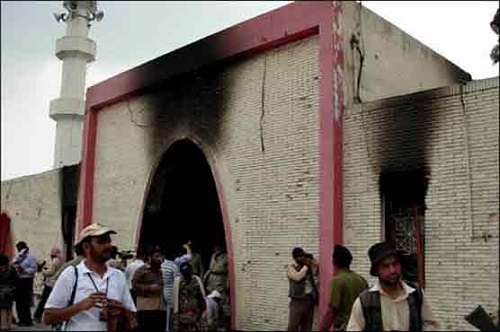
By July 2007, the situation became untenable. Armed followers of the mosque leadership clashed with security forces near the complex. Checkpoints, barricades, and sporadic gunfire became daily realities in the heart of Islamabad. The government started deploying paramilitary forces and then army units to surround the mosque, imposing a curfew and cutting utilities, while urging students to surrender.
Attempts at negotiation continued, involving religious leaders and political figures, but they repeatedly broke down. Abdul Rashid Ghazi, who had initially been seen as the more “moderate” of the two brothers, took a harder line as the siege progressed. The government alternatively issued ultimatums and extended deadlines, projecting both pressure and indecision.
Pakistan Air Force — A living portrait of Iqbal’s Shaheen – by Izmi Herlani
The Operation: Guns, Explosions, and Media
The final military operation, officially codenamed “Operation Silence,” began on 10 July 2007 after failed surrender deadlines and ongoing armed resistance from inside the mosque and its attached madrassas. The Pakistan Army’s Special Services Group (SSG) was deployed to clear the complex, which had become a fortified zone with bunkers, trenches, and reports of armed militants, including possibly foreign fighters.
The battle was intense and bloody. Soldiers faced snipers, booby traps, and close-quarters combat inside dark, cramped corridors. Official figures later reported dozens of deaths, including soldiers, students, and militants, though the exact casualty numbers and the ratio of combatants to non-combatants remain fiercely disputed. Abdul Rashid Ghazi was killed during the operation; Maulana Abdul Aziz had been arrested earlier while trying to flee disguised in a burqa.
Television channels broadcast almost every phase of the siege, creating a national drama watched in real time. This constant coverage shaped public perception: some viewers saw a necessary assertion of state authority against militancy; others saw an unnecessarily brutal attack on a mosque and religious students. The government’s tight control over information and the absence of independent verification from inside the complex fueled conspiracy theories and long-term distrust.
Competing Narratives: Terrorism vs. Oppression
The battle of Lal Masjid quickly became a symbol, interpreted in radically different ways depending on political and ideological positions.
From the **state’s perspective**, Lal Masjid had turned into an armed stronghold defying the constitution, harboring militants, and threatening public order. The government framed the operation as a necessary step to re-establish the writ of the state in the capital and to curb rising extremism. Officials pointed to the seizure of weapons, explosives, and alleged evidence of militant connections as proof that this was not simply a religious institution but a de facto militant hub.
From the **Islamist and some opposition perspectives**, the operation was portrayed as an assault on Islam and on innocent students, especially women and children. They emphasized the mosque’s symbolic status and questioned why the government did not pursue non-violent negotiation more persistently or allow safe passage for all students. The visual of a state army attacking a mosque was powerful and emotionally charged, particularly in an environment where anti-Western sentiment and distrust of Musharraf’s alliance with the US were already high.
In reality, the situation was more complex. There *were* armed militants and serious violations of the law inside Lal Masjid. There were *also* many young students, some minors, whose degree of voluntary participation and full understanding of the situation is debatable. The state *did* delay action for months, and when it finally intervened, it chose a heavy-handed operation that inevitably brought high casualties in a confined religious complex.
Political and Security Aftermath
The battle of Lal Masjid had consequences far beyond Islamabad’s streets. In the months following the operation, Pakistan experienced a sharp spike in terrorist attacks, including bombings and suicide attacks claimed by militant groups who vowed revenge for Lal Masjid. For many extremist organizations, the operation became a rallying cry, used in propaganda to recruit fighters and justify violence against the state.
Politically, the operation further eroded Musharraf’s credibility. To his critics, it confirmed the image of a leader willing to use force against his own citizens while serving Western security interests. To his supporters, it demonstrated long-overdue resolve against religious extremism, but even many of them criticized the timing, tactics, and lack of a broader political strategy.
Lal Masjid also exposed the deep ambivalence within Pakistan’s institutions about dealing with radical religious actors. The same mosque and seminaries that had once enjoyed patronage and tolerance when their activities aligned with state geopolitical goals became “enemies” when they turned their guns inward. This raised uncomfortable questions about the long-term consequences of using religion as an instrument of policy.
A Critical Review: What Lal Masjid Reveals
As a case study, the battle of Lal Masjid reveals at least four critical flaws:
1. State hesitation followed by overreaction
For months, the state allowed vigilante actions that openly challenged its authority. When it finally chose to act, it did so through a blunt military operation in a densely populated religious setting, guaranteeing high human and political costs. A more timely, calibrated law-enforcement approach early on might have avoided a full-blown siege.
2. Instrumentalization of religion and militancy
The long history of tolerance, even quiet support, for radical elements when they were “useful” contributed to the empowerment of figures like the Lal Masjid leadership. Once entrenched, such actors are extremely costly to dislodge. Lal Masjid was a direct legacy of past strategic choices.
3. Lack of coherent communication and transparency
Conflicting official statements, restricted independent access, and opaque casualty figures created a credibility crisis. This vacuum was quickly filled by rumor, martyrdom narratives, and extremist propaganda, some of which still shapes public memory of the event.
4. Absence of a broader deradicalization strategy
Even if one accepts the necessity of some form of armed operation, it was not accompanied by sustained reforms in religious education, regulation of seminaries, or community-level engagement to reduce extremism. The “tactical victory” of clearing a mosque complex did not translate into a strategic reduction in militancy.
Conclusion
The battle of Lal Masjid was not just a clash between soldiers and militants; it was a confrontation between competing visions of law, authority, and religion in Pakistan. It exposed how delayed, politically constrained decision-making can transform a localized challenge into a national trauma. It also showed how once the line between religious activism and armed militancy is crossed, the state is left with very few good options.
In retrospect, Lal Masjid should be studied less as a victory or defeat and more as a warning. It warns of the dangers of tolerating armed religio-political actors for short-term gain, of letting parallel systems of “justice” emerge in the name of morality, and of responding to deep-rooted extremism with purely military tools. The true lesson of Lal Masjid lies not in the storming of a mosque, but in everything that made that storming seem, to many in power, like the only choice left.