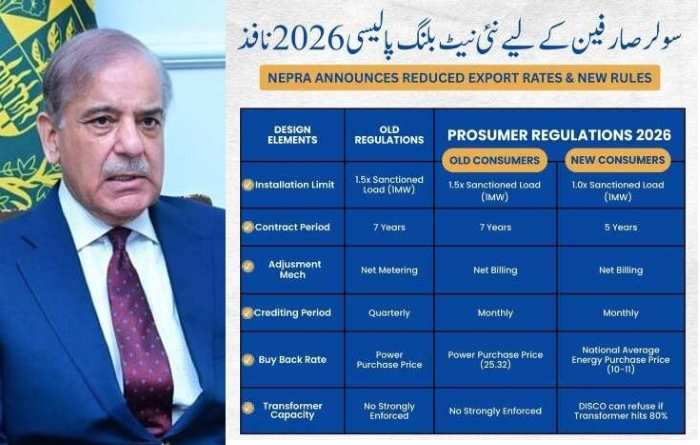
 ISLAMABAD : 11 Feb 2026 – Prime Minister Muhammad Shehbaz Sharif on Wednesday took notice of the new Prosumer Regulations 2026 issued by the National Electric Power Regulatory Authority (NEPRA), directing the Power Division to immediately file an appeal to NEPRA to protect the contract of existing solar consumers.
The prime minister, chairing a high-level special meeting on NEPRA’s new regulations, directed the Power Division to formulate a comprehensive action plan in this regard so that the burden of 466,000 consumers benefiting from solar did not fall on more than 37.6 million consumers using electricity only from the national grid, a Prime Minister’s Office news release said.
The meeting was attended by Deputy Prime Minister and Foreign Minister Ishaq Dar, Federal Ministers Ahad Khan Cheema, Attaullah Tarar, Ali Pervez Malik, Sardar Owais Khan Leghari, Minister of State Bilal Azhar Kayani, Adviser on Privatization Muhammad Ali and relevant senior officials.
Federal Minister for Power Sardar Awais Khan Leghari on Tuesday defended recent regulatory changes relating to solar net-metering while responding to a Senate resolution seeking protection for rooftop solar users and alignment of proposed regulations with national renewable energy policy.
The resolution was later deferred after debate in the upper house.
The resolution, moved by Senator Dr Zarqa Suharwardy Taimur, expressed concern over the National Electric Power Regulatory Authority’s (Nepra) draft Prosumer Regulations, 2025, arguing that the proposed framework could discourage citizen investment in rooftop solar and undermine country’s renewable energy transition.
Responding to the debate, Leghari said the changes under discussion were regulatory adjustments rather than a policy shift, noting that revising electricity regulations falls within the regulator’s legal mandate.
He maintained that existing contracts had not been altered retrospectively and would remain valid until their expiry.
PAKISTAN EXPLOITING REMITTANCES AS ECONOMIC STABILITY OF THE COUNTRY
The minister said Pakistan had more than 34 million electricity consumers, with roughly 466,000 net-metering users generating about 7,000MW through rooftop solar systems.
He argued that maintaining higher buyback rates for a relatively small group could place an additional financial burden on the majority of consumers who lack access to rooftop solar installations.
According to the minister, aligning buyback rates more closely with the average cost of electricity generation was necessary to ensure fairness across consumers.
He added that consultations with industry stakeholders, including solar associations and business groups, had taken place over the past year regarding the proposed regulatory adjustments.
Leghari also highlighted broader power sector reforms, including efforts to reduce reliance on imported fuels, renegotiate certain IPP contracts and improve efficiency in electricity distribution companies.
He said these steps were aimed at stabilising tariffs and reducing financial pressure on consumers.On renewable energy goals, the minister said Pakistan had made progress in increasing the share of cleaner energy sources in electricity generation and remained committed to expanding renewable capacity in line with climate commitments.
Despite differing views expressed during the debate, the Senate deferred the resolution for further consideration.
Net metering reform shields 1.3% vulnerable consumers from added costs, PM’s Coordinator Says
On 11 Feb, Prime Minister’s Coordinator Rana Ehsan Afzal on Wednesday said the revised solar net metering policy is aimed at preventing additional costs from being passed on to the remaining 1.3% of consumers, particularly low-income households, while maintaining a reasonable three-year payback period for solar investors.
Pakistan to Invest $1 Billion in AI Sector by 2030 to Build Future Ready Digital Economy
While speaking to a local media channel, Prime Minister’s Coordinator Rana Ehsan Afzal explained that the revised solar net metering policy was designed to balance supply and demand, a principle followed by energy regulators
globally.
He emphasized that the policy ensures long-term stability of the power system while promoting renewable energy growth.
Responding to a query about consumers’ concerns, he highlighted that the reforms protect around 1.3% of vulnerable consumers from additional costs, particularly low-income households.
He also noted that solar investors would continue to benefit from a reasonable three-year payback period, which the government considers fair and sustainable.
Addressing questions about DISCOs, Rana Ehsan Afzal said that work is underway and significant changes are expected within the next couple of months.
He added that three privatization initiatives are on the way, underlining the government’s commitment to improving efficiency, transparency and service delivery in the power sector.
Pakistan’s Transition to Net-Billing: Balancing the Grid at the Cost of Prosumer Incentives
Pakistan has replaced its existing net-metering regime with a net-billing system, a move that slashes the buyback rate for solar electricity exported to the grid from Rs26 per unit to approximately Rs11 per unit and restricts system sizing to a 1:1 ratio.
While the government aims to address the “duck curve” phenomenon and reduce the financial burden of cost-shifting onto non-solar consumers, the policy significantly lengthens payback periods and reduces investment returns for prosumers.
This shift risks driving consumers toward “behind-the-meter” behaviour and grid defection, which could deepen grid underutilisation and widen the inequity gap by making solar adoption less accessible for lower-income groups.
Critics argue the policy is a poorly designed regime that relies on flat export pricing, failing to offer time signals to address evening peak stress.
Furthermore, the restrictive 1:1 sizing cap ignores future household electrification needs, such as electric vehicles, effectively discouraging long-term renewable planning
Solar users now face drastically reduced buyback rates (falling to Rs 11/unit), resulting in longer payback periods and diminished investment returns.
This shift disproportionately disincentivizes lower-income groups, widening the inequity gap and pushing wealthier prosumers toward grid defection or “behind-the-meter” storage solutions to avoid rising fixed charges.