 Middle East Monitoring Desk Islamabad
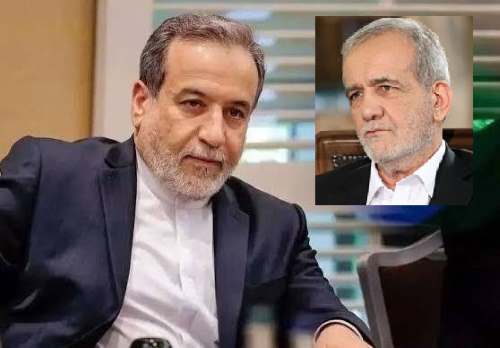
Iranian Foreign Minister Seyed Abbas Araqchi underlined Iran’s decision to continue policy of resistance against aggressors.
“At present, our policy is to continue resistance, and no negotiations have taken place,” the top diplomat said in a televised interview on Wednesday.
“There are no negotiations underway,” he reiterated elsewhere in his remarks, besides questioning the reliability of outside assurances.
Regional diplomatic contacts have taken place, but Tehran’s position has not changed, the minister said, Press TV reported.
“Many foreign ministers from the region have contacted Tehran, but Iran’s position has remained ‘principled and firm.’”
‘Iran dismisses intl. guarantees in favor of inherent guarantee created by reprisal’
“International guarantees are not 100 percent reliable,” Araqchi stated in reference to reported efforts by some third countries to act as intermediaries towards ending the unlawful aggression that has prompted decisive retaliation on the part of the Islamic Republic.
“Through the inherent guarantee that we created ourselves, no one will dare again to go to war with the Iranian people,” the official added, pointing to the Iranian reprisal that has seen the country’s Armed Forces launch at least 81 waves of unrelenting counterstrikes against sensitive and strategic American and Israeli targets throughout the region.
‘Enemy must learn a lasting lesson’
The foreign minister, meanwhile, asserted, “A ceasefire without guarantees is a vicious cycle that only leads to the repetition of war.”
“The enemy must learn a lesson so that it never again even contemplates launching another attack, and the damages suffered by the Iranian people must be compensated,” he said.
‘US bases a liability for host countries’
He also said recent developments had proved how allowing the United States to set up outposts inside regional territories would compromise the security of the host countries rather than contributing to their security.
“This war revealed many truths, one of them being that US bases not only failed to provide security for the host countries, but, in fact, became a source of insecurity for them,” he said.
Araqchi was referencing the numerous occasions in which the Armed Forces have pummeled the US outposts in regional states such as Qatar, Bahrain, Kuwait, Saudi Arabia, and Jordan in retaliation for the aggression and the host countries’ collaboration with the aggressors.
“If these countries are being struck, it is because of the presence of those bases,” he said.
“My message to the countries of the region is that they must definitely distance themselves from this American-Zionist aggression against the soil and people of Iran, and separate themselves from this war.”
The foreign minister also lamented some regional countries’ having stated previously that they would not allow their respective soils to be used against Iran before going back on their words.
“We cannot believe that this occurred without those countries being aware of it,” he said.
‘Retaliation marks golden moment in Iran’s history’
Araqchi commented on the trajectory followed by the aggression as well as Iran’s determined counterstrikes that have witnessed the Armed Forces fire hundreds of ballistic and hypersonic missiles as well as attack drones against hostile objects.
The enemy failed to accomplish several of its objectives, including dividing the country, securing a swift victory, and undermining domestic cohesion.
Iran’s reprisal has gone down as “a golden moment” in its history, with the country preventing two nuclear-armed aggressors from reaching their goals.
The sheer triumph of the retaliation, he added, was witnessed by the aggressors’ speaking of talks with the Islamic Republic, despite urging at the beginning that Tehran had to “unconditionally surrender.”
“The fact that they are now talking about negotiations is itself an admission of defeat. Weren’t they the ones talking about ‘unconditional surrender’? So why are they now mobilizing their highest-ranking officials to pursue negotiations?” Araqchi asked.
On the Strait of Hormuz, which Iran has closed to enemies and their accomplices since the onset of the aggression late last month, Araqchi said the strategic waterway remained open to friendly countries.
“For some countries that we identified as our friends, we allowed passage through the Strait of Hormuz. We allowed China, Russia, India, Iraq, and Pakistan to pass,” he said.
“There is no reason for us to allow our enemy to pass through the Strait of Hormuz.”
Iran has dismissed a US proposal as disconnected from battlefield realities, stating it will end the ongoing imposed war only when its own conditions are satisfied, a senior official told Press TV on Wednesday.
Speaking to Press TV, the official with knowledge of the details of the proposal, said Iran will not allow US President Donald Trump to dictate the timing of the war’s end.
“Iran will end the war when it decides to do so and when its own conditions are met,” the official said, emphasizing Tehran’s resolve to continue its defense and inflict “heavy blows” on the enemy until its demands are fulfilled.
According to the official, Washington has been pursuing negotiations through various diplomatic channels, putting forward proposals that Tehran views as “excessive” and disconnected from the reality of America’s failure on the battlefield.
The official drew parallels with two previous rounds of negotiations held in the spring and winter of 2025, characterizing them as deceptive.
In both instances, the official stressed, the United States had no genuine intention to engage in meaningful dialogue and subsequently carried out military aggression against Iran.
Tehran has therefore categorized the latest overture, which was delivered via a friendly regional intermediary, as a ploy to heighten tensions and has responded negatively.
The official outlined five specific conditions under which Iran would agree to end the war. These include:
- A complete halt to “aggression and assassinations” by the enemy.
- The establishment of concrete mechanisms to ensure that the war is not reimposed on the Islamic Republic.
- Guaranteed and clearly defined payment of war damages and reparations.
- The end of the war across all fronts and for all resistance groups involved throughout the region
- Iran’s exercise of sovereignty over the Strait of Hormuz is and will remain Iran’s natural and legal right, and it constitutes a guarantee for the implementation of the other party’s commitments, and must be recognized.
The official further noted that these stipulations are in addition to demands previously presented by Tehran during the second round of negotiations in Geneva, which took place just days before the US and Israel carried out a fresh round of aggression on February 28.
Iran has communicated to all intermediaries acting in good faith that a ceasefire is contingent upon the acceptance of all of its conditions.
“No negotiations will be held prior to that,” the official stressed, reiterating that the continuation of Iran’s defensive operations will persist until the outlined conditions are met.
“The end of the war will occur when Iran decides it should end, not when Trump envisions its conclusion,” he hastened to add.