 Tazeen Akhtar | Islamabad
The Strategic Mutual Defence Agreement SMDA between Saudia Arabaia and Pakistan has sparked international debate regarding Pakistan’s nuclear capabilities. While the official text remains unpublished, a senior Saudi official described it as a “comprehensive defensive agreement that encompasses all military means,” leading to widespread interpretation of a de facto nuclear umbrella over Saudi Arabia.
Pakistan’s Defence Minister initially hinted that all “capabilities” would be available but later clarified that nuclear weapons were “not on the radar” for this specific agreement.
Saudia side sources including privy to Crown Prince MBS share on media forums that all Saudi weapons, whether nuclear deterrent weapons or others, are operated and used by our Saudi soldiers, and we rely on ourselves. Despite this, we cannot deny that Pakistan has trained our forces for 40 years and facilitated all of Saudi Arabia’s requests. #Pakistan and #Saudi Arabia will be allies forever.
Saudi sources maintain that Military alliances are partnerships between major powers, not protection from anyone. Review history and current events carefully. It was the Saudi army that confronted the missiles and protected Saudi Arabia. The alliance between Pakistan and Saudi Arabia is a strategic one between two superpowers, and it is very difficult for smaller nations to grasp this.
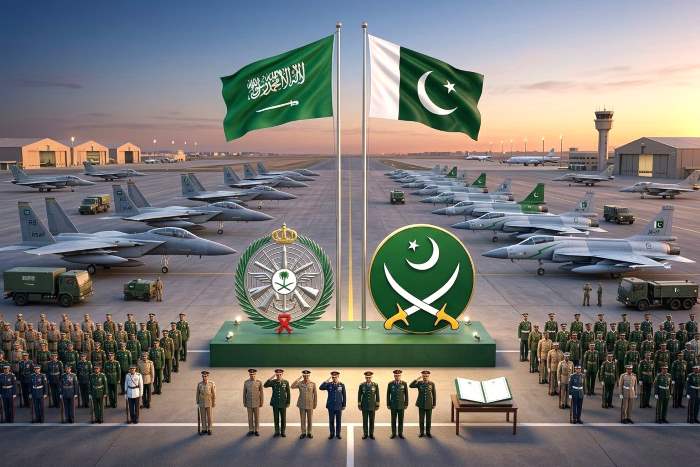
Pakistan and Saudi Arabia currently have a formal Strategic Mutual Defence Agreement (SMDA), signed on September 17, 2025. This landmark pact significantly upgraded their decades-old security partnership into a binding treaty framework. Analysts suggest the pact reflects a shift toward strategic diversification in the Gulf, as regional states seek additional security guarantees beyond traditional U.S. frameworks.
The agreement explicitly states that “any aggression against either country shall be considered an aggression against both”. It aims to strengthen joint deterrence and enhance military coordination across land, air, and sea domains.The pact covers joint training, exchange of expertise, intelligence sharing, and potential joint defence production.
Latest Military Developments (April 2026)
Following recent regional tensions and strikes on Saudi energy infrastructure, the pact has seen its first major activation. On April 11, 2026, a Pakistani military contingent of approximately 13,000 troops and a fleet of fighter and support aircraft arrived at the King Abdulaziz Air Base in Saudi Arabia’s Eastern Province.
This base was earlier being used by US military whose infrastructure was severly damaged by Iranian strikes. The deployment is officially intended to enhance joint operational readiness and reassure Riyadh of Islamabad’s commitment to the kingdom’s security.
Iran’s Response
Despite historical rivalries, Iranian leadership initially welcomed the pact as a step toward a “comprehensive regional security system”.
Certainly, if Pakistan takes responsibility of security of Infrastructure and deploy its systems at Saudi military bases, that is satisfactory for Iran in comparison with US presence in Saudia. Iran knows Pakistan will never strike Iran neither Pakistan will take side between two rival Muslim countries.
The developments in the region help to make opinion that Iran is feeling convenience with Pakistani presenece in Saudia.
On 13 April Foreign Minister Abbas Araghchi and his Saudi counterpart, Faisal bin Farhan, exchanged views on the latest regional developments and the status of talks between Tehran and Washington held in Islamabad, Pakistan. The call marks the second contact between the two top diplomats since the start of the imposed war on Iran.
Saudi Foreign Minister held telephonic conversations with DPM/FM Pakistan and State Minister Marco Rubio as well that portrays a multidimensional approach of Saudi Arabia on the ongoing conflict that is not limited to one sided narrative only.
The base of SMDA was Israel not Iran
The SMDA was concluded in the wake of far-reaching developments in the Middle East, including Israeli strikes on Doha on September 9, 2025, which killed five members of Hamas, and a Qatari security officer. The attack, which occurred amid delicate ceasefire diplomacy, and Qatari mediatory efforts, shocked Gulf capitals. It was seen not only as a violation of Qatari sovereignty but also as a reminder that existing international security guarantees offered little protection against unilateral escalation.
Qatar
Here it is worth mentioning that, State of Qatar not only understands Iran’s stance on strikes inside Arab countries including Qatar. For the same reason, Qatar government has not severed her engagements with Iran so far. The foreign ministers of both countries held a discussion on 13 April to exchange views on the latest situation in the Gulf and about Islamabad Talks.
Oman
Sultanate of Oman was the mediator between Iran and US when US and Israel invaded Iran abruptly. Foreign Minister Abbas Araghchi and his Omani counterpart Badr bin Hamad Al Busaidi held a phone conversation on 14 April, reviewing the latest developments across the region. During their conversation, the two foreign ministers discussed the Pakistani-mediated talks between Iran and the US held in Islamabad earlier this week.
UAE
The only big player in the Middle East that is not on good terms with Iran is UAE for two obvious reasons ; 1- UAE had more American positions to attract more strikes from Iran 2- UAE has diplomatic relations with Israel.