 Pakistan China Monitoring Desk Islamabad
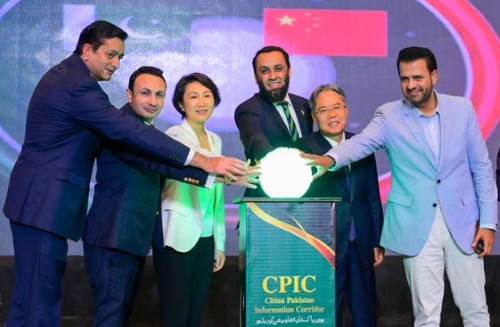
The China-Pakistan Information Corridor (CPIC) was officially inaugurated on October 27, 2026, at a ceremony held at the Pakistan-China Friendship Centre in Islamabad under CPEC 2.0 to strengthen media cooperation, counter misinformation and expand business, research and cultural exchanges.
The launch was inaugurated by Chinese Foreign Ministry Spokesperson Mao Ning, alongside Federal Minister for Information and Broadcasting Attaullah Tarar, Chinese Ambassador Jiang Zaidong, and Information Secretary Ashfaq Ahmed Khalil. Advisor to Prime Minister on Tourism Sardar Yasir Ilyas, Parliamentary Secretary Information Danial Tanveer Chaudhry were also present.
Former ambassadors of Pakistan to China , Amb Khalid Mehmood, Amb Moeen ul Haq and Amb Khalid Masood were also present.
• Occasion: The rollout coincided with celebrations for the 75th anniversary of Pakistan-China diplomatic relations and the third round of the Pakistan-China Spokespersons’ Dialogue.
Purpose and Objectives
• Core Focus: Designed as a digital and information bridge under CPEC 2.0, the corridor moves beyond physical infrastructure to connect people, media, and digital platforms.
• Main Pillars: It focuses on news exchanges, fact-checking mechanisms to counter fake news and misinformation, trade portals, podcasts, social media collaboration, cultural and tourism exchanges, and youth ambassador programs.
• Regional Offices: The first regional office for the trade pillar of the CPIC was established in Karachi.
Addressing the ceremony, Mao Ning said the Pakistan-China relationship had grown beyond friendship into a strong strategic partnership. She also highlighted the positive changes brought by CPEC to the lives of people in both countries.
Mao Ning identified fake news and misinformation as major challenges in the current information environment. She said the new corridor would help strengthen cooperation in response to these challenges.
Drawing a comparison with the Karakoram Highway, she described the initiative as part of a broader effort to build a digital highway connecting the two countries more closely.
Chinese Ambassador to Pakistan Jiang Zedong emphasized the importance of making bilateral cooperation more effective and delivering practical results for the people of both countries.
He said China had continued to share its development experiences with Pakistan and described the Information Corridor as an important platform for expanding this cooperation.
The initiative is expected to provide additional opportunities for information exchange and closer engagement between institutions and communities in Pakistan and China.
Atta Tarar described Pakistan-China friendship as a valuable legacy that successive generations continue to preserve and pass on. He said a formal secretariat had been established for the Information Corridor to support the exchange of information, ideas and perspectives between the two countries.
He explained that while CPEC connects the economies of Pakistan and China, the Information Corridor aims to bring their people closer through communication and shared understanding.
According to Tarar, the initiative is built around four key areas:
1- Media and fact-checking to strengthen information cooperation and address misinformation.
2- Business cooperation to promote connections between enterprises in both countries.
3- Think tanks and research to encourage knowledge-sharing and intellectual exchanges.
4- Culture, tourism and youth linkages to expand people-to-people engagement.
Tarar also highlighted Pakistan’s ongoing digital transformation under Prime Minister Shehbaz Sharif’s vision of Digital Pakistan, including efforts to develop the digital economy.
He added that despite changes in global circumstances, alliances and international relations over the past seven decades, Pakistan-China friendship had remained consistent.