 Pakistan China Monitoring Desk by Editor Tazeen Akhtar
5th Plenum 20th Central Committee (29 Oct 2026) Pledges Full, Rigorous Self-Governance: Xi Leads Party’s Self-Revolution
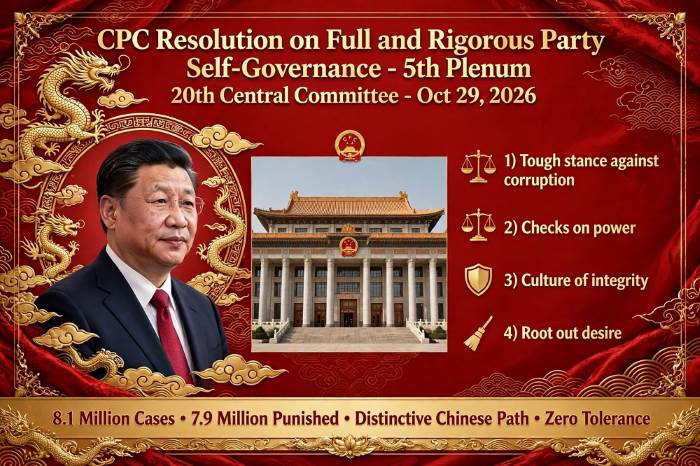
Zero Tolerance Continues: 8.1 Million Cases, 7.9 Million Punished — CPC Adopts Landmark Resolution
From Campaign to Institution: CPC Institutionalizes Anti-Corruption Drive at 5th Plenum
The Fifth Plenary Session of the 20th Central Committee of the Communist Party of China held in Beijing on October 29, 2026. It was presided over by the Political Bureau, with General Secretary Xi Jinping. The Plenum adopted the Resolution of the CPC Central Committee on Certain Major Issues Concerning Persevering with Full and Rigorous Party Self-Governance.
General Secretary Xi Jinping delivering a key address and explanatory remarks on the draft. This is only the 3rd thematic Party-building resolution in CPC history, after 1945 and 1981 historical resolutions. It comes at a critical juncture — 14 years after the anti-corruption campaign launched at the 18th National Congress (2012).
Since 2012, according to CCDI Deputy Secretary Zhang Fuhai, discipline inspection organs have filed 8.105 million cases and punished 7.922 million people, including 963 officials at Central Committee level.
I. GUIDING PRINCIPLES — The “Seven Musts”
The Communique defines 7 principles for self-governance: Serving the Party’s missions and tasks (linking Party-building to Chinese modernization and national rejuvenation), Taking strengthening the Party politically as overarching principle, Exercising rigorous governance across the boardAdopting a problem-oriented approach, Upholding fundamental principles and breaking new ground (守正创新), Adhering to a top-down approachRunning the Party according to regulations
Theoretical foundation reaffirmed: Marxism-Leninism, Mao Zedong Thought, Deng Xiaoping Theory, Three Represents, Scientific Outlook on Development, and full implementation of Xi Jinping Thought on Socialism with Chinese Characteristics for a New Era and Xi Jinping Thought on Party Building.
II. SYSTEMATIC PLANS — 8 Major Tasks
1. Strengthening Party Spirit & Ideological Building: Forge Party spirit, faith, and moral cultivation. Deep study of Party’s innovative theory as compulsory.
2. Strict Practice of Democratic Centralism: Uphold Central Committee’s centralized, unified leadership, and Xi Jinping’s core status. Tighten political discipline — resolutely correct practices where “directives are ignored and prohibitions are defied.”
3. Cadre Management System: Improve education, training, selection and appointment, management and oversight of officials. Emphasis on younger, professional, loyal cadres.
4. Strengthening Party Organizations at All Levels: From central to grassroots, improve combat effectiveness of Party branches. CPC has over 99 million members — ensuring cellular discipline.
5. Improving Conduct and Tightening Discipline: Continue Eight-point Regulation to correct formalism, bureaucratism, hedonism, extravagance. Make conduct building a permanent habit.
6. Taking Coordinated Action Against Corruption — The Four Focuses (as explained by CCDI):The resolution outlines a Distinctive Chinese Path of Anti-Corruption — a holistic approach combining severe punishment, targeted remedy, effective prevention.
Four areas of focus:
a) Tough stance: Zero tolerance, investigation continues — “keep the sword high”
b) Checks on power: Improve Party and State oversight systems, strengthen checks on and oversight over exercise of power. Centralized, unified leadership of Central Committee over anti-corruption work.
c) Cultural-ethical foundation: Fortify culture of integrity — “championing integrity and disdaining corruption”
d) Systematic prevention: Enhance coordinated efforts to root out audacity, opportunity, and desire to corrupt — address both symptoms and root causes.
7. Strengthening Party Regulations and Institutions — Enforcement is Key:Vice President of
Party School Xie Chuntao emphasized this is a new highlight:Mandatory institutional requirements must be executedEveryone equal before institutions, no privilege in observing them, no exceptions in enforcing themInstitutions must be enforced and overseen throughout process of Party organizations performing duties — “authoritative at all times and effective everywhere”Running the Party according to regulations (依规治党)
8. Improving Party and State Oversight System:
Integration of CCDI, National Supervisory Commission,巡视 inspection tours, and people’s supervision.
III. KEY TAKEAWAYS
1. From Campaign to Institution: The anti-corruption drive is moving from a political campaign to institutionalized, rule-based governance. The focus is now on “cannot, dare not, do not want to corrupt” (不敢腐、不能腐、不想腐).
2. Political Discipline First: Corruption is treated not only as economic crime but as political disloyalty. Political discipline is placed above all.
3. Warning to Cadres: The resolution notes — “many favorable conditions are in place, while we also face many new circumstances and new issues” — acknowledging that despite massive punishments, risks of elite corruption, informal alliances, and privilege-seeking remain.
4. Continuity of Xi Jinping Thought: Reaffirms Xi’s core leadership and his Thought on Party Building as central guidance for next 5-10 years, leading to 21st Party Congress in 2027.
5. Governance Model for World: China presents this as its governance model for developing countries — party self-governance as precondition for effective state governance — which is why this document is relevant for Pakistan-China Research Center for Party and State Governance inaugurated during Liu Haixing’s visit to Islamabad.
Conclusion:
The 5th Plenum Resolution signals that self-revolution is the Party’s permanent mission. It is not about purging individuals, but ensuring the CPC, as the ruling party of 1.4 billion people, remains capable of leading Chinese-style modernization and achieving national rejuvenation by 2049.
For Pakistan, the message from Beijing — as briefed by Minister Liu Haixing in Islamabad — is that strong party, strong state; party discipline is seen as prerequisite for development and stability.