 Pakistan China Monitoring Desk Islamabad
Ambassador of China H.E Mr. Jiang Zaidong has said ” Xi Jinping Thought on Party Building upholds confidence and self-reliance taking thousands of adversaries not failing your nation, focus on well being of your people, end of corruption and good governance with reforms and remaining true to the original aspiration and founding mission of the party. He has said China was ready to work with all political parties in Pakistan.”
Seeing it with the eyes of Pakistani people, the ambassador’s invitation is worth acceptance ASAP as all political parties of Pakistan are supposed and they should work and learn from Communist Party of China because the parties in our country are losing the confidence of their own workers even, let alone the common public due to known reasons.
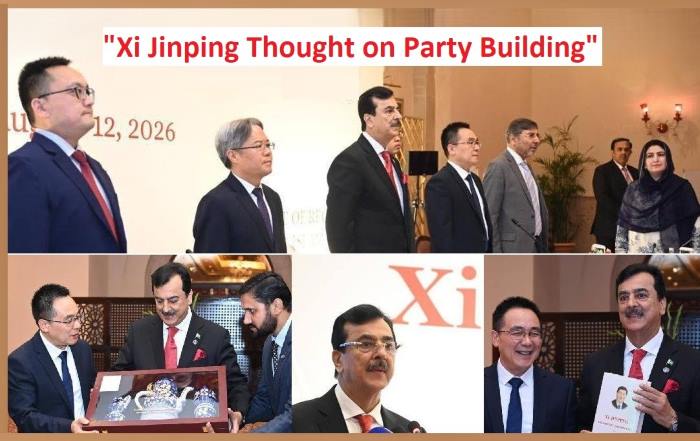
The Embassy of the People’s Republic of China in collaboration with, China Program, Institute of Regional Studies, Islamabad, hosted a Joint Symposium titled “Thematic Briefing on Xi Jinping Thought on Party Building,” examining its theoretical foundations, institutional practice, and relevance for Pakistan and the developing world.
Basically the Symposium was meant and should have been attended by main leaders of all parties of Pakistan but unfortunately the attendance was not satisfactory. Prominent presence was from the two ruling parties only from which Chairman Senate was the Chief Guest while Senator Sherry Rehman, State Minister Rana Ehsan Afzal, MNA Romina Khurshid Khan atteneded the event. PTI, Jamat e Islami and PMLQ sent their representatives but no main leaders was seen.
Political parties in Pakistan, especially, mainstream and ruling two parties are said to be like family companies where no other leader can become the head of the party than from two families only. The people centric approach and policies, reforms, accountability are the least followed things. Party elections either are not held and if held do not have credibility. Therefore, Pakistani political parties can find a lot to learn from CPC.
The session featured Professor Zheng Huan of the Central Party School of the CPC Central Committee; Mr. Liu Daxiu, Head of the visiting delegation and First-Class Inspector at the Party Building Research Institute of the Organization Department of the CPC Central Committee; and Ambassador Jauhar Saleem, President of IRS; with special remarks by His Excellency Mr. Jiang Zaidong, Ambassador of the People’s Republic of China to Pakistan. The Honourable Syed Yousuf Raza Gillani, Chairman of the Senate of Pakistan, graced the occasion as Chief Guest.
Theoretical Foundation: Speakers stressed that the ideology merges Marxist principles with traditional Chinese culture and practical self-governance.
Bilateral Ties: Participants highlighted the 75-year ironclad friendship between Pakistan and China, alongside the developmental benefits of the China-Pakistan Economic Corridor (CPEC).
Core Themes Examined
Rigorous Self-Governance: Focus on disciplined leadership, structural optimization, and internal anti-corruption mechanisms.
Global Significance: Positioned as an intellectual framework for political parties in the Global South to build public trust and organizational strength.
Message of the President of Pakistan
At the commencement of the seminar, the Senate Chairman presented a special message from the President of the Islamic Republic of Pakistan, Asif Ali Zardari. Commending the achievements of the Communist Party of China regarding the country’s development, progress, and prosperity, the President noted that the Chinese experience offers valuable guidance for enhancing institutional capacity and making governance more effective. This exchange provides a significant opportunity to benefit from each other’s experiences—particularly in the realms of political party development, governance, and state administration—and to further strengthen mutual understanding.
Chairman Senate of Pakistan
Chairman Senate Pakistan, Syed Yousuf Raza Gilani, in his keynote address said, Continuous political, parliamentary, and institutional linkages are essential to further strengthen the foundations of bilateral relations and foster mutual understanding at the people-to-people level. He stated that political parties play a pivotal role in ensuring the continuity and sustainability of national policies and strategic partnerships.
Referring to China’s extraordinary experience of development and transformation, the Senate Chairman remarked that China’s achievements offer valuable lessons for developing countries, particularly in the areas of governance, institutional stability, economic growth, poverty alleviation, human resource development, and technological advancement.
Reiterating Pakistan’s unwavering commitment to the “One-China” policy, the Senate Chairman appreciated China’s continued support for Pakistan’s sovereignty, territorial integrity, and national development. He stated that China is a key pillar of Pakistan’s foreign policy and that Pakistan is committed to further strengthening the strategic partnership between the two nations.
The Senate Chairman highlighted the importance of party-to-party contacts and exchanges in fostering mutual understanding and learning from each other’s experiences.
Reaffirming the resolve to further expand cooperation with China, he expressed confidence that growing ties at political, parliamentary, and party levels would create new opportunities for collaboration, mutual learning, and institutional development.
 Address by Ambassador Jiang Zaidong on the Theme
Ambassador Jiang Zaidong, in his address said, President Xi Jinping Thought on Party Building is profound and rich in connotation, calling for consistent efforts to study, understand and apply it. While studying and implementing the innovative theories of the Party, there was a need to reflect on oneself, one’s work and responsibilities.
He said Xi Jinping Thought on Party Building explicitly stressed “remaining true to the original aspiration and founding mission”, namely seeking happiness for the Chinese people and rejuvenation for the Chinese nation.
He recalled that in 2012, General Secretary Xi Jinping pointed out that the Party was dedicated to serving the people wholeheartedly and that the people’s desire for a better life was the goal it worked for. Guided by this devotion to the people, he said, General Secretary Xi Jinping had set a shining example through his personal commitment during China’s poverty elimination campaign. He conducted more than 50 field research visits on poverty alleviation, covering all 14 contiguous poor regions across China.
In a turbulent world, the CPC stands firmly on the right side of history and on the side of human civilisation and progress. Through unremitting struggle, it has profoundly reshaped global development trends and the landscape, led the Chinese people in advancing Chinese modernisation, and created a new form of human advancement. In this great endeavour, Xi Jinping Thought on Party Building embraces a global vision, linking the CPC’s self-improvement to the future of humanity and contributing Chinese wisdom to global party governance.
In particular, Xi Jinping Thought on Party Building upholds confidence and self-reliance while staying true to fundamental principles and breaking new ground. It has opened up a new path for a party to solve its own problems by relying on its own strength. It has established “comprehensive and rigorous governance of the Party” as the strategic guideline for Party building in the new era.
With the sense of mission to “take on thousands of adversaries and never fail the 1.4 billion people”, it has steadfastly advanced the fight against corruption to ensure that officials have no desire, no opportunity and no audacity to be corrupt.
With enduring perseverance and commitment, it continuously advances the Party’s self-reform, using this great self-reform to lead a great social revolution. This ensures that the Party always remains the strong leadership core of the cause of socialism with Chinese characteristics.
The ambassador said, it is fair to say that Xi Jinping Thought on Party Building demonstrates noble value orientations and unique intellectual strength. It provides useful references for political parties in various countries, especially those in developing nations, to strengthen their own party building and independently explore pathways to modernisation, thus making important contributions to the progress of human political civilisation.
Increasingly, political parties and leaders around the world are paying attention to the question: “Why is the CPC able to succeed?” In this regard, President Xi Jinping has pointed out that political parties in different countries should enhance mutual trust, strengthen communication and work closely together.
They should explore the establishment of a new type of party-to-party relationship based on seeking common ground while reserving differences, mutual respect and mutual learning, built upon the foundation of a new type of international relations. They should also build international party exchange and cooperation networks of diverse forms and multiple levels, gathering strong momentum for building a community with a shared future for mankind.
 Mutual Learning on Party Governance
Ambassador, while advancing practical cooperation for the benefit of the two counties peoples, said, the two sides must also pursue mutual learning to deepen exchanges on party governance and state administration. As changes unseen in a century accelerate and the world enters a new period of turbulence and transformation, mankind is once again at a crossroads over which direction to take. Political parties worldwide face the common challenge of “what kind of political party to build and how to build it”.
“We are delighted to see that exchanges and mutual learning between the CPC and political parties in Pakistan continue to deepen. The two sides have signed a memorandum of understanding on inter-party exchange and cooperation, established a political party consultation mechanism for the China-Pakistan Economic Corridor (CPEC), and hosted the China-Pakistan Political Parties Forum,” he said.
Each year, the Chinese side invites representatives of Pakistani political parties to visit China for tours and conferences. It also continuously supports small and beautiful livelihood projects in Pakistan through platforms such as the “Silk Road Workshop”.
This year marks the 75th anniversary of diplomatic relations between China and Pakistan. In May, a senior delegation of Pakistani political parties visited Hubei Province, making positive contributions to promoting local cooperation between the two countries.
In the same month, the 2nd China-Pakistan Political Parties Forum and the Political Party Consultation Mechanism Meeting for CPEC were held. Leaders from 12 major Pakistani political parties attended the event, and both sides reached broad consensus on deepening traditional friendship and promoting practical cooperation.
“Today, by hosting this seminar on Xi Jinping Thought on Party Building, we are at the forefront of deepening exchanges on governance and party-building experience between the CPC and political parties worldwide,” he said.
Moving forward, he said China was ready to work with all political parties in Pakistan to continue implementing the important consensus reached by the leaders of the two countries.
“We will actively expand ‘political party-plus’ cooperation based on existing foundations, ensuring that the iron-clad friendship between China and Pakistan is carried forward through the baton of inter-party exchange and mutual learning,” he said.
He said the seminar would also provide an opportunity to deepen and consolidate the exchange of experiences in party building and governance with Pakistani political parties.
“This will inject new momentum into deepening the China-Pakistan all-weather strategic cooperative partnership, provide new opportunities for our brotherly Pakistani people through the new development of Chinese modernisation, and accelerate the building of an even closer China-Pakistan community with a shared future in the new era,” he said.
“In conclusion, may the friendly relations between the CPC and Pakistani political parties remain vibrant and dynamic! May both China and Pakistan enjoy peace and prosperity! May the China-Pakistan friendship endure forever!” he said.
 Fight Against Poverty
Ambassador said, Xi put forward and applied the concept of targeted poverty alleviation, setting a brilliant example of integrating the power of truth with moral integrity. Under his leadership, China won the fight against poverty, built a moderately prosperous society in all respects and embarked on a new journey of advancing national rejuvenation and building a great modern socialist country through Chinese modernisation.
He said that under the strong leadership of General Secretary Xi Jinping and the Party Central Committee, more than 3 million first Party secretaries and resident cadres, together with nearly 2 million township officials and millions of village-level cadres, fought in unison to eliminate absolute poverty.
“This fully demonstrates the CPC’s capacity to mobilise resources to accomplish major undertakings, and embodies two core principles highlighted in Xi Jinping Thought on Party Building: that ‘the leadership of the CPC is the defining feature of socialism with Chinese characteristics’ and that ‘upholding the centralised, unified leadership of the CPC Central Committee is the highest principle for Party leadership’,” Ambassador added.
The ambassador said it was precisely because the CPC always put people first and regarded delivering people’s well-being as its paramount achievement that it enjoyed enduring popular support and stood as the most reliable and staunch backbone for the Chinese people.
H.E spoke highly on advancing China-Pakistan friendly cooperation.
The ambassador said China-Pakistan cooperation must put people first and ensure that it better benefited the two peoples. The Communist Party of China always serves the public good and governs for the people.
Ambassador said, beyond seeking happiness for the Chinese people and rejuvenation for the Chinese nation, the CPC also strove for progress for humanity and the common good for the world. As General Secretary Xi Jinping noted, we Chinese not only aspire for a good life for ourselves, but also hope people in other parts of the world lead a decent life. This was fully reflected in the development of China-Pakistan relations in the new era.
General Secretary Xi Jinping has consistently cared for Pakistan’s national development and people’s livelihood. Together with Pakistani leaders, the two sides had defined the new positioning of the China-Pakistan all-weather strategic cooperative partnership and reached important consensus on building an even closer China-Pakistan community with a shared future in the new era.
H.E Zaidong shared that General Secretary Xi Jinping had stressed that China’s friendly policy toward Pakistan was always oriented toward the entire Pakistani people, while the planning and layout of the China-Pakistan Economic Corridor (CPEC) should take into account all regions of Pakistan so that the fruits of development could benefit all the people of Pakistan.
Ambassador detailed the figures as, to date, CPEC has brought in over 25.9 billion US dollars in direct investment, created more than 260,000 jobs, added over 8,000 MW of power generation capacity, built 510 kilometres of highways and 886 kilometres of core national power transmission networks. CPEC had injected strong momentum into Pakistan’s socio-economic development, served as a powerful example of high-quality Belt and Road cooperation and become a vivid embodiment of the China-Pakistan community with a shared future.
75th anniversary of relations
Ambassador said General Secretary Xi Jinping had reached important new consensus with President Zardari and Prime Minister Shehbaz Sharif on advancing bilateral cooperation, which the two sides were working earnestly to implement.
“Less than two weeks ago, we visited the industrial park in Faisalabad. We were pleased to learn that 39 Chinese private enterprises operate there, most of them soundly run and profitable, thanks to the enabling business environment fostered by Pakistan.These enterprises also actively gave back to local communities.
Five ceramic enterprises alone pay nearly 20 million US dollars in annual taxes and provide more than 5,000 local jobs. There are many such inspiring examples of mutual commitment delivering tangible benefits for our peoples.
He said China stood ready to work with Pakistan to fully apply the people-centred philosophy of development, advance both major signature projects and “small and beautiful” public well-being projects, and march hand-in-hand towards greater people’s well-being and common prosperity.
Presentation by Prof Zheng Huan
A presentation by Prof Zheng Huan of the Party Building Department at the Party School of the Communist Party of China (CPC) Central Committee highlighted the global significance of Xi Jinping Thought on Party Building and its relevance to governance by political parties worldwide.
He said, the thought, developed following the 18th CPC National Congress in 2012, provides fundamental guidance for exercising full and rigorous self-governance, strengthening Party organisations and maintaining the Party’s long-term vitality.
Five Major Contributions of Xi Jinping Thought on Party Building
Prof Zheng Huan said five major contributions that Xi Jinping Thought on Party Building offers to political parties seeking to address governance and development challenges.
1- The first was described as a new choice for national development paths, with emphasis on long-term planning and stable development strategies beyond electoral cycles. He highlighted China’s economic progress under the 14th Five-Year Plan, noting that its GDP had crossed the 100 trillion, 120 trillion and 130 trillion yuan milestones and was moving towards the 140 trillion yuan mark. He also highlighted China’s targeted poverty alleviation campaign, saying nearly 100 million rural people had been lifted out of absolute poverty over an eight-year period.
2- The second contribution was described as restoring public support and trust through citizen-centred governance. He reaffirmed the principle that the CPC represents no special interest groups, privileged strata or powerful cliques. It also referred to World Values Survey data for 2017-2022 showing high levels of public confidence in governance systems that prioritise public welfare.
3- The third contribution concerned overcoming organisational weaknesses through a broad grassroots network. The CPC has more than 101 million members and 5.43 million primary-level Party organisations across China. He said the organisational structure had also enabled the mobilisation of 255,000 village work teams and more than three million first secretaries and cadres for local development, poverty alleviation and disaster relief.
4- The fourth contribution was described as a direct and comprehensive anti-corruption strategy based on three approaches — making officials “not dare” to engage in corruption, “not able” to do so and “not want” to do so. He said that between the 18th and 20th CPC National Congresses, anti-corruption agencies handled more than 4.64 million cases and disciplined 4.57 million individuals, including 553 provincial- and ministerial-level officials.
5- The fifth contribution was described as a new paradigm for party-to-party relations based on non-interference, mutual respect and inclusive dialogue. He said the CPC maintained regular exchanges with more than 700 political parties and organisations in over 170 countries. He also outlined a three-step roadmap for strengthening international understanding and academic research on Xi Jinping Thought on Party Building.
The first step was to deepen theoretical research into its Marxist origins, traditional cultural roots and practical achievements in full and rigorous self-governance.The second involved translating political concepts into accessible international language and connecting them with shared values to promote mutual understanding. The third called for greater cooperation among governments, media organisations and think tanks to establish dialogue platforms and jointly address common global governance challenges.
The chairman, IRS Jauhar Saleem, the representatives of various political parties, experts, journalists community also participated in the event and appreciated China for its development and uplift to their people.
The thematic briefing was followed by an open discussion session between the two sides, reflecting on the doctrine’s insights and their relevance for effective governance. The event reaffirmed the enduring, all-weather friendship between Pakistan and China, and the new type of Part-to-party relation between the two countries.
Ms. Nabila Jaffer, Senior Research Analyst and Head of China Program moderated the session.