 By Tazeen Akhtar, Editor, Pakistan in the World – Media Group, Islamabad
 Shanghai Cooperation Organization provides a door towards confidence building measures for India and Pakistan seeing the reciprocal visits of ministers and the climax of this engagement despite bitter relations is SCO Islamabad Summit next year that requires participation of Prime Minister Modi in Pakistan. Most recent interaction is the visit of Pakistani minister Musadik Massod Malik to Delhi. The sides are still at daggers drawn but the door is also available to de-escalate and dare to address the real issues in real , open mind with good faith for the betterment of the people of South Asia.
India had originally invited Pakistan’s National Heritage and Culture Minister Aurangzeb Khan Khichi on 28 October. Pakistan on 14 November instead nominated Malik – a deliberate, political choice. Malik is not a culture minister. He is the minister who had been most vocal against India on Indus Waters Treaty.
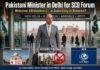
On 20 November 2026, Pakistan’s Federal Minister for Climate Change and Environmental Coordination, Dr. Musadik Masood Malik, arrived in New Delhi. It was first Pakistani federal minister to visit India in 3 years – since Bilawal Bhutto Zardari attended SCO Foreign Ministers meeting in Goa in May 2023. First Pakistani minister to visit India since the May 2025 war – the 4-day military confrontation after Pahalgam terror attack (26 killed) and India’s Operation Sindoor, 7-10 May 2025. First Pakistani minister invited by India since Operation Sindoor.
He came for the 1st SCO Civilisational Dialogue Forum, 20-22 November 2026, Purana Qila, New Delhi – an Indian initiative proposed by PM Narendra Modi at SCO Tianjin, and included in Bishkek Declaration.
Pakistan is currently Chair of SCO Council of Heads of State for 2026-27, and will host the SCO Leaders Summit in Islamabad in August 2027. Its participation was therefore not a favour to India – it was an obligation of chairmanship, and a test of whether SCO can function when its two South Asian members are at war-like hostility.
Pakistan Foreign Office statement:
“Pakistan’s participation in this Forum is reflective of its contribution as an active State to promote dialogue, cooperation and understanding in line with the ‘Shanghai Spirit’.”
“The minister’s address will highlight Pakistan’s constructive role in the SCO, as well as the country’s diverse civilisational and cultural heritage.”
India’s MEA spokesperson Randhir Jaiswal, 28 October:
“India had invited all SCO members as per established practice… Post-Pahalgam, we have a Pakistan policy. That Pakistan policy remains in place; there has been no change.”In other words: India invited because SCO rules required it. Pakistan accepted because SCO chairmanship required it. Neither side called it a bilateral thaw.
His Statement There – What Malik Actually Said
Malik kept his first day deliberately soft, cultural, and forward-looking – very different from his June 2026 rhetoric. On arrival, to ANI: “I think all of our relationships will improve. The region is in flux, as you know. The plates underneath geopolitics are shifting very fast.”
“The forum would be pushing the agenda of the region.”
“I think the opening day was excellent.”He urged the 10 SCO countries to take a “macro view” of regional matters and discuss political and social issues, not just art and architecture.
And in Urdu, with a direct message to India:
مجھے امید ہے کہ اب آپ کو کوئی شکایت نہیں ہوگی، اور یہ کہ ہمارا ایک دوسرے کے ہاں آنا جانا جاری رہے گا…
(I hope you won’t have any more complaints, and that we’ll continue to visit each other).”
On terrorism – the question Indian media most wanted him to answer – he deflected:
“I think tomorrow, once I give my statement, we’ll have a lot of conversations.”
He was expected to address the forum on Saturday, 21 November, on Pakistan’s civilisational heritage – Indus Valley, Gandhara, Taxila, Mohenjo-Daro, Lahore, Multan – the shared heritage India also claims.
Pakistan’s reading of his statement: Restraint, dignity, no provocation, opening a door.
India’s reading: Careful, but not an apology, not a concession on terrorism or water.
This was the core difference. Pakistan wanted the visit to be seen as normalisation. India wanted it to be seen as multilateral routine, not bilateral normalisation.
Indian Controversy Created by Indian Media – Three Storms in 48 Hours
The controversy did NOT start in Delhi’s Purana Qila. It started in Delhi’s TV studios, X, and Opposition press conferences – before Malik even spoke.
Controversy 1: “Cut Off Hands” – The Water Threat
Indian media, led by Economic Times, Times of India, and strategic commentator Brahma Chellaney, revived Malik’s June 2026 statement:
At a press conference with Information Minister Attaullah Tarar, after India placed Indus Waters Treaty (1960) “in abeyance” after Pahalgam, Malik had warned:
“We will cut off those hands attempting to interfere with Pakistan’s water supply” / “Anyone attempting to block Pakistan’s water would have their hands cut off.”
Chellaney on X:
India hosting a minister who threatened to “cut off those hands” raises questions about India’s position that terrorism and talks cannot go together.
Congress spokesperson Supriya Shrinate:
“Threatened to cut off hands, threatened to shed blood. Pakistan is not stopping its promotion of terrorism in our country and the Modi government is busy feeding them biryani and kheer.”
Congress MP Pramod Tiwari, Congress leader Surendra Rajput, Samajwadi Party’s Fakhrul Hasan Chand – all accused BJP of double standards:
“BJP always says talks and terrorism cannot happen at the same time. But now, a Pakistani minister is visiting India.”
“BJP and PM Modi are confused. They ask cricketers to play against Pakistani team. And now, this Pak minister is coming. Our foreign policy is compromised.”
BJP response – Nalin Kohli:
“India did not extend any special invitation to Pakistan. Our bilateral relations remain exactly as they were. There can be no dialogue as long as terrorism is directed against us. This is a multilateral forum.”
“India’s policy towards Pakistan had not changed.”MEA on 20 November repeated: “Absolutely no change” on Indus Waters Treaty.
Controversy 2: Airport Snub – Was He Welcomed or Ignored?
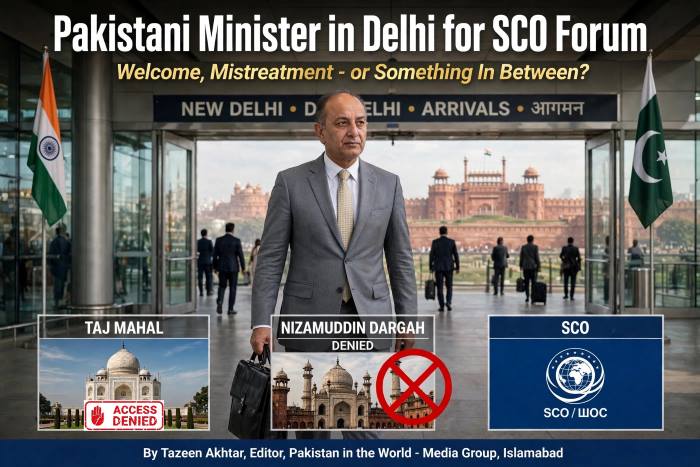
Malik received at airport by Pakistani Charge d’Affaires Saad Warraich only. India did not bother to welcome him. Modi Sarkar did not send any official to recieve him at airport.
Indian sources, via ANI, immediately “rubbished” the claim:
“A director from the Indian Ministry of Culture and the Under Secretary from MEA’s PAI (Pakistan, Afghanistan & Iran) division were present at arrival as part of welcome protocol. All SCO member countries arriving in Delhi are receiving a similar level of protocol.
“Who is right?
Fact-checking shows both are partly true – and that is the point:
India did NOT send a Minister, or a senior Joint Secretary, or a red carpet – the level given to a Foreign Minister in 2023, or to Jaishankar in Islamabad in 2024.India DID send low-level protocol officers – Director + Under Secretary – the same as for other SCO delegates who are NOT heads of delegation / Foreign Ministers.
Pakistan’s CdA was the visible, photographed greeter, because he is the senior Pakistani diplomat in Delhi.In diplomatic terms, this was correct protocol for a non-Foreign Minister at a non-summit cultural forum, but deliberately minimal. No insult, but no warmth either. India made sure the optics could not be used by Opposition as “biryani diplomacy.”
Controversy 3: Taj Mahal & Nizamuddin Dargah – Permission Denied
NDTV / Pioneer / Jagran reported on 20 November:
Malik sought permission to visit: Taj Mahal, Agra, Hazrat Nizamuddin Dargah, Delhi. Both denied. Government sources said :
“He had been granted a visa specifically to participate in SCO Civilisational Dialogue Forum… His visit would be limited exclusively to participation in scheduled SCO proceedings, with no additional visits or engagements permitted.”This became the strongest evidence in Pakistani media that Malik was contained, not welcomed.
In 2023, Bilawal was also restricted to SCO programme, no bilateral, no sightseeing. In 2024, Jaishankar in Islamabad was also restricted to SCO programme, no bilateral, no sightseeing – but he was allowed a walk, dinner, and warm photos with Pakistani leaders.
The difference in 2026: Malik wanted a cultural-religious visit to a Sufi shrine and Taj – both symbols of shared civilisation that the Forum itself was celebrating. Denying that, while hosting a Civilisational Dialogue Forum, looked contradictory to many Pakistanis.
India’s logic: Visa was SCO-only. Any extra movement would require security clearance, and would be exploited politically after Pahalgam. No exception.
The Deeper Pakistan-India Perspective – Two Different Films
This visit must be read not as one event, but as two parallel narratives:
Pakistan’s Narrative ; We went despite war, despite IWT suspension, despite humiliation – to prove we are not isolated, Malik was restrained, positive, spoke of “aana jaana rahega”, Airport reception was cold, Taj/Dargah denied, SCO chairmanship gives Pakistan leverage, India must come to Islamabad in Aug 2027, Civilisation is shared – Indus, Gandhara, Sufi – we belong in Delhi.
India’s Narrative ; We invited because SCO rules require it – not because policy changed, Malik is the same minister who threatened to cut hands on water, Protocol was equal for all SCO delegates, visa was SCO-only, No bilateral, no talks, no cricket diplomacy, no change on terrorism, Civilisation dialogue is cultural, not political – do not mix.
Both narratives are factually defensible. That is why the visit created controversy in India but not a crisis.
In Pakistan: Media largely reported it as a dignified, successful participation. No major party attacked Malik for going. The debate was: Did India respect us?
In India: Media largely reported it as a controversy. Opposition attacked Modi for hosting. Government defended by saying: No special invitation, no bilateral, no change.
The irony: The same visit was attacked in India for being too warm, and in Pakistan for being too cold.That tells the real state of Pakistan-India relations in Nov 2026: Not war, not peace – a frozen, managed hostility, where even a cultural forum becomes a proxy battle over terrorism, water, and national pride.
Conclusion: Was He Welcome or Mistreated? Answer: He was formally welcomed, politically contained, and emotionally mistreated by optics.
1. Formally Welcomed – YES
Visa granted, despite Operation Sindoor still “ongoing” according to IndiaAllowed to attend, speak, be photographed at Purana Qila with PM Modi inauguratingProtocol officers at airport, security, accommodation as per SCO standardNo detention, no protest, no black flags reportedMEA confirmed invitation to all SCO members, including PakistanIf India wanted to mistreat him, it could have denied visa, downgraded invitation, or cancelled forum. It did none.
2. Politically Contained – YES, DELIBERATELY
No bilateral meeting with Jaishankar, Shekhawat, or Modi announcedNo Taj Mahal, no Nizamuddin – restricted to SCO venueNo joint press conference, no joint statementMEA repeatedly stressed: “Multilateral, not bilateral. No change on IWT. No change on terrorism.”This was not accidental. It was a policy of containment – to prevent Opposition, and Pakistani media, from claiming a thaw.
3. Emotionally Mistreated – IN OPTICS, YES
The airport photo – only Pakistani CdA visible – fed the snub narrative in PakistanThe Taj/Dargah denial fed the narrative that India talks civilisation but blocks Sufi shrine visitThe “cut off hands” replay in Indian media, hours before he spoke, ensured he arrived as a villain, not a guest.
Compare to history:
Bilawal in Goa, May 2023: Received by Indian officials, but Jaishankar publicly called him “promoter, justifier and spokesperson of terrorism industry.” Bilawal called visit “success” because he countered narrative on Indian soil.
Jaishankar in Islamabad, Oct 2024: Received warmly, pleasantries, handshake, dinner – but no talks. Passed quietly.Malik in Delhi, Nov 2026: Received correctly, but coldly. No public insult from Jaishankar this time, but no warmth either. The insult came from media/Opposition, not government.
Verdict:
Malik was not mistreated in the legal-diplomatic sense. He was not welcomed in the human, South Asian sense – where a guest, especially after war, is given chai, a shrine visit, a handshake photo.
India chose protocol over hospitality. Pakistan chose participation over boycott. That is progress compared to May 2025 war – but it is not peace.
The real test is now reversed: Will PM Modi / EAM Jaishankar come to Islamabad in August 2027 for SCO Leaders Summit under Pakistan’s chairmanship?
If India sends a low-level delegate, or boycotts, or demands virtual summit, Pakistan will call it mistreatment. If India sends Modi, and Pakistan restricts him to SCO venue, denies him Taxila / Katas Raj / Nankana Sahib visit, India will call it mistreatment.
Malik’s visit has set the precedent: SCO is the only surviving channel, but it is a channel without warmth, without bilateral, without trust. Pakistan-India relations did not improve in Delhi on 20 November 2026. But they did not collapse either. And after a war, that itself is a statement.
For Pakistan, the lesson is: Go, speak, be present – do not let India have an open field. Bilawal did it in 2023. Malik did it in 2026.
For India, the lesson is: You cannot host a Civilisational Dialogue Forum on shared civilisation, and then deny a Pakistani minister a visit to Nizamuddin – the very symbol of that shared civilisation – without the world noticing the contradiction.