 #Tazeen #Akhtar | #Islamabad
 Pakistan and Armenia officially established diplomatic relations on August 31, 2025, ending decades of non-recognition of Armenia from Pakistani side. Pakistani Deputy Prime Minister and Foreign Minister Ishaq Dar and Armenian Foreign Minister Ararat Mirzoyan signed a joint communiqué in Tianjin, China, during the Shanghai Cooperation Organisation summit.
For over three decades, Pakistan was one of the few UN member states that did not recognize Armenia. Islamabad’s policy was rooted in its strong fraternal ties with Azerbaijan and its support for Baku during the Nagorno-Karabakh conflict.
Following the historic peace agreements between Armenia and Azerbaijan, coordinated consultations enabled Islamabad and Yerevan to normalize ties and open official diplomatic channels.
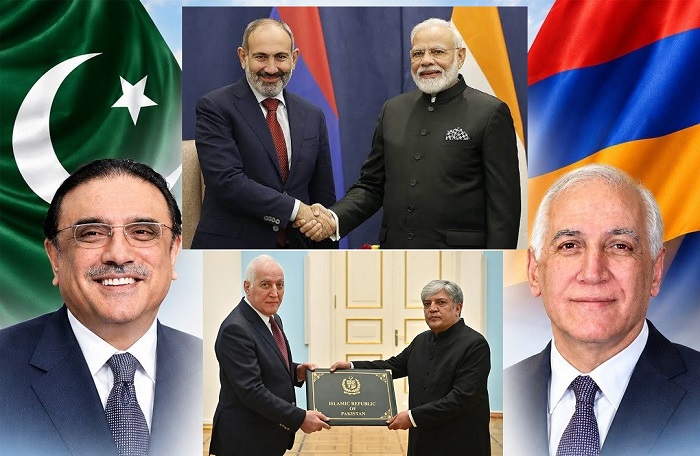
Karen Grigoryan was appointed as its ambassador to Pakistan in July 2026. Pakistan reciprocated with Shafqat Ali Khan as its first ambassador to Armenia on September 11, 2026. Both ambassadors serve concurrently as envoys to the United Arab Emirates. Pakistan has appointed its first-ever ambassador to Armenia, Shafqat Ali Khan, who presented his credentials to Armenian President Vahagn Khachaturyan in Yerevan in September 2026.
During their meeting, President Khachaturyan welcomed Ambassador Khan and conveyed his best wishes for a successful tenure and the effective discharge of his responsibilities.
“The president expressed his readiness to support efforts to further develop Armenia–Pakistan relations and to expand cooperation in areas of mutual interest,” the Pakistani foreign office said on X.
“Ambassador Khan conveyed the greetings and best wishes of the President and Prime Minister of Pakistan to President Khachaturyan and reaffirmed Pakistan’s commitment to strengthening bilateral relations with Armenia.”
The two sides underscored the significant potential for expanding bilateral engagement, particularly in trade and investment, education, culture, people-to-people contacts, and other areas of economic cooperation.
Ambassador Khan called on Armenian Foreign Minister Ararat Mirzoyan. The two sides reviewed the bilateral agenda, discussed avenues for expanding cooperation, and exchanged views on regional and international developments, according to the Pakistani foreign office. Khan also met Deputy Minister of Foreign Affairs Mnatsakan Safaryan and handed over a copy of his Letters of Credence. Safaryan noted that the establishment of diplomatic relations between Pakistan and Armenia represented an important policy decision by the leadership of the two countries.
Khan’s engagements in Yerevan reaffirmed the commitment of Pakistan and Armenia to advancing bilateral relations and provided an opportunity to identify new avenues for cooperation across a broad range of mutually beneficial areas.
President Pakistan , on 20 Sep , extended warm felicitations to the government and the people of Armenia on the occasion of the 35th Independence Day of the Republic of Armenia. In his message to President of Armenia Vahagn Khachaturyan, the President said Pakistan and Armenia have entered a new chapter in their bilateral relations.
Same day, 20 Sep, Azerbaijan was marking the Day of Symbol of Azerbaijan’s Sovereignty and Territorial Integrity . Despite the 2020 victory, remnants of Armenian armed forces remained in the Karabakh economic region, posing a threat to peace and constitutional order. To prevent further large-scale provocations and to restore constitutional order, the Azerbaijani Army conducted a local anti-terror operation on September 19, 2023. The operation lasted just 23 hours and concluded on September 20.
Armenia India Defense Partners
India has emerged as Armenia’s largest defense supplier, with bilateral military-technical cooperation exceeding $2 billion since 2020. Armenia has shifted away from its traditional reliance on Russian military hardware, procuring advanced indigenous systems from India.
This partnership not only enhances Armenia’s defense capabilities but also allows India to expand its influence in the South Caucasus, where it faces opposition from Turkish and Pakistani alliances that support Azerbaijan.
Armenia Foreign Ministry states in the section of relations with India , ” Armenia attaches great importance to the strengthening of friendly and mutually beneficial ties and the establishment of а new partnership with the Republic of India.
Diplomatic relations between Armenia and India were established on August 31, 1992. The high level visits of Military commanders, Foreign Ministers, Presidents of Armenia to India started in 1995. The number is 19.
From India, Chief of Defence Staff General Anil Chauhan visited Armenia in February 2026. Minister of External Affairs Subrahmanyam Jaishankar visited Armenia in Oct 2021. Vice-President and Speaker of the upper house of the Parliament M.Hamid Ansari in 2017 , Vice-President and Speaker of the upper house of the Parliament Bhairon Singh Sekhawat visited in 2005.
Both sides have 16 Agreements, 10 Protocols, 26 MoUs signed and 06 programs are going on between two countries since the inception of relations that reflect the deep rooted bilateral cooperation in all spheres including defense, security and trade.
Air Defense: Akash-1S and Akash air defense missile systems.
Artillery & Rockets: Pinaka multi-barrel rocket launchers (including guided variants), Swathi weapon-locating radars, ATAGS, and 155mm howitzers.
Other Hardware: Anti-drone systems, Konkurs anti-tank guided missiles, mortars, and small arms.
Future Prospects: Discussions are ongoing for prospective acquisitions such as Pralay tactical ballistic missiles, Astra air-to-air missiles, and upgrades to Armenia’s Su-30SM fighter jet fleet.
Why Armenia is Getting Diplomatic Concessions from Pakistan ? Again and Again ? by Tazeen Akhtar
Strategic & Industrial Expansion, Co-Production and MoUs:
The partnership has evolved from a buyer-seller model into joint research, technology cooperation, and local manufacturing. An Economic Times report highlights that India and Armenia signed a formal (MoU) on August 17, 2026, focused on innovation and shared production in the defense industry.
Institutional Ties: High-level diplomatic and military exchanges—such as Indian Defence Secretary Rajesh Kumar Singh’s August 2026 visit to Yerevan—have institutionalized security cooperation and military-to-military frameworks.
Geopolitical Context : This defense alignment helps Armenia diversify its foreign partnerships amidst regional tensions in the South Caucasus. For India, it serves as a vital anchor for its expanding defense export strategy and aligns with broader connectivity initiatives like the International North-South Transport Corridor (INSTC).
Experts opine that India’s involvement in Armenia goes beyond defense; it is part of a broader regional strategy. By deepening relations with Armenia, India strengthens its position as a major player across Eurasia and emphasizes the importance of the International North-South Transport Corridor, which aims to connect India with Europe through Armenia and Iran.
Moreover, India’s support for Armenia’s latest “Crossroads for Peace” initiative—a regional transport proposal that aims to connect Armenia with its neighbors—would be beneficial for regional development and could potentially offer India new business and trade opportunities.
Azerbaijan India Relations
Both nations established diplomatic relations in February 1992, sharing long-standing civilizational and cultural connections. They are working to reset diplomatic and economic ties following recent geopolitical tensions, especially because India always supported Armenia. Both are illegal occupants that bring them near and make them dear to each other. Armenia kept in occupation the Karabakh region while India is still occupant on Jammu Kashmir.
Relations faced friction following Azerbaijan’s official statements supporting Pakistan during Operation Sindoor and opposing India’s security positions. Tensions also arose over multilateral alignment, including Azerbaijan accusing India of blocking its bid for Shanghai Cooperation Organisation (SCO) membership.
High-level talks resumed in Baku (led by India’s Secretary West Cibi George and Azerbaijan’s Foreign Minister Jeyhun Bayramov) to re-engage on trade, regional security, and regularize foreign office consultations.
Bilateral Trade : Trade remains robust, anchored largely by Azerbaijani crude oil exports to India, alongside Indian exports of pharmaceuticals, rice, and machinery.
India’s ONGC Videsh Ltd (OVL) holds minority stakes in Azerbaijan’s major Azeri-Chirag-Gunashli (ACG) oil fields and the Baku-Tbilisi-Ceyhan (BTC) pipeline.
Geopolitical Factors
The Armenia Factor : A major strategic complication is India’s expanding defense partnership with Armenia (supplying radar and tactical systems), which Baku views critically due to the ongoing Armenia-Azerbaijan conflict.
The “Three Brothers” Alignment : Azerbaijan maintains a deep strategic alliance with Pakistan and Turkey, often contrasting with India’s regional interests.
Tourism and People-to-People Ties : India has grown into a leading source of inbound tourism for Azerbaijan outside of its immediate neighbors, supported by direct flight connectivity connecting Baku with Delhi and Mumbai.
What Armenia Gained – What Azerbaijan Achieved ?
Armenian Land Mines
Azerbaijan estimates that 1.5 million landmines and unexploded ordnance contaminate about 12% of its territory in Karabakh and surrounding districts, left largely from decades of conflict and occupation. According to Baku’s updates following the Second Karabakh War in late 2020, dozens of additional military personnel and civilians have been killed in explosions as reconstruction and resettlement efforts began.
The United Nations Development Programme (UNDP) reported a baseline of 123 people killed and over 300 injured in the region following the 1994 truce up to the mid-2000s, though total contamination and casualty figures have scaled significantly higher with the intensive flare-ups and subsequent territory transfers. Armenia has not shared the maps or any information about the mines with Azerbaijan.
Karabakh in Armenian Constitution
The Preamble states that 1990 Declaration of Independence explicitly references a December 1, 1989, joint decision by the Supreme Council of the Armenian SSR and the National Council of Nagorno-Karabakh concerning the reunification of Armenia and Nagorno-Karabakh (Miatsum).
Baku argues that this indirect genealogical link via the Declaration of Independence constitutes an active territorial claim on Azerbaijani land. President Ilham Aliyev made removing this reference a strict precondition for signing a formal peace treaty.
Prime Minister Nicol Pashinyan ordered a Council of Constitutional Reforms to draft a new constitution to eliminate or alter these historical references to pave the way for a lasting peace deal with Azerbaijan but it is still pending.
Access to Nakhchivan
The Trump Route for International Peace and Prosperity (TRIPP) is a U.S.-brokered transit project designed to connect mainland Azerbaijan to its exclave of Nakhchivan through Armenia’s southern Syunik (Zangezur) province. If built it will establishe a roughly 32-to-43-kilometer highway and railway corridor across Armenian territory to link Azerbaijan directly to Nakhchivan and onward to Turkey.
U.S. and Armenian officials have emphasized that Armenia will maintain complete territorial sovereignty, border security, and customs oversight, potentially utilizing third-party operators for day-to-day transit logistics. It bypasses traditional routes through Georgia, offering a faster trade link from the Caspian Sea toward Turkey and Europe, as part of the broader “Middle Corridor”
It is strongly opposed or viewed with high suspicion by neighboring Iran and Russia, as it alters regional transit monopolies and places an American-backed corridor directly near sensitive borders.
SCO Membership
Azerbaijan currently holds the status of an SCO Partner (formerly a Dialogue Partner) in the Shanghai Cooperation Organization, while its bid for full membership remains blocked. India has repeatedly blocked Azerbaijan’s full membership bid.
This blockage is widely attributed to geopolitical friction over Azerbaijan’s close strategic, military, and political alliance with Pakistan, as well as Baku’s public support for Islamabad.
Pakistan has reciprocated by opposing Armenia’s separate candidature or moves for elevation within the bloc from dialogue partner to full member but how long Pakistan can oppose it after establishing ties and seeking close cooperation as mentioned by the President of Pakistan?
Central Asia + India and Azerbaijan
Central Asia is keen to develop cooperation with India. Prime Minister Modi visited Uzbekistan enroute Kygyz Republic for SCO Summit this month. Modi has initiated India Central Asia Summit held virtually on January 27, 2022 attended by the leaders of Kazakhstan, the Kyrgyz Republic, Tajikistan, Turkmenistan, and Uzbekistan. Next is in India next year.
The sides cooperate closely on counter-terrorism, intelligence sharing, and regional stability, particularly regarding Afghanistan via platforms like the Shanghai Cooperation Organisation (SCO) and the India-Central Asia Dialogue.
Central Asia has included Azerbaijan in their shared development agenda and joint ventures to exploit the full potential they possess separately. This phenomenon pushes Azerbaijan towards India in conformity.
Every country is independent to establish ties with any country but here the relations of Azerbaijan with Pakistan and India will remain inversely proportional. Now it is a test of Azerbaijani diplomacy as how they maintain the warmth with Pakistan and welcome India to the community.