 The article has been compiled by Tazeen Akhtar , Editor Pakistan in the World Media Group from various concerned sources and statements from the officials
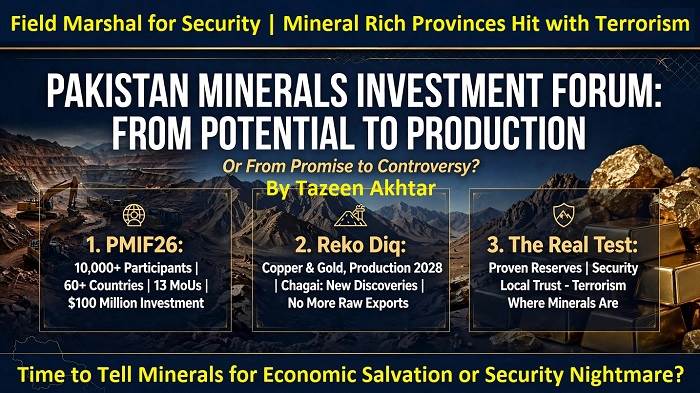
 For two days this week, Islamabad became the centre of the global mining world as Pakistan Minerals Investment Forum 2026 (PMIF26) – 12-13 November drew more than 10,000 participants from over 60 countries, 122 exhibitors, and mining giants like Barrick, Ivanhoe Mines, and Ivanhoe Atlantic.It closed with 13 agreements and MoUs, a $100 million investment announcement, new discoveries in Chagai, and a clear message from top civil and military leadership:
No more raw exports. Build the value chain at home.But the same forum also exposed the central controversy of Pakistan’s mineral story: The richest minerals are in the most insecure places – Balochistan and Khyber Pakhtunkhwa – where terrorism, separatism and illegal mining are also concentrated. Is the mineral boom a path to freedom from IMF loans, or a new trigger for conflict over who owns the wealth?
Key outcomes:
1- 13 agreements / MoUs signed on the closing dayIvanhoe Atlantic – Mari Energies: Joint venture for exploration of copper and gold in Chagai, Balochistan.
2- Two MoUs with Ivanhoe Atlantic, a US firm with modern technology to unearth minerals.
3- MTA International Company and Pakistan Mineral Development Corporation (PMDC): Joint venture for exploration of antimony, copper, gold
4- National Resources Limited (NRL): $100 million investment in the mineral sector, and first gold and copper reserves in Chagai with potential of about 1 billion tonnes
5- Frontier Works Organization (FWO): Estimated 350 million tonnes of copper in Dasht-e-Kain area of Chagai, based on roughly half of its drilling data analysed so far
Mari Energies: New porphyry copper discovery at East Siah Diq, about 50 km east of Reko Diq, after 25,000 metres of drilling – not yet a formally established mineral resource
National Minerals Data Centre and Geological Survey of Pakistan GeoPortal ; inaugurated by PM Sharif and Field Marshal Munir – digital platforms to widen access to geological data and reduce uncertainty for investors
Conference sessions covered AI-assisted exploration, infrastructure security, environmental standards, financing for early-stage exploration, mining workforce and women’s participation.The next forum was invited for November 2027.
Prime Minister Shehbaz Sharif
PM Sharif gave the policy speech on the closing day, and repeated his 2025 promise with even stronger language.On the vision:”Your safety is our safety.”Pakistan could become the world’s sixth-largest economy “earlier than 2050”.He also specifically lauded Mark Bristow, CEO of Barrick Gold, for his commitment to the Reko Diq project.
On no more raw exports: He renewed a commitment he made at last year’s forum to end the practice of shipping Pakistan’s minerals out of the country in raw form, saying, “That day is not far away when this will come to a grinding halt.”Investors should shift their focus from exporting raw minerals to developing domestic processing and refining facilities, assuring them of full government support.
On Reko Diq: Production of copper and gold at Reko Diq on the Tethyan copper belt was expected to commence in 2028 after having stalled for about two decades.
On debt and IMF: In 2025, he had said it even more bluntly: Pakistan is blessed with immense natural wealth of worth trillions of dollars. Harnessing these great assets would help Pakistan get rid of loans and bid farewell to the IMF.
Field Marshal Asim Munir
He addressed both PMIF25 and PMIF26 in 2026. His message has evolved from security assurance to full value-chain vision. He predicted Pakistan could mint at least $2 billion annually from Reko Diq from next year, with profits likely to increase year after year.
Pakistan’s ambition extends beyond exporting raw minerals to developing the complete value chain domestically, including refining and manufacturing. All possible measures were being taken to ensure the security of the entire mining sector, including mines, workers, investments, industries and associated projects.
Communities in mineral-rich regions must directly benefit from mining projects. He called for long-term partnerships that deliver sustainable returns for Pakistan and international investors.Harnessing Pakistan’s mineral wealth was a collective national objective.
What Minerals and Rare Earths Does Pakistan Actually Have?
Pakistan sits at the convergence of the Indian, Eurasian and Arabian tectonic plates. The Geological Survey of Pakistan says the country has 92 known minerals, 52 already exploited commercially, yet mining contributes only 3.2% to GDP and less than 0.1% to global mineral exports.
The headline numbers – handle with care: Government officials frequently cite $6 trillion to $8 trillion in untapped mineral wealth. Independent analysts warn this is speculative – a theoretical in-ground valuation of unverified occurrences, not proven reserves.
Pakistan has no JORC or NI 43-101-compliant resource data for most deposits. Realistic recoverable wealth over several decades is put at $100 billion to $300 billion by credible analysts, with Reko Diq alone worth $60-74 billion.
Balochistan – 80% of Pakistan’s mineral wealth:
Reko Diq, Chagai: One of the world’s largest undeveloped copper-gold deposits. 5.9 billion tonnes of ore, 13 million tonnes copper, 17 million ounces gold. Projected $53-74 billion revenue over 37 years. Barrick Gold 50%, Balochistan Govt 25%, Federal SOEs 25%. Production expected 2028. US EXIM Bank approved $1.25 billion financing in Dec 2025.
Saindak: Copper, gold, silver – 15,800-20,000 tonnes copper, 1.5 tonnes gold, 2.8 tonnes silver annually. Operated by Metallurgical Corporation of China. Chagai Arc: Copper, gold, uranium, lithium, REE prospects – bastnäsite and monazite, with light REEs: Cerium, Lanthanum, Neodymium, plus trace
Thorium and UraniumMuslim Bagh and Khuzdar : Ophiolite-rich terrain, believed to harbour heavy REEs: Dysprosium, Terbium, Yttrium – in intense international demand for EVs, wind turbines, defenceMakran Coast: Monazite-bearing heavy mineral sandsAntimony, Tungsten, Chromite, Barite, Lead, Zinc, Gypsum, Coal
Khyber Pakhtunkhwa:Swat-Dir belt:
Cerium, Neodymium, Praseodymium, Samarium – REE-bearing granites in Dir, Swat, KohistanChitral, Malakand: Tantalum, Niobium, Lithium, precious stones, copper, antimony, gemstonesKohat: Placer gold – see controversy belowMardan, Attock, Tarbela: Gold mining blocks
Gilgit-Baltistan:Skardu, Astore, Gilgit:
REE-bearing minerals – bastnäsite, monazite, lithium-bearing pegmatites, aquamarine, tourmaline, topaz, copper, gold, uranium traces
Punjab:Chiniot, Kalabagh:
500 million tonnes high-grade iron oreSalt Range: Rock salt – Himalayan pink salt, one of world’s largest reserves, plus REE occurrences
Sindh:Thar:
Coal fields with trace REEs in fly ash, mineral sandsCoastal placer sands: MonaziteAzad Jammu and Kashmir:Gemstones, copper, gold
Rare Earth Elements – The 17:
Neodymium, Praseodymium, Dysprosium, Terbium, Yttrium, Cerium, Lanthanum, Samarium, plus Scandium and others. They are essential for EV motors, wind turbines, semiconductors, fibre-optic networks, satellites, robotics, precision-guided munitions. Balochistan alone is said to hold 12 of the 17 REEs. But Pakistan has no commercial REE mining or refining yet. Geological surveys remain incomplete – over 95% of terrain lacks detailed mapping.
First steps to market:2 Oct 2025: First shipment of enriched REEs and critical minerals to US Strategic Metals (USSM) in Missouri – antimony, copper concentrate, Neodymium, Praseodymium – under $500 million FWO-USSM agreement Feb 2026: US approved $1.3 billion financing for Reko Diq under Project Vault, a $10 billion US initiative to re-engineer global critical mineral supply chains5.
The Controversy: Terrorism Is Where the Rare Minerals Are
This is the uncomfortable map that every investor now sees: The richest minerals are in Balochistan and KP – the two provinces with the worst terrorism.In 2024 alone, over 800 people were killed in nearly 500 militant attacks in Balochistan and KP – the very provinces that hold most of Pakistan’s high-value deposits.
Balochistan Liberation Army (BLA), Balochistan Liberation Front (BLF): Separatist militants who view foreign mining as exploitation. They have repeatedly attacked Pakistani security forces, civilians, infrastructure, coal mines, and Chinese projects. On 13 Nov 2026, BLA claimed a suicide vehicle bomb on a Frontier Corps checkpoint in Mastung, underscoring separatist opposition to mineral projects.
Tehreek-e-Taliban Pakistan (TTP): Active in KP, accused of extortion from miners and links to illegal gold mining.
Al-Qaeda in the Subcontinent (AQIS): Warned to exploit propaganda against Pakistan’s mineral deals, especially because they attract Western investment.
Barrick Mining Corporation announced in April 2026 it would slow down development of Reko Diq due to security concerns.
The KP Emergency Controversy:
On 11 October 2026, the federal government imposed emergency and Governor’s Rule in KP, suspending the elected PTI government.
Official reason: terrorism and provincial government’s alleged failure to cooperate in counter-terror operations. Opposition – PTI and JUI-F – says it is a move to bypass the province and capture its minerals. They call it forcible occupation of Pakhtun lands and appropriation of natural resources.
Days before the emergency, US Chargé d’Affaires Natalie Baker publicly backed Pakistan’s mining sector and cited $7 trillion mineral wealth, naming both Balochistan and KP.Days after, Governor Faisal Karim Kundi invited domestic and foreign companies to form joint ventures to extract KP’s minerals.
The Kohat Gold Scandal – The Smoking Gun?
On 11 Nov 2026, 11 policemen, including a DSP, were martyred in a brazen attack in Kohat. Governor Kundi said it was not just terrorism – it was a nexus between TTP and a cartel of illegal gold miners.
His claims, at a press conference on 14 Nov:
3,000 excavators, 1,600 dumpers, 200 heavy loaders operating illegally, 49,000 people working in mining, Rs4.2 billion taken from gold mines every month, about 90 kg gold per month, 80% of money going to Afghanistan, used to finance terrorism against Pakistan, TTP receiving money from gold mining in Kohat, Afghan commanders collecting extortion – a Khwarji commander extracting Rs800,000 from locals and up to Rs4 million from non-local miners, 12 politicians involved, naming Aftab Alam, Sheryar Afridi, Khurram Zeeshan, Amjad Afridi and brother of former CM Sohail Afridi.
In response, KP cancelled all gold mining leases, suspended mining, ordered machinery removed within a week, and announced a judicial commission.
The Baloch Grievance: Baloch leaders, including Mir Yar Baloch, have warned Trump and the US that “Balochistan is not for sale” and that no foreign power would be permitted to exploit its land or minerals “without the explicit consent of the Baloch people.”
Their argument: Balochistan is Pakistan’s largest yet least developed province, ranks lowest in human development, yet hosts the richest minerals. Saindak has exported copper for decades with little local beneficiation. Reko Diq was stalled for years by legal disputes over exploitative contracts and a $6 billion penalty.
The government counters: Reko Diq now gives Balochistan 25% equity, $11 billion fiscal revenues, $6 billion free carry, and jobs. The new policy bans raw exports to force refining at home.
The Geopolitical Game: US vs China
Minerals are now the new oil – and the new Great Game.
China: Controls ∼70% of global rare earth mining and over 90% of processing. Through CPEC, it runs Saindak, and has secured mining contracts in Balochistan. Beijing has imposed export restrictions on 7 categories of rare earth magnets.
US: Wants to diversify away from China. FWO-USSM $500m MoU, US EXIM $1.25bn for Reko Diq, Project Vault $10bn. Washington discussed rare earths with Islamabad at the highest level, including the Munir-Trump lunch in June 2025.
Saudi Arabia, EU, Canada: Also expressed interest at PMIF25 and PMIF26.Pakistan is trying to balance all three – a dangerous but potentially lucrative position. As one analyst put it: “Pakistan fits as a potential upstream supplier, but the term ‘rare earth’ has entered political discourse faster than it has entered bankable reserve statements.”
Conclusion: The Real Test Is Not Geology, It Is Trust
Pakistan does not lack minerals. It lacks three things:
1. Proven reserves: $6-8 trillion is a headline, not a bankable number. Without JORC-compliant data, investors will discount it.
2. Security: No mine can operate if workers are killed, convoys are attacked, and illegal miners fund terrorists. The Kohat scandal shows that illegal mining is not just theft – it is a financing channel for terrorism.
3. Local trust: If Balochistan and KP see minerals as “Islamabad selling our wealth to foreigners” – as the opposition alleges about KP emergency – the insurgency will grow.
If they see first right to wealth, jobs, refining at home, and development spending – as the government promises – minerals could become a peace dividend.
PM Sharif and Field Marshal Munir have set the direction: from potential to production, from raw exports to value-added growth, from promises to action.The next 2 years – Reko Diq production in 2028, Chagai discoveries, US and Saudi deals – will tell whether Pakistan’s mineral treasure becomes its economic salvation, or its next security nightmare.