 Qaiser Nawab, Chairman BRISD
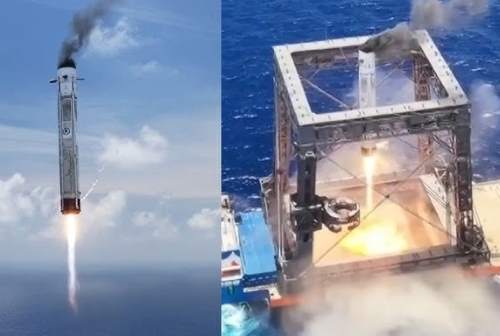
 On July 10, off the coast of Hainan, a Long March-10B rocket lifted away from the Wenchang launch site, dropped its first stage roughly six minutes into flight, and watched it fall back through the atmosphere toward a waiting ship. Instead of unfolding legs and settling onto a floating pad like SpaceX’s Falcon 9, the Chinese booster was caught in a giant net strung across a frame on the deck of a recovery vessel. It worked.
China’s state broadcaster called it a breakthrough. Foreign outlets, more cautiously, described it accurately: the first time any country has recovered an orbital-class booster using a net at sea, and only the second time any country has recovered one at all.
It is worth sitting with that sentence before reaching for dramatic labels, because both the achievement and its limits deserve clear-eyed assessment.
The engineering is genuinely impressive. The Long March-10B is a two-stage, five-metre-diameter vehicle powered by seven kerosene-burning engines on the first stage and a methane engine on the upper stage. Successfully guiding a spent booster back from space and catching it on a moving ship required precise control, high-altitude engine restarts, and reliable sensors working under extreme conditions.
The rocket is designed to carry about 16 tonnes to low-Earth orbit in reusable mode, putting it in the same broad class as the Falcon 9. Chinese engineers say they plan to fly the same booster again before the end of 2026.
A state effort and a private one, moving in parallel
What makes this test more significant is the broader context. The Long March-10B comes from the state-owned China Aerospace Science and Technology Corporation. Yet a newer commercial player, LandSpace, is pursuing the same goal with its Zhuque-3 rocket. In December 2025, LandSpace achieved orbit with its second stage even though its booster recovery failed. Both organisations are now closing in on operational reusability, suggesting this is not a one-off stunt but part of a deliberate national push.
Beijing has made reusability a priority in its space plans. Large satellite constellations planned for low orbit simply do not make economic sense if each rocket can be used only once. Reusability is therefore not a vanity project — it is becoming a practical necessity for China’s ambitions in space-based communications and Earth observation.
Why this matters beyond China’s launch pads
For Pakistan and the wider region, the implications go beyond headlines. Cheaper and more frequent launches could strengthen China’s satellite programmes, potentially offering more competitive options for connectivity in remote and underserved areas. While geopolitical realities and export controls mean Chinese and American systems largely serve different customer sets today, increased competition in the long run could benefit governments and users seeking affordable satellite services.
There is also a security dimension that cannot be ignored. The technologies involved — precision guidance, propulsion control, and autonomous landing — have both civilian and military applications. Any serious analysis must acknowledge this dual-use reality without turning it into undue alarm.
A breakthrough, but not yet a finished one
Caution remains necessary. Recovering a booster once is a real accomplishment. Recovering it, refurbishing it quickly, and flying it repeatedly at lower cost is a much harder challenge. SpaceX took years to move from its first successful landing in 2015 to routine operations. Even today, its larger Starship programme continues to face difficulties. China’s promised second flight with the recovered booster will be the more important test.
What happened on July 10 was a genuine technical step forward. A second country has now demonstrated the ability to bring an orbital booster home intact, using an innovative method. It did so through both state and commercial efforts working in parallel. That is worth recognising on its own terms.
The next twelve months — not this week’s applause — will reveal whether this becomes the foundation for a genuinely more affordable and sustainable approach to space access.
Author: Qaiser Nawab is Chairman of the Belt and Road Initiative for Sustainable Development (BRISD), an international platform fostering cooperation and innovation across Asia, Africa, and Latin America. He can be reached at qaisernawab098@gmail.com