Mir Alisher known as Alisher Navoi is a legendary personality of Central Asia. He was a great Uzbek poet, an icon of the Uzbek literature which is called Chaghatai Literature in the subcontinent. He was a philosopher, historian, administrator, play writer, travelogue writer, and a mystic and sufi poet. He is the father of modern Uzbek language and literature.
He is an inspiration for philosophers, historians, linguists, writers and poets of the South Asia and Central Asia. Babur, the founder the Uzbek/Mughal dynasty in sub-continent, introduced Navoi to this region.
Navoi was introduced to subcontinent by Mughal Emperor Babur who was actually founder of the Uzbek dynasty of subcontinent. Babur acknowledged the contribution of Alisher Navoi to the Uzbek language in his autobiographies Baburnama. He stated that the people are following the pronunciation of the language as written by Alisher Navoi. Babur was influenced by Navai and mentioned him in his autobiography a few times.
He was born in Herat. He went to Samarkand and stayed there for few years under the patronage Ahmad haji Beg. Navoi brought a revolution into the Turkic languages by creating literature in Turkic languages. He has written six masnavis.
Among these, five have been written in imitation of Khamsa. The sixth one is called Lissan al-tayr, which has been written in the meter of Mantiq al-tayr. Khamsas are actually a collection of five dastans (epic poem) which he wrote during the period 1483-85.
These dastans are: Hairat ul-Abrar, Farhad wa Shirin, Laila wa Majnun, Sab`ai Sayyar, Sad-i- Iskandari. He also completed four diwans of ghazals. Under his pen name “Fani” he also wrote in Persian. Similarly he wrote in Arabic as well. His well known poetry are found in his four divans which consist of approximately 50,000 couplets.
In each part of these works he has described different periods of life of a person. These periods have been termed as: Ghara’ib al-Sighar (Wonders of Childhood), Nawadir al-Shabab (Witticisms of Youth), Bada’i’ al-Wasat (Marvels of Middle Age), Fawi’id al-Kibar (Advantages of Old Age).
His other important works include: Muhakamat al-Lughatain, Waqfiya, Lisan at-Tair (The Language of the Birds), Majalis un-Nafais, Mahbub ul-Quloob, Mezan ul-Awzan, Minhaj un-Najat (The ways of salvation), Munajat, Munshaot (A Collection of Letters), Mufradat, Nazm ul-Javahir, sim ul-Huld, Risalai tiyr andokhtan, Ruh ul-Quds (Holy Spirit), Siraj ul-Muslimin, Tarikh-i-muluki Ajam, Tuhfat ul-Afkar, Fasali arba`a (Four seasons), Hazain ul-Maaniy,
Influences of Alisher Navoi on Urdu Literature
For strengthening cultural relations and people to people contact, it is necessary to introduce Navoi’s works Pakisrani literary circles. Navoi’s ghazal style and his style of play writing should be introduced to literary circles in Pakistan through Literary organizations. We find impact of his writing style on some story tellers, play writers and poets of Urdu language. In the development of ghazal, in the sub-continent, he contributed much.
Ghazal developed in sub-continent under Mughals’ influence and particularly through Sufi mystics. Syed Sajjad Haider Yaldram, an Urdu writer, followed the technique of travelogue writing of Alisher Navoi. Some play writers in Urdu also followed Navai’s style. Some scholars say scene writing wtyle in Urdu dramas like Anarkali and Rustom wa Sohrab is influenced by the style of Alisher Navoi.
Alisher Navoi Research Corner
Pakistan and Uzbekistan have mutual diplomatic relations since the independence of Uzbekistan in 1991. Language, literature and culture of Uzbekistan have been studied in Area Study Centre (Russia, China and Central Asia) University of Peshawar since its inception in 1975. Recently another development occurred in strengthening the bilateral relations between Pakistan and Uzbekistan.
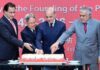
H.E. Lt. Col. Sadulla Tashmatov, the Head of Mission of the Republic of Uzbekistan, inaugurated Alisher Navoi Research Corner at Area Study Centre (Russia, China and Central Asia) University of Peshawar, on 18th September 2020. On this occasion he also gifted five volumes of the new Uzbek Dictionary and ten volumes of poetical works of Alisher Navoiy to the newly established Research Corner. An interactive session on Pak-Uzbek bilateral relations was also held on this occasion.
On 18th November 2020, H.E. Sadulla Tashmatov, Charge de Affairs Embassy of Uzbekistan Islamabad again visited Alisher Navoi Research Corner at Area Study Centre, University of Peshawar.
He promised that very soon more relevant materials will be provided to the said research corner. On this occasion, he also spoke at a round table discussion on Uzbekistan-Pakistan Joint Collaboration for Peace and Stability in Afghanistan.
This discussion was organized by Area Study Centre, University of Peshawar. A bilateral mechanism for quick liaison between the two countries was also discussed by the Director, Area Study Centre, University of Peshawar. Importance of Cultural integration between Pakistan, Uzbekistan and Afghanistan was discussed and considered significant for peace and stability in Afghanistan.
Establishing the Research Corners like Alisher Navoi’s Research Corner at Area Study Centre can bring these regional states closer to each other.
Alisher Navoi’s research corner has started working on cultural, literary and linguistic relations between these states. It is important to translate the literary works of Alisher Navoi into Urdu and Pashto and Allama Iqbal and Khushal Khan Khattak’s works into Uzbek language so that people of these three countries may know each other literary figures and cultures.
Dr. Muhammad Ali Dinakhel is Lecturer Area Study Centre (Russia, China & Central Asia)
University of Peshawar Email: aliasc@gmail.com

 Dr. Muhammad Ali Dinakhel