 World Journalism Monitoring Desk Islamabad
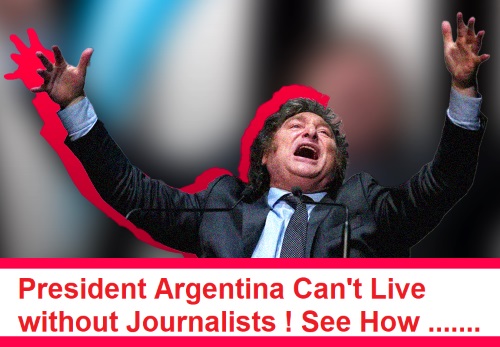
Reporters Without Borders (RSF) analysed Argentine president Javier Milei’s activity on the social media platform X over a six-and-a-half week period and documented 1,674 posts hostile to the press in 47 days — an average of over 35 posts per day. The Argentine head of state’s aggressive messaging portrays journalists as “mercenaries” paid to bring down his government, and he accuses news professionals of corruption, lying and political activism. RSF condemns this systematic campaign of discrediting and denigrating news professionals.
RSF analysed Javier Milei’s X account between April and May 2026 and found that in 47 days, Argentina’s head of state posted 1,674 posts attacking journalists and the media, including reposts — which is more than what Elon Musk posts against the press in a year. These staggering figures illustrate the extent of the Argentine president’s fixation with journalists, whom he regularly insults by calling them “basuras inmundas,” or “disgusting trash.”
Accusing journalists of corruption
The most prominent category of Javier Milei’s attacks on the press is accusations and insinuations that journalists are corrupt, showing up in 498 out of the 1,674 hateful posts . The Argentine president, who figures on RSF’s list of press freedom predators, claims his administration has “eliminated” government advertising and, because of this, journalists bribed by regional governments and private companies have sought revenge by spreading false information about him.
These corruption allegations are the crux of his argument: for years, the media supposedly lived on an infusion of public money. Deprived of revenue from pauta oficial (state advertising) under the Argentine president’s policy, he claims journalists are seeking vengeance by conspiring against the government in power and carrying out “operations” to destabilise it — in other words, disinformation campaigns — to the benefit of his political opponents.
He has repeatedly reposted messages spelling out this logic, including posts describing private media outlets as “beggars,” and claiming that journalists are “ensobrados” (literally, “put in an envelope,” like cash in a bribe), who are “blatantly working against his government because it withdrew their advertising.”
Beyond the fact that this aggressive anti-press discourse clouds public debate, the core of his argument is unfounded. While the use of government advertising has been the subject of legitimate controversy in Argentina, there is no basis for the claim that journalists have been corrupted by this funding, or that critical coverage of Javier Milei is a consequence of its withdrawal.
All journalists considered political opponents
But for Javier Milei, almost all Argentine journalists are adversaries. He even has a statistic of his own, seemingly plucked out of thin air: 95% of those who practice journalism in Argentina are “lying trash,” “a bunch of criminals” whose job is to “lie with impunity” and “corrupt people hooked on pauta and bribes.” This number has become a recurring hallmark of the Argentine president’s posts.
Javier Milei’s rhetoric equates challenging government decisions with fighting against “ideas of freedom” and defending the “caste.” This discourse erases the line between political opposition and journalism that holds power to account. He often uses the pejorative term kuka — a contraction combining the “K” of former presidents Néstor and Cristina Kirchner with cucaracha (“cockroach”) that originally referred to Kirchnerist activists — to describe journalists critical of his administration, likening journalistic criticism to a form of political opposition.
A lose-lose situation for news professionals
The Argentine president seeks to do more than merely discredit journalists. He fosters a circular rhetoric in which journalism is the enemy in every case. In a rare, lengthy post published on 4 May, he stated his vision: “In a truly free market, society itself would take care of cleaning up the system by sending into bankruptcy the media outlets that constantly publish falsehoods, smear campaigns and insults […] As long as the majority of media outlets continue to live off advertising from some subnational government — since we have eliminated advertising — the market’s corrective mechanisms don’t work, because these outlets are artificially supported in the service of the interests of one politician or another.”
The profit-seeking mentality that Javier Milei attributes to the Argentine press is not just due to a dependence on public funds, but an alleged greed for money in general. He has said so bluntly, stating that if the media attack him, it is because it “pays more money.” There is, therefore, no way for the media to win the president’s approval. Either journalists sell themselves to local or regional government advertising — including advertising from the province of Buenos Aires, governed by his Peronist rival Axel Kicillof (“No one says anything bad about Kicillof because he puts money into all the media,” claimed one post Javier Meili shared) — or the media criticise him to inflate their revenues.
Reposter-in-chief
Javier Milei rarely published X posts in his own name: of the 1,674 hostile X posts identified by RSF, 1,499 — 89% — are reposts. RSF also counted 151 quoted posts, in which he added a brief comment to someone else’s tweet. Only 21 tweets, barely 1.2%, were written by him alone.
Sometimes, the Argentine president shares them twice. First as a simple repost, then as a quoted post featuring his favorite slogan, “No odiamos lo suficiente a los periodistas,” or “we don’t hate journalists enough.” It is sometimes abbreviated as NOLSALP, often written with a dollar sign (NOL$ALP) to evoke the idea of corruption. The slogan has become his stamp for endorsing hateful attacks and fuels a system that incentivises attacks on press.
This stamp is also applied to defenders of the press.
MEXICO MEDIA MURDERS | 2026 The Worst Year | 08 Killed for their Press Work including a Woman
The Argentine journalists’ rights organisation Foro de Periodismo Argentino (FOPEA) was targeted by a NOL$ALP post after publishing a report on attacks against press freedom in the country. As was RSF, on 1 May, when Javier Milei added the same NOL$ALP to an X post challenging Argentina’s decline in RSF’s 2026 World Press Freedom Index. Argentina ranks 98th in the Index, eleven places lower than in 2025 and 69 places lower than in 2022, notably as a result of policies pursued by President Milei.
Only cries foul when its against his own side
The presidential narrative leverages every incident involving the press as an opportunity to attack the profession as a whole. This is illustrated by the peaks in activity on Javier Meili’s account. From 3 to 5 April, the “Russian plot” affair — allegations that Russian funds were financing publications by Argentine media outlets that were hostile to the government — sparked intense controversy. The president leveraged the affair to portray journalists as enemies, passing judgment on the press as a whole and branding journalists as “corrupt and traitors to the nation.”
On 20 April, a team from the news channel TN secretly filmed common areas of the presidential palace, Casa Rosada. The Casa Militar — the department responsible for the security and assistance of the Argentine president — filed a complaint against the two journalists involved. Javier Milei called them “basuras repugnantes” (“disgusting trash”), and his supporters accused them of espionage. Three days later, all accredited journalists were barred from entering the presidential palace.
When the press investigates the president’s administration and allies, he bares his claws. When his chief of staff, Manuel Adorni, came under investigation over alleged illicit enrichment, Javier Milei denounced a lynching from the media, posting “I will not execute an honest person on the altar of journalists’ egos.” When reporters asked him whether his chief of staff is corrupt, he replied, “You are the corrupt ones.” In June 2026, Manuel Adorni acknowledged he omitted roughly $500,000 from his asset declarations before resigning on 27 June.
Thibaut Bruttin, RSF Director General, says ;
When the president of a republic uses his X account to continually attack, insult, denigrate and portray the press as an enemy of the state, they are using their political authority to undermine a pillar of democracy. The barrages of insults the president directs at journalists are unacceptable and reveal a profound contempt for democracy. Using the presidency’s communication channels to systematically attack journalists amounts to attacking Argentines’ right to information instead of protecting it.
A head of state can challenge an article, request a correction, exercise a right of reply or, better still, use their powers to pursue ambitious public policies in support of the sustainability of the media. There is no shortage of areas for action, but Javier Milei has chosen to descend further into verbal violence, insults and disinformation. This is unbecoming of a leading political figure.