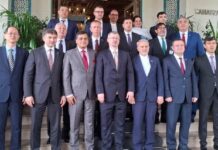
Islamabad, November 14, 2024: The Higher Education Commission (HEC) Pakistan and the British Council jointly organized the launch ceremony of the Phase-II of Pak UK Education Gateway at the HEC Secretariat on Thursday.
Federal Minister for Planning, Development and Special Initiatives Mr. Ahsan Iqbal was chief guest on the occasion. The event was also attended by Parliamentary Secretary for Federal Education and Professional Training, Ms. Farah Naz Akbar, Chief Executive of the British Council, Mr. Scott McDonald, UK’s Deputy High Commissioner, Mr. Andrew Dalgleish, Punjab’s Education Minister, Rana Sikandar Hayat, Secretary Ministry of Federal Education and Professional Training, Mr. Mohyuddin Wani, vice chancellors and officials from the British Council and HEC.
The programme aims to strengthen bilateral collaboration between Pakistan and the United Kingdom’s higher education sectors. Building on the achievements of Phase-I, launched in 2018, the second phase is anticipated to further fortify academic connections and joint research initiatives for a lasting educational partnership.
Scheduled to begin in June 2025, Phase-II of Pakistan-UK Education Gateway introduces six key components to support Pakistan’s higher education goals, promote student and faculty mobility, and facilitate joint research efforts with UK institutions. These components include Research for Impact, Transnational Education and Mutual Recognition of Qualifications, Leadership and Governance, Scholarships, Women in Higher Education, and Faculty Development.
Phase-I of the Gateway, valued at approximately PKR 1.97 billion, yielded significant achievements, including funding for eight collaborative research grants, resulting in 27 patents and 47 academic publications. The training of 275 PhD supervisors, leadership development programmes for over 40 vice-chancellors, and 200 academic fellowships were also key highlights of Phase I.
In his remarks, Federal Minister Mr. Ahsan Iqbal acknowledged the British Council’s valuable support in formulating the Quality Assurance Framework for Pakistani universities. He expressed optimism about the continued success of the Pak-UK Education Gateway and emphasised the need for further collaboration between the UK and the Government of Pakistan to raise the country’s tertiary education rate above 13% in the coming years, aiming to match the educational standards of regional competitors.
British Council organizes Pakistan Stories Film Screening as part of Pakistan/UK: New Perspectives
He proposed initiatives such as crash training programmes for faculty, increasing the number of PhDs from UK universities for Pakistani students, and offering postdoctoral opportunities for Pakistani faculty members with PhDs.
The Minister also stressed the importance of investing in quality education, particularly when sending students abroad for higher studies. He urged Vice-Chancellors to reorient research efforts towards benefiting the national economy, addressing industrial needs, providing innovative solutions, and promoting community welfare.
He called for improvements in corporate governance, as well as character and skill development for students, while remaining mindful of the challenges posed by sensational and polarising misinformation in today’s digital age.
In his opening remarks, Chairman HEC Dr. Mukhtar Ahmed highlighted the longstanding collaboration between HEC and the British Council, emphasising the support provided by both the UK and Pakistani governments. He noted that Phase-I represented a unique model of reciprocity and system-to-system support, engaging government departments, universities, faculty, and students from both nations to promote mutual learning and growth.
“Thought Leaders Summit 2020” organized by the British Council Pakistan”
He also mentioned that the project had been instrumental in developing a revised HEC Quality Assurance Framework for 2023, as well as new policies for Open and Distance Learning and Transnational Education, aiming to revolutionise Pakistan’s higher education sector into a forward-looking, globally compatible ecosystem.
Regarding Phase-II, the Chairman expressed optimism that the initiative would reach new heights, focusing on impact, quality, inclusivity, and sustainable growth in higher education, research, and development for both countries. He anticipated that the programme would yield benefits for many years, continuing to add value even after its formal conclusion.
Mr. Scott McDonald, Chief Executive of the British Council, emphasised the mutual respect and trust the British Council has built with HEC over time. He praised the strong political commitment of the Government of Pakistan to the Pakistan-UK Education Gateway, describing it as heart-warming, and extended his appreciation for establishing a framework for collaboration between the UK and Pakistan.
HEC of Pakistan Launched Women Empowerment Mentoring programme (WEMP) for Female Faculty & Employees