 CHASHMA, MIANWALI: December 30, 2024: Minister for Planning, Development, and Special Initiatives Professor Ahsan Iqbal, while terming the Chashma Nuclear Power Project Unit-5 (C-5) a ‘milestone,’ on Monday said it reflected the strength of Pakistan-China cooperation and reaffirmed the commitment of both nations to sustainable development and energy security.
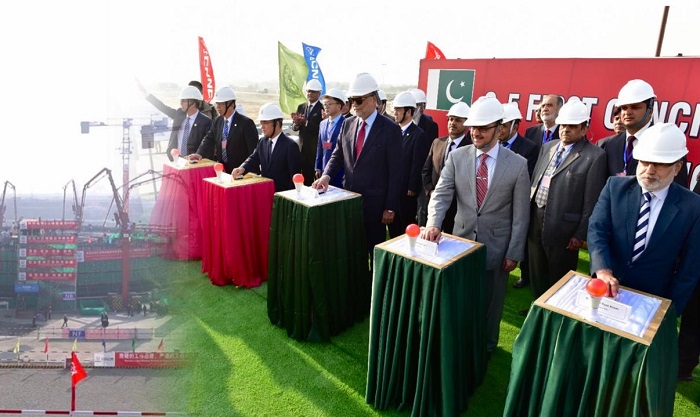
He expressed these views while speaking at the first concrete pouring ceremony of Unit-5 (C-5) as chief guest in Chashma (Mianwali), which was attended by Director General of the Strategic Plans Division Lt Gen. Yusuf Jamal, Ambassador of China to Pakistan Jiang Zaidong, Vice President of CNNC Zhang Kai, federal secretaries and delegates from China.
Pakistan Atomic Energy Commission achieved a major milestone in the construction of Chashma Nuclear Power Plant Unit 5 (C-5). The process started with ground breaking by the Honourable Prime Minister, Mian Muhammad Shehbaz Sharif on 14 Jul 2023, made steady progress and moved on to formal construction phase with start of concrete pouring.
Addition of C-5, the largest and most advanced Nuclear Power Plant in the country will add another 1200 MW of clean and economical energy in the national grid increasing nuclear energy to 4760 MW and boost socio-economic development.
Ahsan Iqbal, recalling his role as the chief guest at the dome placement ceremony of Chashma-4 in January 2014, he said “Witnessing the progress of our nuclear energy program over the years fills me with immense pride and optimism for our nation’s future.”
The minister said nuclear energy played a vital role in Pakistan’s energy mix, offering a clean, reliable, and affordable solution to the country’s energy challenges.
Currently, he said, Pakistan’s nuclear power plants, including the four operational units at Chashma (C-1, C-2, C-3, and C-4) and the two at Karachi, contributed over 3,530 MW to the national grid. “This constitutes a significant share of the country’s clean and green electricity, reducing our reliance on imported fossil fuels and lowering energy costs.”
The minister said the addition of C-5, with a capacity of 1,200 MW, would further enhance the contribution of nuclear energy, solidifying its position as a cornerstone of Pakistan’s energy strategy.
“Nuclear energy is not only cost-effective but also dependable, with plants capable of operating continuously for up to 18 months once refueled. This makes it an ideal base-load option for a sustainable energy future,” he added.
Ahsan Iqbal said the development of mega projects like C-5, with the support of China, reflected the trust and confidence the Chinese leadership has in Pakistan’s economy. “This investment strengthens the energy sector and demonstrates Pakistan’s potential as a reliable partner in large-scale infrastructure and technological projects.”
He said Pakistan was confident that this milestone would open avenues for further investments in critical sectors, including industry, agriculture, infrastructure, and mining, fostering economic growth and creating jobs.
Pakistani Ambassador to China & Minister Planning Discuss CPEC 02
Commenting on the China-Pakistan Economic Corridor (CPEC), the minister termed it a ‘hallmark’ of President Xi Jinping’s visionary Belt and Road Initiative (BRI), which symbolized the shared commitment of Pakistan and China to regional connectivity and sustainable development.
“CPEC is not just a collection of projects; it is a symbol of the unbreakable bond between Pakistan and China, transforming lives and fostering prosperity,” he said, quoting Prime Minister Shehbaz Sharif as saying on the flagship project.
President Xi Jinping, he said, has similarly emphasized that “CPEC is a pioneering initiative that demonstrates how nations can collaborate for mutual benefit, creating a model for international development.”
Ahsan Iqbal said the C-5 was a shining example of this collaboration, addressing Pakistan’s energy needs while advancing the broader goals of CPEC.
The minister viewed that under the 5Es National Economic Transformation Plan, nuclear energy was aligned with Pakistan’s focus on efficient, affordable, and green energy solutions.
“This strategy emphasizes Exports, E-Pakistan, Equity and Empowerment, Environment—Food and Water Security, and Energy and Infrastructure.”
A key objective of this plan, he said, was to transform Pakistan into a techno-economy, driven by innovation and technological excellence.
He said the professionalism and expertise demonstrated by Pakistan’s scientists and engineers in the nuclear sector should serve as a standard for all other industries. “By fostering a culture of innovation and precision, we can ensure that Pakistan remains competitive in the global economy.”
To enhance the country’s export capacity, Ahsan Iqbal stressed the need to explore joint ventures between Pakistan and China for the design, development, and production of nuclear power plants for the international market. “Such collaborations will position Pakistan and China as leaders in global nuclear energy solutions while unlocking new economic opportunities.”
The planning minister said the transition to sustainable energy was critical for Pakistan’s future, and nuclear energy was central to this effort. At the same time, he said, safety remained the top priority, appreciating the Pakistan Nuclear Regulatory Authority (PNRA) for ensuring the safe operation of all nuclear facilities and maintaining compliance with International Atomic Energy Agency (IAEA) standards. “This commitment to safety is fundamental to our nuclear program’s success.”
Dr. Raja Ali Raza Anwar, Chairman Pakistan Atomic Energy Commission highlighted the contributions of Nuclear Power being clean and economical source of energy and stressed its importance for country’s energy security. Pakistan’s journey in the field of Nuclear Power is the high point of Pak-China cooperation which dates back to the decade of 1990s. All the six nuclear power plants currently operating in the country have been constructed with the Chinese assistance.