Demise of Jiang Zemin: A Personal Reflection of an Outstanding Leader

0
887
Dr Mehmood Ul Hassan Khan
Great leaders never die because their holistic and comprehensive people’s friendly policies become immortal. They use to conquer hearts and souls of the people through institutionalization of economic equality, social justice and ethnic harmony and Jiang Zemin is one of them. Jiang Zemin was an outstanding political leader enjoying high prestige acknowledged by the whole Communist Party of China (CPC), the entire military and the Chinese people of all ethnic groups. The demise of former Chinese President Jiang Zemin is indeed a great loss for China, CPC and its people but hopefully his everlasting services and schemes for the nation’s unity, dignity, sovereignty and economic prosperity will be cherished in people’s minds forever.
He was a born communist fighter and an outstanding leader of the great cause of socialism with Chinese characteristics. He was the core of the third generation of the Party’s central collective leadership and the principal founder of the Theory of Three Represents which gradually but surely changed the outlook of China, its economy, politics, society and its people.
He was famous for people’s friendly socio-economic policies and programs and initiated numerous structural reforms for complete economic transformation to achieve the desired goals of socio-economic prosperity, massive industrialization, economic liberalization and opening-up and ultimately China joined World Trade Organization (WTO).
Jiang led the CPC’s central collective leadership by promoting rule of the whole Party, the entire military and the Chinese people of all ethnic groups by protecting and safeguarding the great cause of socialism with Chinese characteristics and successfully advancing the cause of socialism with Chinese characteristics into the 21st century.
He was man of unity of command having unconventional style of leadership in the country. He had ironfisted methods to control any social, political or economic chaos which proved effective to maintain high economic growth during his regime which had been rated as splendid decade of growth (10 percent of GDP). He is now died at the age of 96. He made remarkable achievements and won the heartfelt love of the whole Party, the entire military and the Chinese people of all ethnic groups, as well as the wide acclaim of the international community which is indeed a great achievement.
Simply, he had integrated ironfisted and unconventional ways and means to complete his country’s transformation into a market economy by joining the World Trade Organization. Previously, he was involved in the formulation of economic policies on expanding foreign trade, introducing advanced foreign technologies and equipment, and absorbing and utilizing foreign capital.
He also supervised the implementation of special policies and flexible measures in Guangdong and Fujian provinces and participated in the establishment of special economic zones. He geared up the Chinese economic growth through establishment of many SEZs in the country. Jiang Zemin was Chinese president from 1993 to 2003.
He was appointed general secretary of the Communist Party (CCP) in June 1989, and he worked very hard for the further consolidation of the CPC at the grassroots level. Jiang delivered keynote speech at the 14th CPC National Congress in October 1992 and presented a report titled “Accelerating the Reform, the Opening to the Outside World and the Drive for Modernization, so as to Achieve Greater Successes in Building Socialism with Chinese Characteristics.”
In this connection, he rightly proposed establishing the guiding role of Deng Xiaoping’s theory of building socialism with Chinese characteristics in the Party, and identified establishing a socialist market economy as a goal of China’s economic reforms. He was enlightened by patriotism and the ideas of the democratic revolution in his childhood. He was also deeply influenced by fine traditional Chinese culture.
Prime Minister Shehbaz Sharif expressed condolence on demise of former Chinese president Jiang Zemin. Taking to Twitter, the prime minister wrote: “Late President was a wise leader and a statesman. In Pakistan, we fondly remember him as a great friend who made valuable contributions in strengthening Pakistan-China relations”.
Jiang took power in the aftermath of the Tiananmen Square sponsored chaos and led the world’s most populous nation towards its emergence as a powerhouse on the global stage. His demise is indeed a profound grief not only for China but also for Pakistan.
He was an outstanding leader. He was a great Marxist, a great proletarian revolutionary, statesman, military strategist and diplomat, a long-tested communist fighter, and an outstanding leader of the great cause of socialism with Chinese characteristics. Despite the western false, fake and fictional propaganda he took the right decision during the serious political turmoil in China in the spring and summer of 1989, Comrade Jiang Zemin supported and implemented the correct decision of the Party Central Committee to oppose unrest, defend the socialist state power and safeguard the fundamental interests of the people.
The Chinese flags are flown at half-mast at Chinese government buildings. When Jiang replaced Deng Xiaoping as leader in 1989, China was still in the early stages of economic modernisation. By the time he retired as president in 2003, China was a member of the World Trade Organization, Beijing had secured the 2008 Olympics, and the country was well on its way to superpower status. Jiang, who was president for a decade until 2003 and led the ruling Communist Party for 13 years until 2002, died of leukemia and multiple organ failure in Shanghai.
Jiang was responsible for China “getting onto a global platform and rehabilitating itself after 1989. He will be remembered as someone who made probably a pretty positive contribution. In 13 years as party general secretary, China’s most powerful post, Jiang guided the country’s rise to economic power by welcoming new members into the party and pulling in foreign investment after China joined the WTO. China passed Germany and then Japan to become the second-largest economy after the United States. Jiang was born Aug. 17, 1926, in the affluent eastern city of Yangzhou.
Official biographies downplay his family’s middle-class background, emphasizing instead his uncle and adoptive father, Jiang Shangqing, an early revolutionary who was killed in battle in 1939. After graduating from the electrical machinery department of Jiaotong University in Shanghai in 1947, Jiang advanced through the ranks of state-controlled industries, working in a food factory, then soap-making and China’s biggest automobile plant. Like many technocratic officials, Jiang spent part of the ultra-radical 1966-76 Cultural Revolution as a farm labourer.
His career revived after that and in 1983 he was named minister of the electronics industry, then a key but backward sector the government hoped to revive by inviting foreign investment. As mayor of Shanghai between 1985 and 1989, Jiang impressed foreign visitors as a representative of a new breed of outward-looking Chinese leaders. A tough political fighter, Jiang defied predictions that his stint as leader would be short. He consolidated power by promoting members of his “Shanghai faction” and giving the military double-digit annual percentage increases in spending. During his tenure, Hong Kong was promised autonomy and became a springboard for mainland companies that want to do business abroad.
Moreover, Jiang showcased One China Principle towards Taiwan and termed it part of China. Comrade Jiang Zemin’s death is an incalculable loss to CPC, military and Chinese people of all ethnic groups. The announcement was made by the Central Committee of the Communist Party of China (CPC), the Standing Committee of the National People’s Congress of the People’s Republic of China (PRC), the State Council of the PRC, the National Committee of the Chinese People’s Political Consultative Conference, and the Central Military Commissions of the CPC and the PRC.
The Comrade Jiang Zemin was an outstanding leader enjoying high prestige acknowledged by the whole Party, the entire military and the Chinese people of all ethnic groups, a great Marxist, a great proletarian revolutionary, statesman, military strategist and diplomat, a long-tested communist fighter, and an outstanding leader of the great cause of socialism with Chinese characteristics. He was the core of the CPC’s third generation of central collective leadership and the principal founder of the Theory of Three Represents.
Jiang broke the country out of its subsequent diplomatic isolation, mending fences with the United States and overseeing an unprecedented economic boom. He served as president from 1993 to 2003 but held China’s top job, as head of the ruling Communist Party, from 1989 and handed over that role to Hu in 2002. He only gave up the position as head of the military in 2004, which he also assumed in 1989. Chinese newspapers turned their front pages black on the demise of Jiang Zemin and flags were put at half mast in mourning for the death of former president Jiang Zemin, while well-wishers laid piles of bouquets outside his childhood home.
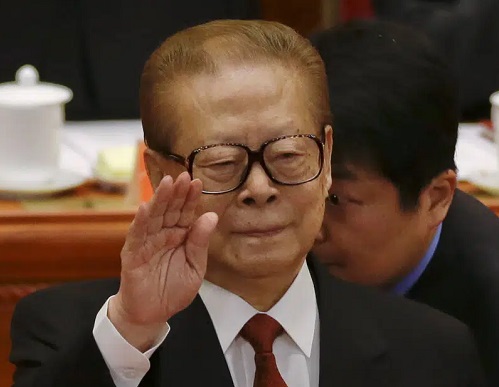
The front page of the ruling Communist Party’s official People’s Daily devoted its whole front page to Jiang, and carried a large picture of him wearing his trademark “toad” glasses. “Beloved comrade Jiang Zemin will never be forgotten,” it said in its headline, above a story republishing the official announcement of his death.
Flags flew at half mast on key government buildings and Chinese embassies abroad, while the home pages of e-commerce platforms Taobao and JD.com also turned black and white. Mourners laid piles of bouquets of white chrysanthemums, a traditional Chinese symbol for mourning, outside Jiang’s childhood home in the eastern city of Yangzhou. Some people knelt down in front of his house in a show of respect, the person added.
In one picture, people held up a black and white banner reading “Comrade Jiang Zemin you will forever live in our hearts”. The U.S. and Japanese governments both expressed their condolences. U.S. National Security Council spokesperson Adrienne Watson said that during his two visits to the United States as president as well as multiple other meetings with U.S. officials, Jiang worked to advance ties “while managing our differences an imperative that continues today”.
To conclude, Jiang Zemin was man of great character, determination and courage. He was man of principle, prosperity and progress. He worked restlessly for building socialism with Chinese characteristics through holistic and comprehensive economic structural reforms, political and cultural development. He was greater reformist who knew the art of creating balancing acts between reform, development and stability, as reform is the impetus, development is the goal and stability is the precondition.
He was champion of building a moderately prosperous society in an all-round way. He delivered a tremendous speech during the 16th CPC National Congress and highlighted various integrated policies to achieve this goal. He was of the opinion that the first two decades of the 21st century, efforts should be concentrated on fully building a moderately prosperous society of a higher standard for the benefit of well over 1 billion people.
Jiang upheld that Chinese economy should be further developed the economy. He emphasized that democracy, science and education, culture, social harmony, and people’s living standards should be achieved through a holistic and comprehensive economic road map. Interestingly he institutionalized positivity, productivity and participatory economic model in the country which ultimately changed the fates of common people.
He pinpointed that entrepreneurs and technicians of private sci-tech enterprises, managerial and technical personnel employed by foreign-funded enterprises, the self-employed, private business owners, employees of intermediaries, freelancers and people from other social strata should be foremost important agent of real change and socio-economic development with Chinese characteristics.
Jiang also proposed the vigorous promotion of knowledge-based innovation, as well as scientific and technological innovation. Jiang stressed the importance of adhering to socialism, and carrying out socialist reform to explore a path of socialist development that suits China’s actual conditions. He was against any borrowed idea of governance and development. He remained staunch supporter of socialist reform to explore a path of socialist development that suits China’s actual conditions.
According to him, China must open up to the outside world, promote economic, scientific, technological and cultural exchanges and cooperation with other countries, and embrace and learn from everything advanced. Thus he started the Chinese journey towards global integration and greater regional connectivity. China’s entry into the World Trade Organization (WTO) proved vital for China’s economic development. He termed that constant structural reforms and opening-up, and the WTO were important for the Chinese robust economic development and social transformation.
Jiang rightly considered that to achieve modernization the policy makers should reply on national economic development with relatively fast growth and relatively good economic results, shifting the economic growth mode from extensive to intensive, and maintaining sustained, rapid and healthy development of the national economy. He proposed a new path to industrialization, driving industrialization with informatization and promoting informatization through industrialization which played an important role in the immense industrial development of the country. He rightly considered that fundamental purpose of economic development should improve the standard and quality of people’s lives.
Jiang was strong supporter of socialist democracy and considered that the unity of the Party’s leadership, the running of the country by the people, and law-based governance should be implemented in its true spirits. Interestingly, Jiang promoted the establishment of the Shanghai Cooperation Organization (SCO) the first regional cooperation organization.
He exerted an important influence on contemporary international relations through his innovative public and state diplomacy. He succeeded to unite the central collective leadership of the CPC in tackling a series of international emergencies concerning China’s sovereignty and security, overcoming difficulties and risks cropping up in the political and economic spheres and those brought by natural disasters, and in particular successfully coping with the impact of the Asian financial crisis and winning a complete victory in the disaster relief efforts during the floods in 1998.
On behalf of the Center for South Asia & International Studies (CSAIS) Islamabad we share our profound grieves on the demise of great leader, innovative reformer, visionary politician, economic guru, unique military strategist, champion of social development, pioneer and staunch supporter of socialist democracy. LONG LIVE JIANG ZEMIN.
The writer is Executive Director: The Center for South Asia & International Studies (CSAIS) Islamabad Regional Expert: China, BRI & CPEC
 

LEAVE A REPLY

Please enter your comment!
Please enter your name here