 Tazeen Akhtar/ Islamabad/Pakistan
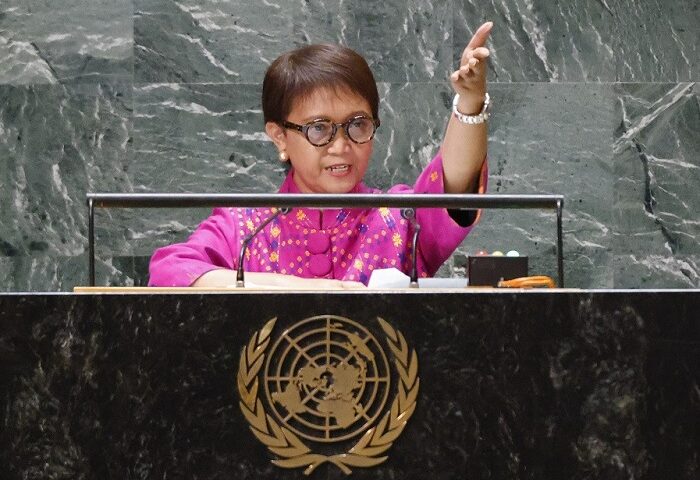
Foreign Minister of the Republic of Indonesia, Ms Retno Lestari Priansari Marsudi gave a wake up call to the members at the General Debate of the 78th Session of the UN General Assembly New York on 23 September 2023 for shared and common values of human rights, UN Charter, Sovereignty, Territorial Integrity, Equality of all races, peaceful settlements of disputes, Promotion of Mutual interests and cooperation. These are the 10 Principles that were set for the world to observe by newly independent states in 1955 in historical Bandung Conference hosted by Indonesia. Thus Indonesia pioneered 7 decades ago for the equality and peace in the world, Indonesia again takes initiative to sensitize the global fraternity to do the needful in today’s highest volatile world for stability and safety of mankind.
Matter of fact is, the United Nations was formed to resolve the disputes between the states in peaceful manner saving the humanity from the bloodshed and destruction that the World had seen in two World Wars but if we see the state of affairs at UN and the state of the World itself, the role of UN itself has become disputed. Many nations are not satisfied with the contribution of UNO in upholding the human rights and sovereignty of all nations. UN has been dormant in several cases where the affected and damaged states were looking towards this World body to stop the aggression and maintain the territorial integrity of the weak or poor states.
A STRONG MESSAGE BY INDONESIAN FM
The foreign minister of Indonesia was wearing a traditional fabric from East Nusa Tenggara, Indonesia, while her delegations were wearing different traditional fabrics, representing the diversity of over one thousand ethnicities in Indonesia. Certainly it was a message to the world as a whole and the countries at war especially to see the people with different cultures, languages, religions can live together in peace and harmony. If thousand different communities can survive together in one country why the states in the globe can not live and let live the others?
“We are diverse, but we are one. The world now is at a strategic crossroad. Global solidarity and collective responsibility are the only answer to address trust deficit and global inequality. This is the main essence, transpired from Bandung Conference or Asia Africa Conference in 1955, pointed out the FM Indonesia.
She reminded the Ten Principles of Bandung and said that through these principles we called for respect towards human rights and the UN Charter, sovereignty and territorial integrity, equality of all races and all nations, peaceful settlement of disputes and promotion of mutual interests and cooperation. The Bandung Conference reminded every country of their equal rights and responsibility, in maintaining peace and stability, mainstreaming win-win cooperation and championing solidarity.
“Indonesia brought along the Bandung spirit when we presided the G20 last year, Chairmanship of ASEAN this year, during President Jokowi’s visit to Africa last month and we will bring the spirit everywhere we go, including to this UNGA.The Bandung spirit enable Indonesia to listen and become part of solution.”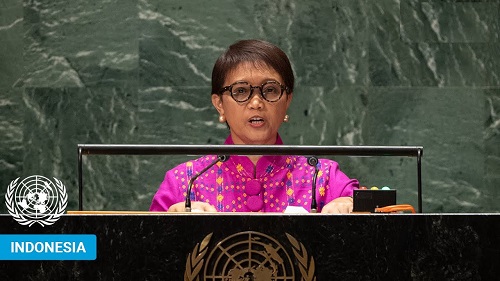
She mentioned, “For Indonesia, global leadership should not only be about power or about the influence to dictate others.Instead, global leadership should be about listening to others, building bridges, respecting international laws consistently and put all nations equally.”
Rebuilding trust and reigniting global solidarity is the theme for this year’s UNGA.This theme is timely and on point. We are again at a strategic crossroad, as in 1955.
She raised timely question, “Trust deficit reappears, lack of solidarity resurfaces, these situations have hampered the attainment of SDGs, especially for countries in the Global South.The question is, do we really have the commitment to rebuild trust, to reignite global solidarity, to attain the SDGs target together?
Will our presence today at the UNGA really bring commitment and show readiness towards a global unity and collective responsibility? Standing before this esteemed assembly of the UN, we said a lot of good words and promises. Let us now be honest with ourselves, do we do what we said we would do?
If all of us are committed to do what we said and say what we do, I am sure, the current world situation will not be like what we see right now. Where trust deficit is running deep, where differences are soaring high and sharp, where wars and conflicts are tearing us apart.
The problem is that we do differently than what we said. We say differently about what we did.We do not walk the talk.
Against this backdrop, The Foreign Minister shared some thoughts on how we can rebuild trust and reignite global solidarity in line with what we envisioned through the Bandung Spirit.
FM emphasized forging collective global leadership. She said;
The fate of the world cannot be defined by the mighty few.A peaceful, stable, and prosperous world is a collective right and responsibility of all countries, big and small, North and South, developed and developing.We all must do our part and work together towards this common goal. And this can only be achieved if all of us adhere to the same rules of the game.
We must uphold respect for international law, particularly the fundamental principles of sovereignty and territorial integrity.This will ensure that disputes would be settled on the negotiating table rather than at the battlefield.
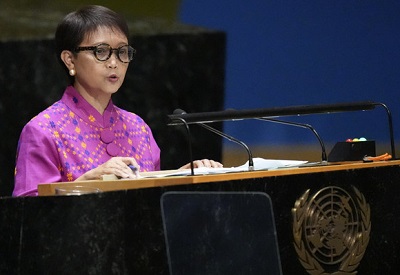
In this connection , she touched the issues of Palestine and Afghanistan. She said, “A collective responsibility is also especially needed to the people of Palestine and Afghanistan.For far too long, we have allowed our Palestinian brothers and sisters to suffer. Indonesia will not back an inch in our support for Palestinian statehood.In Afghanistan, Indonesia will do its utmost to help the Afghan people and ensure the rights of women and girls are respected, including their rights to education.”
She recommended advocating development for all. She said;
Every country has the same right to develop and grow.But the global architecture of today only benefits the selected few.Trade discrimination against developing countries continues to happen. Global supply chain is being monopolised by certain countries.
Many developing countries may not meet the SDGs by 2030. They also struggle with foreign debts and development financing.All of these would contribute to eroding trust and solidarity. Therefore, it is time for us to make a real change.
Industrial down-streaming must not be an exclusive call of developing countries. Developed countries should also support this call to build a stronger future together.
The same ideals are applicable in our fight against climate change, and sea-level rise, as well as safeguarding biodiversity. Indonesia has led by example by fulfilling its international obligation including being among early signatories of the BBNJ Agreement.But developing countries cannot do this by themselves.
We need developed countries also to fulfill their responsibility, including on climate financing, green investment and transfer of technology.Technology and innovation should not be exclusive, for the selected few.
Access to safe and secure digital technology for developing countries, including AI is crucial for future sustainable growth.This is time to practice what we have preached.
FM for reinforcing regional cooperation. She shared;
Regional institutions should be net contributors and building blocks for global peace and prosperity.As the ASEAN Chair this year, Indonesia had to navigate ASEAN through such geopolitical dynamics in the region.ASEAN has already managed to do this for the last five decades.
We sent a clear message that we will not let our region to be a pawn of rivalries.Instead, Southeast Asia must be an Epicentrum of Growth, where all countries can benefit meaningfully.Inclusivity will forever be the pillar of our region’s architecture building. It suffices to say we managed to pull through.
“ASEAN has maintained its unity and established a long-term vision for ASEAN 2045.ASEAN has reinforced its centrality in strengthening regional resilience and preparing for economy of the future.ASEAN has initiated closer partnership with the Pacific Islands Forum and the Indian Ocean Rim Association for a stable and peaceful Indo Pacific.We have translated the ASEAN Outlook on Indo-Pacific into concrete and inclusive cooperation.”
On Myanmar, implementation of the Five-Point Consensus remains the main reference.ASEAN continues to urge the military junta to implement it.ASEAN will spare no effort to ensure the people of Myanmar are not left alone.
Ms Retno Lestari Priansari Marsudi concluded to underline a point, on the reform of multilateral system.Many proposals have been produced throughout the years. But we are still far from getting anywhere.The best time for actions may have already passed.But the second-best time is now.Let us translate our commitment into actions. The 2024 Summit of the Future cannot fail. Trust and solidarity must be part of these efforts.Our people and the world await, and we must deliver.
Bandung Conference
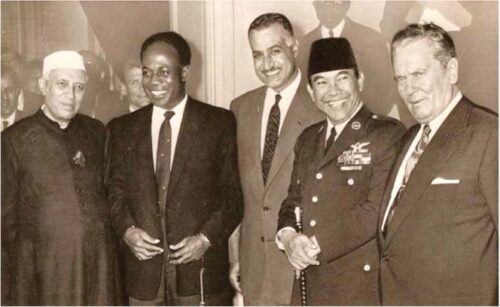
The Bandung Conference in 1955 proved to be the second most important forum of the nations after the establishment of United Nations in 1945. This conference is still relevant in the international dynamics as the nations of the world are organizing themselves in different blocks inspite their biggest common block is already present in shape of UNO. It is only because UNO failed in many cases and could not provide equal rights of existence, sovereignty, peace and development that were the central aims of the Bandung Conference.
was organized by Indonesia’s President Sukarno in collaboration with India’s prime minister Jawaharlal Nehru on 18–24 April 1955 in Bandung, West Java, Indonesia.It was attended by 29 countries mostly from Asia and Africa and many of them were newly independent states representing a total population of 1.5 billion people, 54% of the world’s population. Myanmar, Sri Lanka and Pakistan also contributed in organisation of the conference. It was coordinated by Ruslan Abdulgani, secretary general of the Ministry of Foreign Affairs of the Republic of Indonesia.
The conference stated its strong determination to oppose colonialism or neocolonialism by any nation.Non-Aligned Movement (NAM) was the new international forum that emerged from this conference and that is working even today to maintain the principles of Bandung Conference.