Margalla Dialogue 2-WAR ON TERROR WAS DISASTER TO PAKISTAN-Now We Will Be Bridge & Reconciliator Only -Imran Khan

0
1072

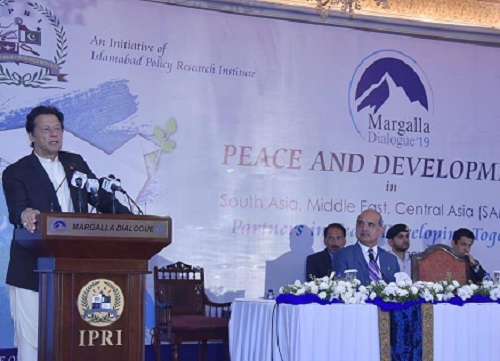
Islamabad-14 Nov 2019-Margalla Dialogue 2019 is a useful vehicle for policy makers to benefit from research-based inputs and independent ideas. Prime Minister Imran Khan recommended that events like the Margalla Dialogue should be annual events. He was addressing the Concluding Session of the two-day Margalla Dialogue on “Peace and Development” in South Asia, Middle East, Central Asia (SAMECA) organized by the Islamabad Policy Research Institute. “Events like this are a great beginning which communicate Pakistan’s ideas and point of viewto the outside world,” he stressed.The Prime Minister pointed out that “we do not want to be aligning with any country where we have to fight someone else’s war.This only leads to great suffering. As a frontline state, we lost more than we gained. The impact on our society has not been analyzed, especially its negative fallout. The war on terror was a disaster for Pakistan. Now, we will only be a bridge builder and reconciliator.” He applauded China’s diplomacy and said “China’s way of running their foreign policy is far superior since at no time did they commit to anyone else’s war.”The Prime Minister highlighted that Pakistan is putting its house in order. “Now we are making it easier to visit the country and invest here. The tourism sector is growing; and visa policies becoming more tourist and business-friendly.
On inter-regional dynamics, Mr Imran Khan said that “I am proud to say that Pakistan is playing a big role for a peaceful political settlement in Afghanistan since no military solution will work.  Saudi Arabia has always been a friend in times of need, while Iran is a neighbour. I am pleased to say that Pakistan is doing its best to find peace between these two nations. The last thing this region needs is another conflict.”

The Prime Minister further stated that China offers Pakistan great hope for growth and expansion. “China is helping us in R&D in AI, even in improving agricultural yields. The problem is India. We have tried our best to work with India but the country is in the grip of extremist ideology,” he lamented.

“What is happening in India right now is tragic, it is racist. It is based on Nazi fascism and an ideology of hate.” Prime Minister Khan warned that no one understands the direction in which India is heading. “It is moving towards becoming a totalitarian fascist state where the media and people are being scared into submission. Prime MinisterModi is riding a tiger and with every passing day, it will lead to great destruction. India will suffer under this ideology, its people will suffer, especially the minorities.” On Kashmir, the Prime Minister highlighted that “Modi has gone into a blind alley. What happens when the curfew is lifted? Does India think things will go back to being normal again? I don’t think the Modi government has factored this in. Rather than fighting poverty and issues like climate change together, India is sowing seeds of hatred. Such hate is beyond Pakistan. The international community must step in,” he urged.

Mr Khan concluded that the world was slowly becoming more aware of what is happening in Kashmir and India. Afghanistan is headed in the right direction. “If US-Iran relationship improves, if sanctions on Tehran are lifted, Iran can become a powerhouse and Pakistan, like the rest of the region will benefit. Aside from problems with India, for Pakistan things are looking good and moving in the right direction.”

Delivering his Keynote Address at the second day of the Margalla Dialogue session on“Prospects of Economic Integration in SAMECA: Exploring New Vistas of Cooperation,”Dr Abdul HafeezShaikh,Advisor to Prime Minister on Finance, Revenue and Economic Affairs, Government of Pakistan shared that the reasons why some countries have done better than others carry big lessons. “There are three important answers to this question: one, we cannot have developed countries with underdeveloped people. Skill enhancement and technical capacities are very vital. People should be the main focus of any development initiative. Two, no country has done it alone. The only way to grow an economy is by selling one’s products to others and to ensure that others partner with us, especially neighbours. Third, the only way to develop is when you allow your private sector to develop and work unencumbered.” Dr Shaikhsaid that governmentministers are not important unless they make good policies.Coaches and managers cannot play on the field – it is the players that make the game a success.

Lamenting the lack of integration in the SAMECA region, he was of the view that apart from businesses, there needs to be real people-to-people contact.In this regard, he suggested implementing a Shanghai-type visa regime for the SAMECA region as a starting point for improving regional integration and connectivity.“To give space for growth, the government sometimes needs to step aside, but unfortunately, the government is not trained that way since they are mistrustful of people who make money. There is a need for change in such a mind-set. The business of government is not to create jobs in government departments, it is job is to create jobs in the rest of the economy,” he remarked.Pakistan should not miss the opportunity of CPEC. In order to convert a transaction into a transformation, it must be China-Plus,” he opined.

Speaking on inter-regional issues, Minister Shaikh shared that Pakistan has been working to resolve the Afghanistan conflict. “We do not conflict between Saudi Arabia and Iran. Countries should recognise not to get tricked into a conflict since there is too much at stake. Conflict leads to suffering alone. “We discussed with President Trump not to make this region worse than it already is,” he shared.

Congratulating IPRI on initiating the Margalla Dialogue, he said that the government of Pakistan needs to take ownership of an initiative like this and recommended that Dialogues like the MargallaDialogue must have greaterfocus and to inject relevance into the proceedings by following the format of a Dialogue and dispense with moderators. On the question of how the success of an initiative can be judged, he advised that rather than looking for information in tit bits, there needs to be operational content. “Zero in on the operational steps and then revisit them after 3-6 months to see where those steps lead.Gatherings of regional colleagues, such as the Margalla Dialogue, should lead to more answers and solutions rather than focusing only on the things that are not working,” he concluded. The session was chaired by MakhdoomKhusroBakhtiar, Federal Minister of Planning, Development and Reform, Government of Pakistan.

MrYaseen Anwar, Senior Adviser at ICBC Singapore and former Governor of the Central Bank of Pakistan, discussing “Potential of Pakistan as a Trade and Energy Hub in SAMECA Region,” said thatChina’s Belt and Road infrastructure initiative gives access to capital for those connected emerging markets that have not had the necessary investment grade ratings to tap international bond markets. These economies have never had the opportunity to attract offshore investors who require ratings dictated by their corporate policies. Nor do those investors have a high enough risk appetite to venture into uncharted emerging markets. “Infrastructure, the core of Belt and Road funding, is and has been the engine of growth for most economies.” However, he lamented that lack of quality infrastructure has hampered the economic development that many Belt and Road-related countries sorely need. “For example, the shortage of power in Pakistan has impaired GDP growth rates of up to 3%. The lack of a developed transportation network for refrigerated trucks for distribution of agricultural products results in a 50% loss of perishable products. The Belt and Road initiative can play at least a key role in filling these economies’ substantial financing gap, he shared.”Mr Anwar recommended that the collective resources of multilateral institutions can be leveraged to fill financing gaps and alleviate the concerns of risk-averse private sector participants.“The Belt and Road makes available ample resources and opportunities to stimulate production and inclusive growth, as well as to preserve regional economic stability. Payments settlement risk can also be reduced by using the renminbi as an alternative currency.” He remarked that exogenous shocks remain a risk, and regional economies must install policies and systems to mitigate such threats.“The Belt and Road offers the necessary ingredients to restore confidence and some stability in the international monetary system, while simultaneously generating new jobs and reducing poverty in many emerging markets,” he concluded.

The diverse region of SAMECA has economic potential which is yet to be profoundly explored.Regional expertslike Dr Wang ZhengXu from China,Mr Leonid Savinfrom Russia,AmbassadorJavadKachoueianfrom Iran stressed that the SAMECA region is a vital link in the global economy. Theystressed that it would be myopic of governments of these regions to only see the trade corridors as means of improving infrastructure and to make transportation convenient. These engineering feats can trigger urbanisation and create jobs for the locals, alleviate poverty, and attract FDI.

Mr Yao Jing, Ambassador People’s Republic of China to Pakistan, highlighted thatPakistan, at the centre of CPEC can mitigate not only itseconomic challenges, it can havefar-reaching impact on the region as well revolutionizing connectivity like never before. If regional rivalries are overcome, economic integration can be realized which will benefit the regional population and act as a spur for the global economy. In addition, sound and stable economic policies and reforms are the ingredients needed for enhanced and long-term economic integration.

Regional and national environmental experts Dr Pervaiz Amir, Ambassador ShafqatKakahel, Dr Imran Saqib and Dr RehanaSiddqui from Pakistan; and Dr Netra P. Timsina from Nepal argued that climate changehas taken toll on the region of SAMECA. Parameters such as air quality index depict an alarming situation.Rapid industrializationurbanization anddeforestation are a few reasons behind the dreadful shift in regional climate. All these have exacerbated the problem of water scarcity.There is a growing recognition that the region needs to cut down on its carbon emissions. As such, policy circles should emphasize and promote the use of renewable energy resources. Economic development plans ought not to be executed at the expense of the planet’s health. An effective system of water storage in the form of small dams, especially for rain water storage is needed. The right balance between economic activity and conservation of the environment needs to be struck.Legislation needs to be enacted not just by individual governments but on a regional level. SAMECA must come up a similar agreement like the Paris Accord because it is one of the regionsmost vulnerable to the effects of climate change.

In the session on “Cyberspace in 2025: Cyber Security Challenges in SAMECA and Prospects for Multilateral Cooperation” chaired by Fawad Ahmed Chaudhry, Federal Minister for Science and Technology, Government of Pakistan, cyber security professionals highlighted thatthe digital economy of the different countries of the SAMECA region is booming, bringing huge benefit for governments as well as the private sector.However, all of this comes with the threats to cyber security. SAMECA is undoubtedly a crucial part of the cyber politics of the world, especially in terms of its colossal user base and sheer size of digital information usage. The region needs to strengthen itsdefense mechanism against potential cyber threats by addressing the lack of governance as well as skilled capacity issues. There is a dearth of attribution capabilities which leads to cyber-enabled information rifts within SAMECA. To make matters worse, the threat of cyber espionage has exposed the ill-preparedness of the nations of SAMECA, which are sitting ducks for such rogue operations. Despite an increase in the number of people having access to the internet, cyber technology penetration in the region is virtually missing along with awareness in this area. Mr AmmarJaffri from Pakistan; Prof Dr Bilal Sambur from Turkey; Dr. Richard Wilcox  from Genevastressed that for online security resilience, the SAMECA nations must promote cyber norms of behaviour by developing both national and regional cyber security strategies. This will assistthe region in being a better capacity to defend the battlefront of cyberspace againsthacktivism and data breaches.

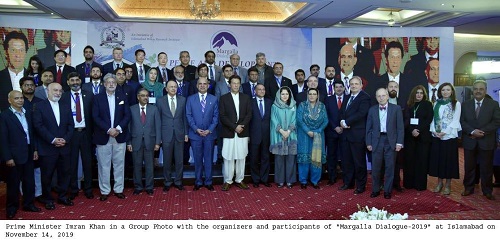
In his Vote of Thanks, Ambassador Vice Admiral Khan Hasham bin Saddique thanked 25 speakers from 13 different counties for discoursethat was imaginative and generated highly intellectual discussions proffering extremely useful policy proposals.

LEAVE A REPLY

Please enter your comment!
Please enter your name here