Margalla Dialogue Day 1-Need to Institutionalise a Comprehensive Regional Response to the Peace and Development Challenges facing the SAMECA region.

0
735

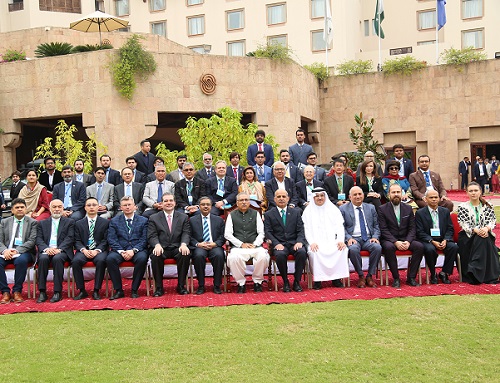
Islamabad;13 Nov 2019-Leading international opinion-makers, heads of national and regional organisations, and policymakers from 14 countries including Afghanistan, China, Iran, Germany, Kazakhstan, Malaysia, Nepal, Pakistan, Russia, Turkey, Saudi Arabia, the European Union, and the United States have gathered here in Islamabad at the Margalla Dialogue to discuss Peace and Development, especially conflict resolution, diplomacy, security, climate change  governance and cyber technology issues that are impacting the region of South Asia, Middle East, Central Asia (SAMECA).

President of Pakistan Dr Arif Alvi inaugurated the Margalla Dialogue. In his Inaugural Session, he said the dream of peace and security in the world has not been realized since countries are unable to look beyond the lens of vested interests and resolve mutual conflicts on the principles of humanity.“The world is letting the people of Kashmir suffer the humanitarian crisis, while it protects its vested economic interests.”President Alvi regretted that even after passage of several resolutions of United Nations Security Council (UNSC) on the Jammu and Kashmir dispute, there was no progress over implementation.He pointed out that multinational companies and lobbies had become powerful enough to hijack the opinion and policies of states to push vested agendas.He said the region could become engulfed in a nuclear crisis if important matters such as Kashmir remained unresolved. However, he added that Pakistan would continue to play its role for maintaining peace in the region.He said opening of Kartarpur Corridor speaks volumes about Pakistan’s efforts for maintaining peace regardless of discord with India.The same day in India, he said the unilateral decision of Indian Supreme Court in Ayodhya case has given rise to frustration among Muslims all over the world, especially in Pakistan.

In his Welcome Address, President of IPRI Vice Admiral (R) Khan Hasham bin Saddique outlined the background of the Margalla Dialogue explaining that it would be held annually in Pakistan. “The Dialogue is intended to be a Track 1.5 undertaking and will focus on the most happening regions of the world i.e. South Asia, Middle East and Central Asia acronymed (SAMECA). The singular objective being to formulate implementable strategies and plans to tackle the challenges that confront us collectively.”

The Guest Speaker of the Inaugural session,Dr Moeed Yousaf, Chairperson, Strategic Policy Planning Cell, National Security Division, Prime Minister’s Office, Pakistan discussed that Pakistan sits at the intersection of the three of the most active nodes of great power competition: Asia Pacific; Middle East; and Afghanistan and Russia’s extended Central Asian backyard.  “Seeing Pakistan as a trade and transit hub for the South and Central Asian region could transform its territory into a melting pot for great power cooperation. The good news is that Pakistan policymakers recognize that the status quo is no longer tenable and working hard to change,” he opined.

Mr Daniel F. Runde, Senior Vice President from theCenter for Strategic & International Studies (CSIS), USA in his speech stressed that the US needs to create a much larger community that understands Pakistan and is interested in the success of the country outside military and intelligence communities. He said that, “We need more American students studying in Pakistan. We need more American businesses in Pakistan.” Mr Runde was of the view thatPakistan and the US need to prepare for a reframed relationship not based on the distorted and precarious lens Afghanistan. He called for the need to break through the stale and unproductive approach to US-Pakistan relationship and to reframe the relationship through collective efforts.

In the first plenary session on “Seeking Peace through Conflict Resolution”, Sardar Masood Khan, President, Azad Jammu and Kashmir (AJK)said that Kashmir is undergoing the darkest time of its history as people of region are suffering at the hands of foreign occupation. However despite India’s extreme nationalistic and hegemonic designs, he said the “moral of Kashmiris is very high and no power on the earth can defeat them nor can force them to compromise on their dignity and identity.” He called upon the peace-loving nations of the world to collectively raise their voice in support of Kashmiri peoples’ struggle for their right to self determination and peaceful settlement of Kashmir issue in line with UNSC resolutions.

Ms Mishaal Hussein Mullick, Chairperson, Peace and Culture Organization, Pakistan appealed to the international community to take notice of the worst Indian brutalities in the occupied Kashmir and pressurize New Delhi for lifting of curfew in the held valley. Practical steps, she said, should be taken to help the people of IOJ&K, who had been denied their basic right of freedom and held hostage by the occupation Indian forces.The persistent curfew in the held state, she said, had created a starvation-like situation there, with acute shortage of essential items, including food and medicines. She said the occupied Kashmir was bleeding as the Indian forces were killing, torturing and perpetrating grave human rights’ violations to suppress the just movement of Kashmiris.MsMullick said India was replicating the policies of Hitler to satisfy its nefarious designs.

Mr Ahmer Bilal Soofi, President, Research Society of International Law (RSIL), Pakistan pointed out that executive action of changing regional maps was extremely problematic and should be taken very seriously. He stressed that this unilateral and unjustified move by India should be taken up by the Shanghai Cooperation Organization.The session was moderated by Dr Maria Sultan, Director General, South Asia Strategic Stability Institute (SASSI), Pakistan.

Discussing intra-afghan dialogue, Ms Fawzia Koofi, Former Member of Parliament and Chairperson Movement of Change for Afghanistan,was of the view that since the people of Afghanistan have suffered more than four decades of war, there is now the desire for a dignified peace. She said that the Afghan people arecautiously optimistic and Afghan women will not let down by the peace process. She said that while the Taliban’s views on social issues may have changed, they shouldshare them publicly to show they will not be a burden on Afghanistan’s progress.

Dr Andreea Stoian Karadeli, Peace Mediator at EU and NATO, in her presentation, raised awareness regarding the level of devastation caused by the conflict in Yemen and its long-term consequences; and analyzed the UN’s role in the conflict. She urged that the war in Yemen is a preventable humanitarian disaster that, if continued after 2019, will take the lives of nearly one-quarter of one million people. “If this war continues it will continue to disproportionately kill children, mostly due to a lack of access to food, health services and infrastructure,” she said.DrKaradeli strongly urged greater involvement of the international community, but with respect to the context.

Speaking on the Saudi perspective on regional security, Dr Mohammed S. Al Sulami, Chairman, RASANAH, Saudi Arabia, outlined thatSaudi Arabia remains committed to its religious principles and values, and to fundamental issues such as the Palestinian cause. He shared that Saudi Arabia also believes the benefits of the 2030 Vision will not be limited to itself, but, rather they will extend to its neighboring countries such as the mega-projects developed in the northwest of Saudi Arabia in partnership with both Egypt and Jordan as well as in GwadarPort in Pakistan. He opined that Riyadh has always tried to stay away from political tensions with all countries as much as possible. “Yet, Saudi Arabia’s avoidance of political tensions does not mean Riyadh turning a blind eye to any attempt to target its security and safety or its national interests,” he remarked.

The session on “Geopolitics in South Asia, Middle East, Central Asia (SAMECA): Role of US, China and Russia,”included Ms Lidiya Parkhomchik, Director, Institute of World Economics and Politics (IWEP), Kazakhstan discussed thatChina, Russia, and the United States are essentially interested in the same thing – preventing the region from becoming another hotbed of global instability. She shared that the example of China-Russia interaction in Central Asia shows that the intersection of the interests in a number of areas should not necessarily lead to direct confrontation. “Taking into consideration the highly diverse capabilities of players involved, their interaction in the region will continue to be complex and open-ended,” she concluded.

Dr Huma Baqai, Associate Dean, Social Sciences and Liberal Arts, Institute of Business Administration (IBA), Pakistan in her presentation discussed that the competition in SAMECA has created diverse security challenges including energy security, piracy, and military posturing as well as diverse opportunities. “Commercialization connected with geopolitics is making geoeconomics take precedence in these regions. Chinese investments under Belt and Road Initiative have heightened the Indian Ocean and Persian Gulf’s strategic value,” she opined.

Dr Li Jing Feng, Director of the Regional Studies and Strategies Research Center, Sichuan Academy of Social Sciences (SASS), China, in his presentation, shared thatChina adheres to its foreign policy of cooperation with the SAMECA countries; and will become the most important safeguarding force for peace and stability in the region. Dr Li stressed that China will adhere to its opening-up policy, and continue to establish its image as a trusted partner in the SAMECA region through its continuous efforts to work together to explore new ideas and new models that are conducive to bilateral and multilateral cooperation.

Dr Sergei Ermakov, Head of Research, Russian Institute for Strategic Studies (RISS),discussed that Moscow favours peace talks and reconciliation in Afghanistan. He outlined that Russia’s relationships with SAMECA region, especially Pakistan, have made significant developments, including defensecooperation pacts, lifting of arms embargo on Pakistan and investment of USD 2 billion to develop 1,100-kilometers long gas pipeline from Karachi to Lahore. “Russia views the Belt and Road Initiative (BRI) not just as means of growing Chinese influence, but also an opportunity to enhance connectivity between two countries through Central Asian States,” he said.

Professor Emeritus Dr Marvin G. Weinbaum, Director, Afghanistan and Pakistan Program, Middle East Institute (MEI), USA also spoke on the panel about articulation of US foreign policy in SAMECA region and its challenges.The session was chaired by Professor Dr Syed RifaatHussain, HoD, Department of Government and Public Policy, National University of Sciences and Technology (NUST), Pakistan.

Under the aegis of the Islamabad Policy Research Institute, the Margalla Dialogue is a unique Track 1.5-level event which also brought together Pakistan’s topmost leadership, a number of Federal ministers, key parliamentarians, senior bureaucrats, academicians, media personnel.

LEAVE A REPLY

Please enter your comment!
Please enter your name here