Report – Tazeen Akhtar with Camera – Raja Ghulam Farid & Ramzan Moghal
Experts on Central Asia Pakistan connectivity have emphasized upon early completion of all the projects meant for restoration of direct linkages between Central Asia and Pakistan , either they are travel means for enhancing trade goods transfer, energy corridors or digital , online banking facilities.
They expressed their satisfaction on the presence of enthusiasm and committment on all sides to accelerate the progress on the connectivity projects for the benefit of both the regions , Central and South Asia.
They appreciated role of Pakistan in connectivity as regional hub and ready to provide sea access to landlocked countries of the Central Asia that are actually landlinked states.
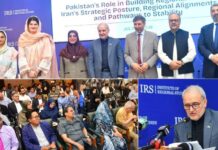
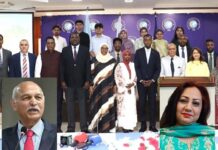
This consensus was built in an International discussion on “Central Asia and Pakistan: Efforts and Prospects for Connectivity” between the stake holders and experts held at Center of Pakistan and International Relations COPAIR in collaboration with Diplomatic journal Pakistan in the World in Islamabad on 29th Aug 2025.
Ms Amna Munawwar Awan, Chairperson COPAIR and Editor “Pakistan in the World” Tazeen Akhtar initiated the discussion refering to the historical links between the two regions before colonial rule and the efforts of the Central Asian states to rebuild and restore this connectivity across Afghanistan.
 The participants were Ambassador of Turkmenistan, H.E Atadjan Movlamov, Ambassador of Tajikistan , H.E Sharifzoda Yusuf Toir and Ambassador of Uzbekistan , H.E Alisher Tukhtaev and Ambassador of Azerbaijan H.E Khazar Farhadov online as main speakers while
Deputy Head of Mission of Romania Mr. Eduard Robert PREDA , President English Speaking Union Mr. Khalid Malik, Former Chairperson National Commission on Rights of Child Ms Afshan Tehseen Bajwa also participated and expressed themselves on the topic.
Deputy Head of Mission of Tajikistan Mr. Saeedjon Shafiev and Trade Consular of Uzbekistan Mr. Alisher Duschanov, President Greek Pakistan Chamber of Commerce Ms Robina, students form Bangladesh and Somalia, media persons and civil society representatives were also paresent at the occasion. A large number of students of International Relations joined via zoom.
Key projects under discussion included:
1- TAPI and multimodal trade routes — new avenues for supply, transit, and expanded markets.
2- CASA-1000 — an energy initiative opening up new opportunities.
3- The Trans-Afghan Railway — a strategic corridor linking Central and South Asia.
4- Trans Caspian Corridor, Transport and Transit avenues, Energy Corridors , Zangzur Corridor ,
5- Recently held international conferences of Landlocked countries in Turkmenistan,
6- ECO in Azerbaijan
7- Trilateral Summit of Azerbaijan, Turkmenistan and Uzbekistan with focus upon connectivity with Pakistan.
 H.E Atadjan Movlamov, Ambassador of Turkmenistan
H.E Atadjan Movlamov highlighted an important initiative – the Turkmenistan–Afghanistan–Pakistan–India (TAPI) Gas Pipeline Project, total length of 1,840 kilometers. Implementation of the Project has significant advantages that make it a priority for all stakeholders. In particular, for Pakistan and the region as a whole.
This gas pipeline will benefit Pakistan to:
1- Enhance Pakistan’s energy security;
2- Pakistan will receive stable income from transit fees,
3- The project is also expected to create thousands of job opportunities.
Turkmenistan’s efforts and achievements in developing regional connectivity, with particular emphasis on projects towards Pakistan:
We have two railway connections with Afghanistan: Serhetabad (Turkmenistan) – Turgundi (Afghanistan) and Imam-Nazar (Turkmenistan) – Akina (Afghanistan) and further – Andhoi.
Four power transmission lines to the 5 northern provinces of Afghanistan (last 500 kV power transmission line along the Kerki (Turkmeinstan) – Sheberghan (Afghanistan) route was inaugurated in January 2021).
Two fiber-optic communication lines along the Ymamnazar–Aqina and Serhetabat–Torghundi corridors, which are critical for the development of Afghanistan’s digital infrastructure and regional internet connectivity.
The Avaza Action Program for 2024-2034, along with specific measures to modernize the transport and transit system provides for the creation of a platform for inclusive and sustainable development in all landlocked developing countries.
 H.E Sharifzoda Yusuf Toir, Ambassador Tajikistan
H.E Sharifzoda Yusuf Toir emphasized on more contacts in people of both countries and regions. He said the people of both countries are the same. They are relatives.
He said Central Asia South Asia electricity transit project CASA-1000 is a major project with regards to connectivity between the two regions because it connects Tajikistan , Kyrgyzstan, Afghanistan and Pakistan. Its timely completion is in the vast interest of all countries.
He suggested establishment of Banking channels between the two countries where the traders at both sides are facing hardships to make financial transactions.
Ambassador Toir spoke highly about commonalities between the two countries. He said , Tajikistan always welcomes Pakistani tourists, traders, businessmen, students and heritage lovers. He said , Tajikistan already has an education corridor with Pakistan. Many students are studying in our universities.
H.E Alisher Tukhtaev, Ambassador of Uzbekistan
H.E Alisher Tukhtaev shared the details of The Trans-Afghan Railway. He mentioned the sigining of Framework Agreement to prepare the Feasibility Study for the Trans-Afghan Railway. It is important to emphasize that the Feasibility Study will be fully financed by Uzbekistan and Pakistan.
The Embassy of Uzbekistan screened a video presentation of the project during the discussion.
The future railway route will run as follows: Termez – Hairaton – Mazar-i-Sharif – Oybek – Logar – Kharlachi. We will need to build 647 kilometers of new railway line that will be completed in 5 years. The Railway will open new opportunities for farmers, entrepreneurs, students, and traders.
The importance of this railway is difficult to overestimate. Once launched, it will reduce delivery time of goods from Central Asia to Pakistani seaports from 30-35 days to only 3-5 days, while cutting transport costs by almost 40 percent. But more than numbers, this is about people and the future.
For effective progress, we have already established the Project Office of the International Digital Transport Corridors Development Strategy in Tashkent. Its branches are also operating in Islamabad and Kabul. These offices closely cooperate with each other, allowing us to coordinate actions, conduct research, and form a common roadmap.
H.E Khazar Farhadov, Ambassador Azerbaijan
H.E Khazar Farhadov addressed through a video statement. He mentioned about 7 direct flights of AZAL between the two countries. The flights have been helpful in making P2P and B2B contacts.
Ambassador mentioned green energy cooperation between Azerbaijan, Kazakhstan and Uzbekistan. He said Caspian connectivity is not only connecting Central Asia and Azerbaijan but it can provide the trade and travel avenues for Pakistan as well in the future.
He stressed the need of strengthening and accelerating the engagements between private sectors to exploit the opportunities of Transport, Transit , Digitization provided by the governments of Azerbaijan and CARs.
He mentioned the potential of Baku Tiblisi corridor that has increased the volume of trade good from CARs from 1 M Tonn to 5 M Tonn and it has the capacity to enhance it up to 15 to 25 M Tonn. He highlighted UN Special Program on the economies of CARs. He said Azerbaijan has joint investment fund with Kazakhstan, Kyrgyzstan,Uzbekistan and the same can be done with Pakistan.
The conference concluded with a shared understanding that:
1- Developing transport and logistics corridors,
2- Expanding trade and economic partnerships,
3- Strengthening cooperation in the energy sector — are the keys to sustainable development in Central and South Asia.