 ISLAMABAD : Spokesperson for the President of Pakistan, Mr. Murtaza Solangi has said Pakistan welcomes China’s, Turkiye’s and Qatar’s mediation with regard to its relationship with Afghanistan. Pakistan is also interested in trans-regional connectivity. Pakistan’s defense pact with Saudi Arabia is part of our broader agenda of improving relationships with the GCC and Pakistan has a very sound relationship with Iran.
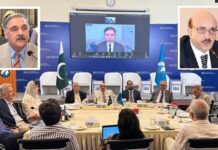
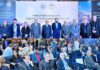
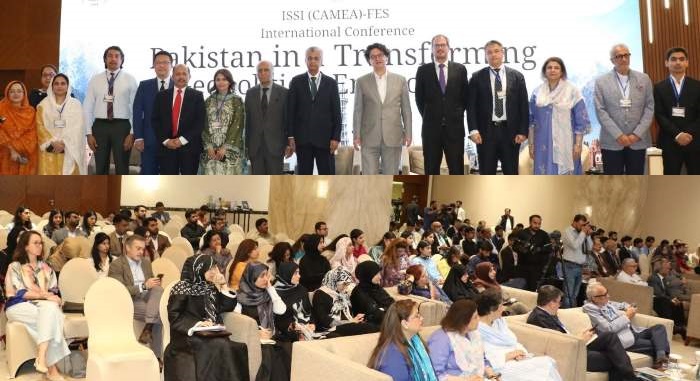
The Centre for Afghanistan, Middle East and Africa (CAMEA) at the Institute of Strategic Studies Islamabad (ISSI), in collaboration with the Friedrich Ebert Stiftung (FES), Pakistan office, hosted a one-day International Conference, titled ‘Pakistan in a Transforming Geopolitical Environment.’
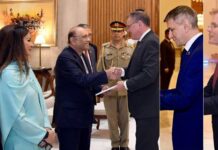
Mr. Murtaza Solangi, Spokesperson for the President of Pakistan, was the Chief Guest at the inaugural session. Speakers included Dr. Amina Khan, Director CAMEA; Ambassador Khalid Mahmood, Chairman, BOG ISSI; Mr. Felix Kolbitz, Country Director, FES Pakistan; and Mr. Arno Kirchhof, Charge d’Affaires, Embassy of the Federal Republic of Germany, Islamabad.
Ambassador Khalid Mahmood , while giving his welcome remarks, stated that Pakistan finds itself in a regional and global environment that is changing rapidly, with strategic competition intensifying, regional alignments shifting, with conflicts producing wider political and economic consequences.
He said that the line between traditional and non-traditional security challenges is becoming increasingly blurred. He further opined that, for Pakistan, these developments are not abstract as they directly affect our security, economy, diplomacy and regional outlook.
Pakistan’s location gives it strategic importance, but it also places a responsibility to pursue a balanced, thoughtful and forward-looking foreign policy. Pakistan’s approach has consistently been based on dialogue, peaceful coexistence, respect for sovereignty, regional stability, economic cooperation and connectivity.
Mr. Murtaza Solangi , while speaking at the occasion, said that this conference is very timely and important as it brings together experts from across the world at a very consequential moment. He went on to say that we live in a transformative arena where we see a transition from a unipolar to multipolar order. The order created after the second world War is collapsing and the big global powers are creating their own spheres of interest.
Pakistan today is also at the intersection of several transitions; unsettled Pakistan Afghanistan relations and a fast moving global order. These are the most consequential years for Pakistan. Last year’s India Pakistan war, continued conflict between the United States and Iran all affect Pakistan.
Pakistan maintains good ties with the GCC, with China and also the US. Pakistan has tried to reposition itself and has tried to bring peace to a volatile region. Pakistan seeks a peaceful and stable relationship with Afghanistan and has historically stood with the Afghan people. Pakistan would not like to see Afghanistan become a global sanctuary for terrorism.
Security has become transformative and we face numerous challenges like pandemics, natural disasters and other . He concluded by saying that Pakistan’s foreign policy rests on strategic balance with regional neighbour’s and proactive diplomacy.
Mr. Arno Kirchhof presented European Union as an example to express optimism regarding the functionality and sustainability of the ‘rule-based world order’, despite persistent challenges. He identified several key areas in which Pakistan could establish and strengthen its partnership with Germany and other European countries. He stressed the need to further enhance trade, investment, and human resource exchange between Pakistan and Germany.
Mr. Felix Kolbitz applauded Pakistan’s recent global diplomatic maneuvering in the region and beyond as remarkable. With successfully brokering a peace deal between Iran and the United States as well as concluding a defense agreement with Saudi Arabia, Pakistan has emerged as a net security provider for the region.
Indicating Pakistan’s unique geography, he identified several key challenges facing Pakistan such as water and climate security and transnational terrorism. He stressed that these were shared challenges that require collective strategy and shared response by the global community.
Dr. Amina Khan , in her introductory remarks, said that the annual CAMEA–FES Conference continues to promote deeper dialogue and understanding of shared challenges and the evolving regional dynamics. She was of the view that Pakistan is located in what has been constantly called a ‘tough neighbourhood.’
The region continues to confront a complex interplay of traditional and non-traditional security challenges, further compounded by geopolitical rivalries, great-power competition, and protracted conflicts. However, at the same time, the region possesses enormous potential for connectivity, economic integration, and shared prosperity.
At a time of profound geopolitical transformation, sustained dialogue and regional cooperation remain indispensable for building trust, advancing connectivity, and promoting lasting peace and shared prosperity, she concluded.
Conference’s schedule includes three separate working sessions on: Afghanistan, Central Asia and the Future of Regional Stability, Pakistan and the Middle East in a Transforming Geopolitical Environment and Non-Traditional Security Challenges Across a Changing Regional Landscape.
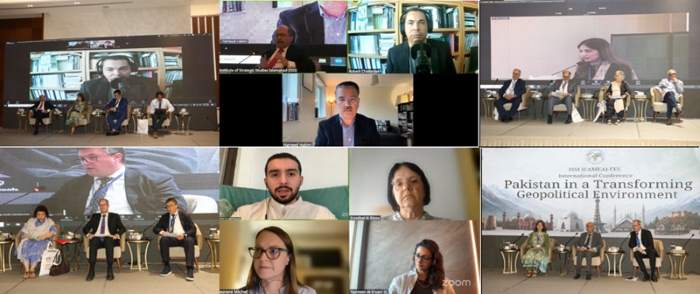 The conference featured three working sessions. The first working session, titled “Afghanistan, Central Asia and the Future of Regional Stability” was moderated by Director CAMEA, Dr. Amina Khan. The speakers of the session included: Ambassador Mansoor Ahmad Khan, Former Ambassador of Pakistan to Afghanistan; Hameed Hakimi, Senior Research Associate at ODI Global think-tank, London; Dr. Ye Hailin, Dean, Institute of West Asia and Africa Studies, Chinese Academy of Social Sciences; Robert Chatterjee, Deputy Editor-in-Chief, Zenith magazine, Germany; Hamza Boltaev, Head of the Centre for Afghanistan and South Asian Studies at The Institute for Advanced International Studies (IAIS), Uzbekistan.
The speakers observed that terrorism remains the principal challenge in Pakistan-Afghanistan relations and stressed that lasting stability cannot be achieved through military means alone. They called for sustained political dialogue, confidence-building measures, stronger institutional linkages and a broader shift towards geo-economics, regional connectivity, trade and people-to-people exchanges. The panelists also highlighted Afghanistan’s central role in linking Pakistan with Central Asia; noted China’s potential contribution to dialogue and trilateral cooperation, and emphasized that genuine political will remains essential for meaningful progress.
The second working session titled “Pakistan and the Middle East in a Transforming Geopolitical Environment ” was moderated by Prof. Dr. Zafar Nawaz Jaspal, Vice Chancellor, Quaid-i -Azam University, Islamabad (QAU. The speakers of the session included: Ambassador Asif Durrani, Pakistan’s Former Special Representative for Afghanistan; Mr. Rashid Al-Mohanadi, Non-Resident Fellow at the Middle East Council on Global Affairs; Ambassador Riffat Masood, Former Ambassador of Pakistan to Iran; and Mr. Mohamed Amersi, Chairman of the Amersi Foundation.
The discussion focused on the evolving geopolitical landscape of the Middle East, Pakistan’s balancing role in the region. The emerging regional security arrangements, the implications of the Iran–U.S. Memorandum of Understanding, the future of the Abraham Accords, and the growing importance of indigenous security cooperation were also discussed.
The speakers highlighted Pakistan’s longstanding role as a credible mediator, rooted in its principled foreign policy, strategic balance and commitment to peaceful dialogue. They also examined shifting Gulf security partnerships, the pursuit of greater regional strategic autonomy, and the need for sustained diplomatic engagement to promote stability, cooperation and peaceful conflict resolution in an increasingly complex environment.
The third working session titled “Non-Traditional Security Challenges Across a Changing Regional Landscape” was moderated by Felix Kolbitz, Country Director FES Pakistan. Speakers included: Flavius Caba-Maria, President and Director of the Political Department, MEPEI; Yasmin Al-Eryani, Executive Director for Knowledge Production Sana’a Center for Strategic Studies; Dr. Jeanene Mitchell, Founder and Principal, Confluence Envirosocial LLC; Dr. Shabbana Fayyaz, Professor, Department of Defence and Strategic Studies, QAU, and Dr. Erzsébet N. Rózsa, Scientific Advisor at the Institute of World Economics, Budapest, Hungary.
The speakers emphasized the need for integrated and locally grounded responses to the growing overlap between traditional and non-traditional security challenges. They identified economic vulnerability, energy dependence, demographic pressures, crime, misinformation, climate change, water security, migration and resilient infrastructure as increasingly interconnected concerns.
The panelists called for stronger implementation of existing policy frameworks, greater community participation, wider use of nature-based solutions and citizen science, and closer cooperation among governments, civil society and local communities. It was also stressed that sustainable security depends on credible institutions, public trust and practical regional and international partnerships.