 Imran Shauket
The writer is a former Senior Advisor to the Government and a sector development specialist. He is a member of the APP Think Tank and Pakistan’s Buddhist Heritage Promotion Ambassador for Green Tourism, a company under SIFC.
Recently, I had the opportunity to be a panelist on a show. The topics of discussion were “investment opportunities” and “economic empowerment” for Pakistan. Every panelists had their take and not unlike many other discussions that I have witnessed, many experts link Pakistan’s economic empowerment to foreign direct investments (FDIs).
This also seems to be the go-to solution of consecutive governments. A concurrent solution paired with FDI is increased IMF and international loans. However, we need to wake up to the realities of Pakistan, and shift our focus from international reliance to domestic smart strategy – an economic revival strategy which builds on Pakistan’s comparative advantages.
And, the biggest comparative advantage of Pakistan is not a product or a raw material or mineral or heritage or landscape – it is its population and the youth.
Arguably, FDI and international loans are a necessity for Pakistan, but they cannot be the saviors of Pakistan. Why? Let us look at the facts. For all the time and effort spent on cajoling countries to invest in Pakistan, average FDIs have been $2 billion in the past 30 years.
The average yearly international loans during the same time period have been in the range of $6 – $8 billion. If we high ball the combined numbers, FDIs plus loans average $10 billion yearly. Ten billion is nothing to scoff at, yet in the overall scheme of things it is a pittance for Pakistan’s size or need – a country of 250 million people and a GDP of $350 billion, or $1 billion per day. Given this, $10 billion is equivalent to only 10 days of economic output of Pakistan – not a lot.
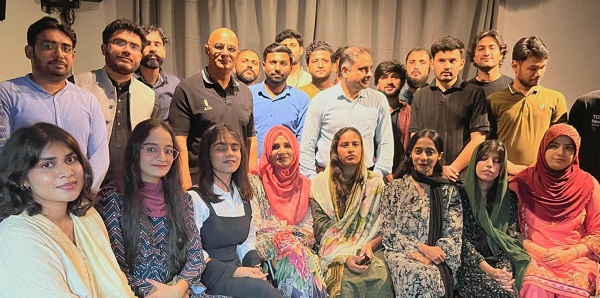
The author with youth leaders in a conference
If the loans and FDIs cannot uplift our economy, what can Pakistan count on? The answer lies in its burgeoning population – the real comparative advantage that Pakistan has to offer. For instance, 60% of the population of Pakistan is under 30. That is, 150 million Pakistanis are in the youth category.
If our youth were a country, they would be the 9th largest of the 200 countries of the world. This country would be bigger than Russia or Mexico or Japan. Our youth are a huge asset and Pakistan needs to focus on their empowerment and capacity building for its economic revival. They can fill workforce shortages in the world and build sectors domestically that can catapult Pakistan’s economy. Let us consider the following.
Manpower exports have tremendous potential. However, when considering manpower exports, we need to focus on exports of a “qualified workforce” rather than a “cheap workforce”.
While Pakistan has surplus youth, many of the rich countries of the world are hitting super aged population, and facing zero or negative population growth. Japan, South Korea, China, Germany, Austria, Switzerland, Thailand, Singapore, Canada, Spain, Portugal, Italy, Greece, and Poland are just to name a few.
These countries need health professional (3.5 million needed), elderly care workers (Japan alone needs 2.5 million), hospitality and IT workers, teachers, and so on. Can Pakistan not export 1 million youth with professional training to these countries? At an average salary of USD 80,000 by 2035, they would generate USD 80 billion in earning and if they remit back one-third of their income, Pakistan would gain USD 26 billion.
In comparison, currently 9 million Pakistanis remit USD 35 billion yearly which, incidentally, floats our economy. An additional USD 26 billion in remittances would be a boon and wean us from FDIs and loans.
In the domestic market, the low hanging fruit is agriculture which is the largest employer of Pakistan and 25% of the GDP. Approximately, 80 – 90 million Pakistanis comprise of farming families, and approximately 40% or 20 million of Pakistan’s labor force is engaged in agriculture.
Green Tourism’s 10 year strategy to create a $30B Gandhara Mega-Sector by Imran Shauket
By extrapolation, we can assume that 10 million youth are engaged in agriculture. Hence, our youth and women are heavily engaged in the rural economy, but primarily as low end workers and producers. No effort has been made to train them to increase their yields, to cultivate in a more efficient and climate conscious manner, or to engage in value addition through food processing to generate higher income.
In fact, 40% of Pakistan fruits and vegetables are subject to waste and rot. If we can focus on making our youth agri-entrepreneurs through grass root level value addition, we can convert the estimated USD 5 billion losses in horticulture into a USD 20 billion sector. The youth will be the main beneficiaries and Pakistan will increase its GDP by billions.
Asides from agriculture, there are myriad other sectors where Pakistan can capitalize on its population and youth bulge. Hospitality industry can engage upwards of 2 million professionals while nursing sector requires more than 1 million nurses.
We can also catapult the health and IT sector by bringing on line millions of our professionals sitting at home, namely, the educated and qualified female work force. Other sectors where Pakistan can engage its youth are education, security services, IT free lancing, IT out sourcing and back-end support, Fintech and digital banking, logistics and transportation professionals focusing on CPEC routes, heritage and Gandhara based tourism service providers, etc.
There are many gloom and doom pundits who bemoan Pakistan’s rampant population growth and the negatives associated with it youth bulge. However, I argue that Pakistan’s population and youth bulge can also be the panacea and can wean us from the over reliance on international investments and loans.