 Yemen Monitoring Desk Islamabad
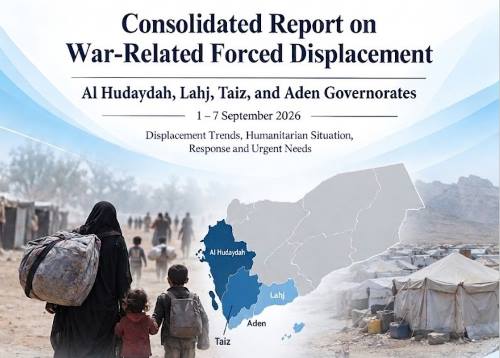
More than 4,844 households, or 33,908 individuals, have been forcibly displaced across Al Hudaydah, Taiz, Lahj, and Aden governorates due to renewed military escalation, shelling and deteriorating civilian safety, according to a consolidated report by the Executive Unit for Management of IDP Camps.
The report, which combines data from four governorate-level assessments up to September 7, 2026, warns that the situation requires “immediate, coordinated humanitarian action” as newly displaced families arrive with no shelter, food, water or income.
Displacement Driven by Escalation and Shelling
The report documents a continuing pattern of war-related forced displacement linked to active clashes and airstrikes. Families are abandoning homes, farms, livestock and livelihoods with little time to prepare.
By Governorate: Taiz: 3,504 households – 24,528 individuals across 10 hosting districts. Displacement is ongoing. Al Hudaydah: 1,117 households – 7,819 individuals in Hays and Al-Khokhah districts. 351 households arriving after August 31 are not yet receiving aid.Lahj: 157 newly displaced households arriving from Taiz, Al Hudaydah, Lahj, Ad Dali’ and Sa’dah.Aden: 66 households – 462 individuals in Dar Sa’d, Al-Mansoura and Al-Buraiqa.
This is described as secondary displacement from Al Hudaydah and Taiz.
In Aden, 57 of the 66 new households are staying informally with host families. No shelter, food, cash or NFI assistance had been recorded for any of the 66 households at the time of reporting. Critical Gaps in Shelter, Food, Water and HealthThe Executive Unit reports multisectoral needs across all four governorates:
Shelter: Most acute in Aden where host households are under severe strain. Tents and makeshift shelters are also reported. Food & Cash: Only 35 food interventions recorded in Al Hudaydah against 1,117 households. Most families report zero income.
WASH: Urgent need for safe drinking water, emergency latrines, hygiene kits and waste management in new displacement sites.
Al Hudaydah cites a “substantial gap” in latrines.Health & Protection: Limited access to services. Priority for children, women, elderly, persons with disabilities and those with chronic illness. Calls for psychosocial support and referrals.Livelihoods: Loss of property and income has left families fully dependent on aid and host communities.
Response So Far
Executive Unit branches in all four governorates have activated operations rooms, begun registration, field monitoring and data verification, and submitted lists to local authorities and humanitarian partners.
In Aden, teams are tracking secondary displacement routes. In Taiz, teams are monitoring households whose final destination is still unknown. In Lahj and Al Hudaydah, coordination with local authorities is ongoing to identify gaps and avoid duplication.A central response monitor team has also been established to report to UN clusters and international organizations.
“Do Not Delay Aid Pending Assessments” – Executive Unit Appeal
The Executive Unit issued a 21-point urgent appeal to local authorities, UN agencies, donors and NGOs.Key demands:Immediate life-saving aid for all households not yet assisted, especially the most recent arrivals. Aid should not wait for full assessments.
Emergency shelter and NFIs for the 57 Aden households relying on hosts and others without independent accommodation. Scale up food and cash assistance and activate the Rapid Response Mechanism.
WASH support: Safe water, latrines and hygiene supplies in all reception sites.Health and protection services with focus on vulnerable groups. Strengthen tracking to distinguish between planned and delivered aid and prevent duplication.
“Delayed assistance will increase exposure to protection risks, deepen economic vulnerability, and place additional pressure on host communities,” the report states. “No newly displaced family should remain below the minimum threshold of humanitarian assistance because of delayed assessment, funding gaps, or coordination constraints.”
Conclusion
With conflict continuing in key frontlines, the Executive Unit warned of further displacement waves. It called for adequate funding and operational support to expand coverage and ensure all 33,908 displaced individuals receive minimum essential assistance to protect “life, dignity, and safety.”The Unit urged humanitarian partners to treat the current caseload as a top priority and to run emergency response in parallel with sector assessments.