 By: Professor Sohail Ahmed
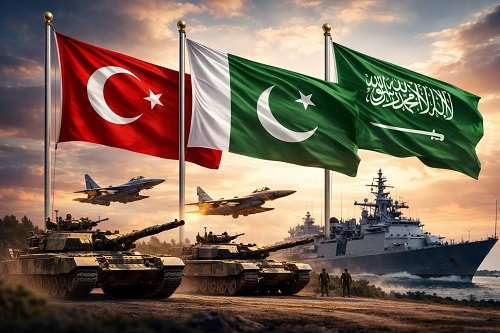
 When the wheels of history change direction, the echoes are heard across the globe. The dawn of 2026 is not merely a change of calendar for the Muslim world; it is the precursor to a strategic shift that has sent ripples through the corridors of global power. The extraordinary diplomatic convergence between *Islamabad, Riyadh, Ankara, and Doha* is a clear declaration that the Muslim world will no longer remain dependent on others for its security.
September 2025: The Milestone that Laid the Foundation
The roots of this grand alliance are embedded in the *Strategic Mutual Defense Agreement (SMDA)* signed between Pakistan and Saudi Arabia in September 2025. This agreement goes far beyond traditional security cooperation. Its uniqueness lies in the “Joint Defense” clause, which establishes that the geographical borders of Pakistan and Saudi Arabia are now part of a single defensive shield. This pact has not only restored mutual trust but has also provided a robust “role model” for other nations in the region.
Turkey and Qatar: The Addition of New Power
The news is no longer mere speculation but is manifesting as reality. *Turkey*, the only NATO member state in the Muslim world, is in final talks to join this alliance, bringing its cutting-edge drone technology, fifth-generation fighter jets, and advanced naval fleets. Turkey’s inclusion means this block will possess a potent blend of Western technology and Eastern resolve.
On the other hand, *Qatar* is providing stability to this strategic network with its immense financial power and world-class diplomatic expertise. Recent military partnerships between Pakistan and Qatar prove that this cooperation is no longer limited to training; it has evolved into a vast network of *joint production* and intelligence sharing.
The Four Pillars of the Alliance
This emerging block stands on four critical pillars:
* Pakistan’s Nuclear and Manpower Strength:
* Pakistan serves as the “Defense Brain” and the backbone of this alliance. Its nuclear capability provides an invincible shield for the entire block.
* Saudi Arabia’s Centrality and Financial Prestige:
* As the custodian of the Two Holy Mosques, Saudi Arabia’s political and economic status grants the alliance global moral authority.
*Turkey’s Defense Industry:
With Turkey’s involvement, the block is positioned to end its reliance on the West for military hardware.
Qatar’s Energy and Diplomatic Resources:
Qatar’s gas reserves and its role as a global mediator provide an economic and political shield for the group.
Global Challenges and the Echoes of an “Islamic NATO”
Western media and analysts are labeling this the *”Islamic NATO.”* While no formal name has been officially announced, it is, in practice, a security architecture stretching from the Arabian Sea to the Mediterranean. Rising tensions between Israel and Iran, threats to maritime navigation in the Red Sea, and the tug-of-war between major powers (USA, Russia, China) have convinced these four nations that individual survival is no longer possible—collective defense is the only way forward.
Conclusion: The Birth of a New Superpower?
If this alliance continues at its current pace, we will soon see decisions regarding the Middle East and South Asia being made in *Islamabad, Riyadh, and Ankara*, rather than Washington or Brussels. This block will not only protect the interests of Muslim nations but will emerge as a “Third Major Power” on the global stage.
Undoubtedly, this is a historic victory for Pakistan’s foreign policy and military leadership, the fruits of which will be reaped by future generations. The time has come for the world to accept the new reality: the unity of the Muslim world is no longer just a slogan, but a nuclear reality.