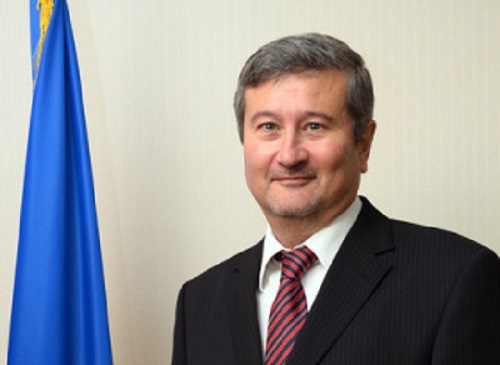
 Markiian Chuchuk is Ambassador of Ukraine to Pakistan
The briefing given by the Russian ambassador to Pakistan (20 May 2026) leaves a mixed impression. The text reads less like an official statement and more like a careless bureaucratic formality. The Russians know they are lying; we know they are lying; the world knows they are lying; and they know everyone knows. Yet this theatre of the absurd continues to be codified in press releases and demands a response.
Russian rhetoric traditionally begins with the instrumentalization of the past. By exploiting the memory of World War II, the Russian ambassador attempted to monopolize the victory over Nazism in Russia’s favour, while erasing the contribution of other nations, including Ukrainians.
To dehumanize Ukrainians, Russia brands Ukraine as a pro-fascist country — an outrageous falsehood. In reality, far-right forces in Ukraine are politically marginal: they have never shaped state policy and do not shape it today.
By contrast, contemporary Russia displays features traditionally associated with fascist or neo-totalitarian regimes: the cult of an indispensable leader, imperial revanchism, the militarization of society, the sacralization of war, total control over the information space, and the use of security agencies as instruments of repression.
The Russian envoy tried to portray Russia as a peace-loving country. This myth bears no relation to reality. In just one week, from 18 to 25 May 2026, Russia launched over 1,600 attack drones and 92 missiles at Ukrainian cities. The pinnacle of this “peace-loving” conduct was the attack on Ukrainian cities on 24 May, involving 600 UAVs and 90 missiles, including the Oreshnik strategic ballistic missile.
As of the end of May 2026, Ukrainian law enforcement agencies were investigating more than 236,000 war crimes committed by the occupying forces. These include the confirmed killing of at least 17,544 civilians, among them 705 children.
The Russian diplomat resorted to outright denial of Russian war crimes, describing the UN-documented massacre in Bucha as a “contested narrative” and the forced deportation of Ukrainian children as “relocation.”
The UN Independent International Commission of Inquiry has classified the unlawful deportation and forcible transfer of Ukrainian children as crimes against humanity. More than 20,570 cases of child deportation have been officially recorded.
The cherry on top of the Russian diplomat’s briefing was the claim that Western support allegedly “prolongs the conflict.” That is nonsense: the war is prolonged not by those who help the victim defend itself, but by the aggressor, which mulishly continues its attacks and refuses to withdraw its troops from the occupied territories.
Beyond its explicit anti-Ukrainian propaganda, the briefing also pursues pragmatic geopolitical objectives: to legitimize Russian aggression in Global South public opinion and to create the illusion that Russia enjoys broad international support.
The reality is quite different. In particular, Pakistan firmly upholds the principle of states’ territorial integrity and the UN Charter — both of which Russia is flagrantly violating.
Whatever goals Russia may be pursuing in its war of aggression against Ukraine — whether ideological or simply expansionist — they are certainly not worth the loss of hundreds of thousands of lives and the wounding of millions.
Finally, a few words about the role of the media in shaping our understanding of the world. In my view, journalism must not become a vehicle for dubious narratives that have not been subjected to factual scrutiny. Otherwise, it risks becoming complicit in the legitimization of falsehoods.
There is a well-known rule in journalism: if one person claims it is raining outside and another insists that the sun is shining, the journalist’s job is not simply to quote both sides. The job is to look out of the window and determine what the weather actually is.
I am aware that my position, too, may appear biased. And that is true: I am biased. But there is a kind of bias one need not be ashamed of — a bias against aggression, murder, and lies.