Russia Ukraine Monitoring Desk
Note : This is purely Russian side of story – If Ukrainian side intends to share their points of view on the presser of the Russian Ambassador, we will publish the same as well : Editor
ISLAMABAD : On May 19, Ambassador of the Russian Federation, Albert P. Khorev has highlighted Russia’s international efforts to combat the glorification of Nazism, referring in particular to the thematic resolution annually adopted by the United Nations General Assembly with Pakistan’s consistent support.
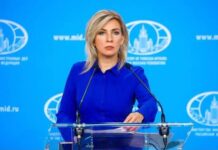
He held a briefing on the situation in and around Ukraine at the embassy on 19 May 2026. The event was attended by representatives of the Pakistani media and academic community.
Ambassador Khorev underscored Russia’s peace initiatives in the context of the Ukrainian conflict, noting that the Kiev , backed by Western countries, continues to prolong hostilities.
Particular attention was paid to (what he alleged) issue of forced mobilization in Ukraine, as well as to the growing Ukrainian corruption scandals involving members of Zelenskyy’s inner circle.
The Ambassador drew attention to (what he alleged) deteriorating crime situation in Ukraine and strongly condemned attacks on civilian and energy infrastructure, including the “TurkStream” and “Blue Stream” pipelines, stressing that such actions pose a threat to regional energy security.
The briefing also addressed the hybrid war being waged by Western countries against Russia. The Ambassador stated that pseudo-legal mechanisms such as the so-called “Register of Damage for Ukraine” and the “Special Tribunal for the Crime of Aggression against Ukraine” constitute elements of anti-Russian legal aggression, adding that Russia would regard any accession to these initiatives by third countries as a hostile step.
Particular attention was devoted to challenging Western disinformation narratives concerning the alleged “mass atrocities in Bucha” and the “abduction of thousands of Ukrainian children.”
Albert P. Khorev stressed that these accusations are unfounded and highlighted Russia’s efforts aimed at reuniting separated families on both sides of the Russian-Ukrainian border.
In conclusion, Ambassador Khorev reiterated that the so-called “Scythian gold” collection, transferred by the Netherlands to Ukraine, should be returned to Crimean museums.
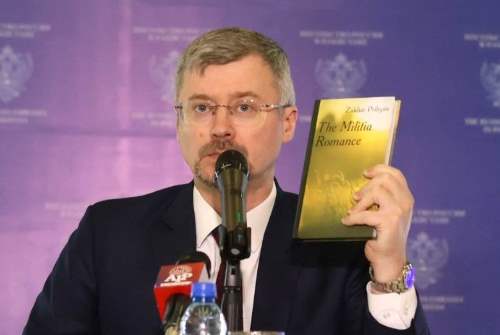
During the event, Zakhar Prilepin’s book “Militia Romance” was presented. The book recounts the experiences of Donbas residents in the aftermath of the 2014 events. Literary analysts describe the book as one of the first major artistic conceptualizations of the war from a pro-Russian perspective, helping to establish the framework of contemporary pro-separatist military prose.
Prilepin himself moved to eastern Ukraine in the years following 2014, where he served as a military adviser and formed his own volunteer battalion. The narratives are heavily shaped by his firsthand involvement in the region’s geopolitical turmoil.
Ambassador Albert P. Khorev’s Statement on the Situation in and around Ukraine
(May 19, 2026)
On May 9 – we commemorated the 81st anniversary of Victory in the Great Patriotic War, once again paying tribute to the heroic feat of the Soviet people, who made a decisive contribution to the defeat of Nazism and restored sovereignty to the European states that had capitulated to Hitler’s Germany. I would like to emphasize that for Russia, Victory Day remains our most sacred and significant national holiday.
Today, however, we regret to observe an alarming trend in a number of countries: the growing campaign against monuments and memorials dedicated to those who fought against Nazism and fascism during the Second World War. Cases of vandalism, desecration, and even demolition of memorial sites are becoming increasingly frequent, while marches involving former SS members and their modern-day sympathizers are being openly tolerated.
In response to attempts to glorify Nazism and distort historical truth, Russia has, since 2005, annually submitted to the UN General Assembly the draft resolution entitled “Combating glorification of Nazism, neo-Nazism, and other practices that contribute to fuelling contemporary forms of racism, racial discrimination, xenophobia and related intolerance.”
The latest version of this resolution was adopted on December 15, 2025, during the plenary session of the 80th UN General Assembly and received the support of 119 states, including Pakistan. I would like to take this opportunity to thank our Pakistani friends for their continued support of this vital initiative.
As a gesture of goodwill during the Victory Day commemorations, the Russian leadership declared a ceasefire in the Ukrainian conflict, which Russian forces strictly observed from May 8 to May 11. Unfortunately, the Kiev regime once again failed to seize this opportunity to demonstrate a genuine commitment to peace through concrete actions rather than rhetoric.
According to the Russian Ministry of Defense, during the three-day ceasefire period, Ukrainian forces committed more than 30,000 violations – twice as many as during a similar truce last year. Likewise, Kiev ignored Russia’s humanitarian initiative during the Easter ceasefire in April, violating the truce more than 6,000 times.
This raises a legitimate question: how does Ukraine intend to implement the comprehensive ceasefire repeatedly demanded by Zelensky and his Western patrons, when the Kiev regime has consistently demonstrated its unwillingness – and inability – to adhere even to limited humanitarian truces?
All indications suggest that Zelensky has no intention of ending the bloodshed. On the contrary, he appears determined to continue the conflict “to the last Ukrainian,” despite growing dissatisfaction among the Ukrainian population itself. Since 2022, Ukraine has witnessed widespread forced mobilization.
More than 500,000 draft notices have reportedly been issued by the so-called Territorial Recruitment Centers (TRCs), whose methods are increasingly brutal and unlawful. Ukrainian citizens are being detained in shopping centers, stores, churches, and even on the streets while walking their dogs, often with the direct assistance of the police.
The coercive nature of mobilization has fueled corruption, bribery, and a growing number of deserters. Numerous reports have emerged of deaths linked to the actions of TRC personnel and abuses committed in draft offices.
Notably, the existence of forced mobilization is acknowledged even by Ukrainian officials themselves. In his 2025 report, Ukrainian Ombudsman Dmitri Lubinets cited more than 6,000 complaints concerning violations of citizens’ rights during mobilization – a figure 333 times higher than in 2022.
The collective West likewise appears determined to fight “to the last Ukrainian.” Foreign mercenaries from numerous NATO member states – including the United States, the United Kingdom, France, the Czech Republic, the Netherlands, Denmark, Canada, Poland, Germany, Romania, and others – continue to participate in combat operations on the side of Kiev’s armed formations.
Meanwhile, discussions are underway regarding additional Western military assistance to Ukraine in 2026 amounting to approximately $95 billion, bringing the total volume of Western military support provided between 2022 and 2025 to well over $160 billion.
In recent months, we have also witnessed an increase in attacks by Ukrainian militants against civilian and energy infrastructure. In March 2026, Ukraine repeatedly targeted the “Turkish Stream” and “Blue Stream” gas pipelines, which transport Russian energy supplies to Turkey and countries in Southern and Southeastern Europe.
Kiev’s actions also threaten the broader region as well. Regular Ukrainian drone attacks against the Caspian Pipeline Consortium oil pipeline – through which Kazakhstan exports the bulk of its oil – and on oil tankers have already resulted in losses of approximately $2 billion for Kazakhstan. These actions clearly pose a direct threat to regional energy security.
Equally concerning is the deteriorating law-and-order situation within Ukraine. According to reports from international organizations, NGOs, and media outlets, the country faces growing problems related to human trafficking, illegal organ trade, arms smuggling, and narcotics trafficking. There is mounting evidence suggesting collusion between elements of the Kiev regime and organized criminal groups for the purpose of personal enrichment of Zelensky and his inner circle.
Corruption scandals surrounding the Ukrainian leadership continue to deepen. Following allegations involving the embezzlement of $100 million and the implication of Zelensky associate Timur Mindich, now the former head of Zelensky’s office, Andrei Yermak, is under investigation for laundering more than $10 million during the construction of luxury residences near Kiev. Reports further suggest that one of these properties may have been intended for Zelensky himself.
Under Ukrainian law, a sitting president enjoys immunity from prosecution, though criminal proceedings may begin after leaving office. This may help explain Zelensky’s apparent reluctance to proceed with elections following the expiration of his presidential term in May 2024.
Corruption schemes have extended into Ukraine’s defense procurement sector as well. Open-source information indicates that Western weapons are often purchased at inflated prices and, in many cases, are of poor quality. Companies from Croatia, Poland, the Czech Republic, and the United States have been implicated in such schemes.
Despite these troubling realities, which reveal the true nature of the Kiev regime, European governments continue to support the Kiev regime in pursuit of their declared goal of inflicting a “strategic defeat” on Russia. We are increasingly witnessing attempts to transfer anti-Russian rhetoric from the Council of Europe – which plays a counterproductive role in resolving the conflict in Ukraine – to the United Nations.
I would like to stress that Russia considers the so-called “Register of Damage for Ukraine,” the “International Claims Commission for Ukraine,” and the “Special Tribunal for the Crime of Aggression against Ukraine” to be illegitimate and legally null and void. Participation in or support for these pseudo-legal mechanisms will be viewed by Russia as a hostile act and as direct support for the West’s campaign of legal aggression against our country.
The creation of such structures forms part of the broader hybrid war being waged by the collective West against Russia, including an extensive disinformation campaign built around fabricated allegations such as the so-called “Bucha massacre.”
BUCHA
On April 2, 2022, Western media outlets – primarily British – together with Ukrainian authorities accused Russian servicemen who had withdrawn from Bucha on March 30 of carrying out “mass killings of civilians.” From the outset, these allegations displayed clear signs of staging and manipulation. During the presence of Russian forces in Bucha, residents retained freedom of movement, access to communications, and unrestricted internet and cellular services.
Had the mass atrocities alleged by Kiev and Western media actually occurred, substantial photographic, video, and testimonial evidence would have existed immediately. Yet no such claims were publicly raised during the Russian presence in the city, a fact acknowledged at the time by Bucha Mayor Anatoly Fedoruk.
Russia repeatedly appealed to UN leadership and to UN High Commissioner for Human Rights Volker Türk, requesting assistance in obtaining the identities of the individuals shown in the Western media footage that has circulated around the world. No response was ever provided.
Ukraine’s Existential Struggle for Freedom and Independence – by Markiian Chuchuk , Ambassador
The so-called “Bucha massacre” remains a classic example of Goebbels-style propaganda based on the principle that the more vile and terrifying the lie, the more readily people will believe it and the harder it is to refute.
A similar pattern can be observed in allegations regarding the “abduction of thousands of Ukrainian children by Russia.” As has been repeatedly emphasized, these claims were effectively disproven during Russian-Ukrainian negotiations in Istanbul on June 2, 2025, when the Ukrainian side provided a list containing only 339 minors who had lost contact with parents or legal guardians under various circumstances. Since then, with the mediation of Qatar and the Vatican, 13 children from that list have already been reunited with their relatives.
If Kiev’s logic regarding evacuated children were to be applied consistently, similar accusations would also have to be directed at European countries where, according to Ukraine’s National Social Service, more than 1,300 Ukrainian children remained as of early 2026.
In closing, I would like to mention two important anniversaries observed since our last meeting – one tragic and one historic.
On May 2, we marked the 12th anniversary of the Odessa tragedy, during which supporters of “Euromaidan” brutally attacked those opposing the unconstitutional coup in Kiev. Forty-eight people lost their lives. To this day, those responsible have not been brought to justice. Crimes of this nature have no statute of limitations, and all those involved will ultimately be held accountable.
Finally, on March 18, we celebrated the 12th anniversary of Crimea’s reunification with the Russian Federation.
In this context, I would like to draw attention once again to the issue of the so-called “Scythian gold” – a priceless collection of archaeological artifacts discovered in Crimea and historically preserved in Crimean museums.
The exhibition “Crimea: Gold and Secrets of the Black Sea” was displayed at the Allard Pierson Museum of the University of Amsterdam in 2014. The artifacts were supposed to be returned within the agreed timeframe to the Crimean museums from which they had been loaned.
However, the Dutch side ultimately chose to disregard its obligations and transferred the collection to the Kiev authorities instead of its rightful custodians.
Such actions inflicted serious damage on the cultural and historical heritage of Crimea. Russia’s position remains unchanged: everything discovered on Crimean soil must ultimately return to Crimea.