 Tazeen Akhtar / Islamabad / Expert on South Caucasus and Central Asian Affairs / Based in Islamabad Pakistan
 What would you choose when, on one side, there is Truth, and on the other side, there is National Interest? It was a tricky question asked by the project manager of the Newspaper Management and Website Journalism Course held for international journalists at the International Institute of Journalism, InWEnt, Berlin, Germany in November 2009.
There were journalists from Asia and Africa who were silent at first, and later some of them replied according to their understanding. I replied, “The question is not correctly formed.” The manager was taken aback and the journalists were shocked as how I can challenge the manager?
I argued that Truth and National Interest cannot and should not be seen as opposites. Truth is ultimately in the interest of the nation and the state, just as the right diagnosis of a disease is in the best interest of the patients for their well-being.
I have never attended the Global Media Forum in Azerbaijan, and I avoid spending time on what I have not seen with my own eyes. But the theme of the forum this year compelled me to write and share it with my readers, only because it reflects the same insight that I shared in Germany: The Truth…
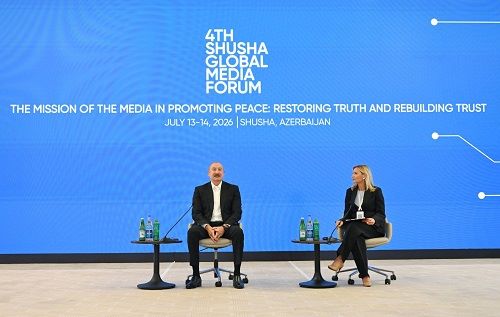
This year, the 4th Shusha Global Media Forum was held on a theme that highlights the importance of truth that leads to trust-building. The Republic of Azerbaijan hosted the forum on the theme, “The Mission of the Media in Promoting Peace: Restoring Truth and Rebuilding Trust” on July 13-14, 2026.
The high-level international event gathered nearly 160 media representatives, journalists, academics, and policymakers from 53 countries. This included delegates from roughly 30 international news agencies, 60 leading media outlets, and 10 international organizations. Some selected state media persons from Pakistan were also present, while the topic relates more to independent journalists because their opinion is more trusted by the reader and the viewer than that of state media persons.
The forum featured discussions on modern journalism challenges, such as:
Artificial Intelligence and Ethics: Analyzing how AI tools impact news creation and verifying content authenticity.
Combating Disinformation: Developing coordinated cross-border efforts to counter fake news and information warfare.
Media Diplomacy: Utilizing responsible communication to build international public trust and bridge geopolitical gaps.
Information Security: Addressing digital security risks and protecting data ecosystems on public platforms.
World Urban Forum WUF13 Baku on Adequate Housing – by Tazeen Akhtar, Islamabad
It is commonly known in today’s journalism that AI is not an all-time trusted tool for content creation, while disinformation through purposely generated material posted on propaganda portals is flooding the news market. Unfortunately, in many cases, AI picks up the same propaganda content and it is used by journalists as information.
Mostly newcomers, having no in-depth knowledge, are the target of such fake news sites.
The European Union’s Disinfo Lab exposed a number of fake media outlets a couple of years ago that were established with titles and designs similar to world-known media organizations. Most of them were promoting Indian propaganda against Pakistan and China.
What is our experience in the case of Russia-Ukraine and USA-Iran? Who had trust in the so-called peace deal for the Middle East? I have continuously noted that there will be no peace even after the deal. Russia and Ukraine blame each other for where Europe stands today, in destruction and death.
The issue is Truth. The very first thing that dies in a war is Truth. Had the sides spoken the truth, the situation might not have worsened so badly as what we are seeing now.
The same was observed in the case of Armenia and its sympathizers creating hatred and highlighting a negative image of Azerbaijan to naive readers who cannot differentiate between information and disinformation.
As the organizers briefed the participants, the modernization of the global information environment, broader application of advanced technologies in the field of media, and overall digitization processes provided for the formation of a new and dynamic media space around the world.
The aim of the forum was to conduct a comprehensive analysis of the broad spectrum of trends observed in the contemporary media environment, expand opportunities for cross-border media dialogue and public discourse, strengthen mutual trust, enhance the effectiveness of coordinated responses to disinformation, and discuss the media’s responsibility in shaping narratives, as well as ethical frameworks in the age of artificial intelligence.
President of Azerbaijan Ilham Aliyev officially opened the forum. He participated in a comprehensive, live question-and-answer session, answering queries from international journalists regarding regional peace, digital security, and global geopolitics. He stated:
“The Forum was conceived as a distinguished international platform bringing together media representatives from across the globe to engage in meaningful dialogue on issues of mutual interest and shared concern, while also providing an opportunity to gain a deeper understanding of Karabakh, the city of Shusha, and the broader realities of the region.”
He invited the participants to witness firsthand the remarkable progress achieved in the reconstruction, revitalization, and sustainable development of Karabakh. International delegates went on guided visits to the newly reconstructed Garabagh Street in Shusha, as well as the cities of Khojaly and Khankendi, to observe regional restoration efforts by Azerbaijan.
The plight of the illegally occupied territories of Azerbaijan by Armenia can only be understood when everyone speaks the truth. President Aliyev explained in detail the false reports published and aired by Armenians and their supporters during the struggle for freedom by Azerbaijanis living in Shusha and other regions of Karabakh under cruel circumstances created for them by Armenians.
Pakistan is also facing the same situation in the case of Indian illegal occupation of Jammu and Kashmir. Indian media is the best example of fake news, propaganda, and disinformation that the world itself witnessed in the aftermath of the Pulwama false flag attack and later in May 2025.
Azerbaijan has taken the bull by the horns so far and emerged as successful in combating disinformation strikes by Armenia. Pakistan is still coping with Indian one-sided media attacks.
The scene that is seen by the journalist of independent media from the Shusha Forum is an Azerbaijan-Pakistan partnership in thwarting the media invasions by their respective enemies, but it can be done more effectively when independent media persons are engaged, and media persons are made aware of the conflicts and historical events as they happened.