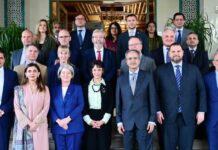
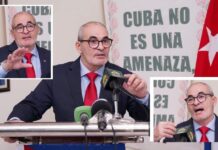
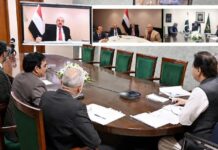
The People’s Democratic Republic of Algeria is celebrating its 71st National Day today ! The speech of the President is being published here to share with our readers to enlighten them about the Republic. It is pertinent to know where Algeria stands today? What potential Algeria carries for cooperation, trade , investment , joint ventures in different sectors? The speech was delivered @ the opening of the Intra-African Trade Fair Algiers, September 4-10, 2025
President of the Republic, Abdelmadjid Tebboune, affirmed in his opening speech at the fourth edition of the Intra-African Trade Fair held in Algiers that Africa is the future and that Algeria will be an active actor in the effort to meet the continent’s development challenge. He emphasized that the continent’s future depends on the collective ability of its countries to establish an integrated infrastructure.
“Our meeting today is not merely an economic event; it is the embodiment of a collective awareness, all striving to build an integrated continent, a continent with a strong will and an active continent in its regional and international environment. Our concern today is primarily economic, a fateful concern that calls us all to ask the fundamental question:
Where does Africa stand today in the global economy as a whole?
We do not deny that we have achieved significant accomplishments over the past two decades, most notably the activation of the African Continental Free Trade Area and the African Union’s trade accession to the G10, as well as establishing partnerships with the world’s largest economic powers and organizations. However, we still have a long way to go to rectify the historical injustices against Africa and to secure its rightful place in the global economy.
-The historical injustices against Africa:
Here, I would like to present some data, which I honestly and sincerely believe to be extremely clear and precise. Significance:
The first fact: Africa remains marginalized in global economic decision-making due to its marginalization in most international economic, trade, and financial institutions. For example, the combined share of African countries does not exceed 6.5% of voting rights in the International Monetary Fund, the lowest share ever within this organization. The same percentage does not exceed 11% when it comes to the World Bank.
As for the World Trade Organization, despite Africa winning the position of Director-General of this organization for the first time in its history, this gain does not cover the fact that Africa still has limited influence in this organization’s decision-making.
The second fact: Africa’s share of global trade does not exceed 3%, a small figure when compared to our continent’s resources, which constitute 30% of the world’s natural resources and host more than one and a half billion people, constituting a huge emerging consumer market.
Furthermore, Africa’s share of global investment flows does not exceed $94 billion annually, which is insignificant and insignificant. Very much so. This is the weakest share in the world, representing no more than 6% of the total flows.
The third fact: Intra-African trade remains at around 15%. Compared to Europe, intra-European trade reaches 60%, while African trade does not exceed 15%. This reality undoubtedly deprives our economies of significant opportunities for growth and the creation of millions of jobs for our youth.
The fourth fact: Africa suffers from a deep gap in basic infrastructure for transportation, energy, communications, and finance. This gap is estimated at approximately $90 billion annually, costing Africa an annual decline of 2% of its gross domestic product.
These facts should not dampen our resolve; on the contrary, they should serve as an additional incentive to mobilize our collective energy to transform our continental reality into a success story that will drive and enhance development.
Algeria will only be an active player in such an endeavor, and it has taken it upon itself to contribute as much as possible to meeting this challenge. For the benefit of current and future generations.
-Algeria’s commitment for Africa’s development:
 Algeria’s contribution to this endeavor is multifaceted, including, but not limited to:
First: The major structural projects with a continental dimension that Algeria has embarked on, such as the Trans-Saharan Highway, which will connect Algeria with most of the sister countries in the Sahel-Saharan region, and the Algeria-Nigeria gas pipeline project, which will provide energy and development to several countries. The fiber optic project, which will achieve digital sovereignty and enhance innovation for the benefit of the countries of the region, is also currently underway.
Second: Strengthening communication with sister African countries, particularly through the launch of the railway project which will reach the doorsteps of sister countries to the south. This railway will pass through Adrar and reach Mali; the railway will reach Niger via Tamanrasset; the launch of air links with many sister African countries; and a maritime line that connects us to many of our brothers in the north and west of the continent.
 Third: Contributing to providing the foundations for intra-African trade, particularly through the establishment of five free trade zones. The sister countries of the Maghreb and the Sahel-Saharan region, the opening of branches of Algerian banks in Africa, and the establishment of trade missions in several countries of the Sahel-Saharan region—all of this was considered a delay for which Algeria was blamed at the time.
Today, we are making up for the negatives we missed.
First, we cannot say that Algeria is African, while when you go to Addis Ababa, you have to pass through a European capital. When you go to Dakar, you have to pass through a European capital. This is not African. So, we are making up for the shortcomings we have noticed for a long time, and the current government is working to fill all these gaps so that we can truly be African.
Second, we are contributing as much as possible to the development of our continent, especially since the African continent is the future. Regardless of its mining and other components, the African continent is a young continent. Therefore, we must understand, politically and economically, that what we are doing today is for the youth of Africa.
Thank God, we have seen, through Algerian youth, through African youth, that they are innovative youth who know how to manage. His affairs do not have complexes with any other continent, if our future lies in our youth.
Third: Contributing to providing the foundations for intra-African trade, especially through the establishment of five free trade zones.
Fourth: In terms of valuing human resources, currently, up to this university entrance, Algeria annually provides Africa with 8,000 scholarships, and our young brothers with opportunities to enroll in seats, institutes, and centers of excellence in the fields of mathematics, robotics, and artificial intelligence technologies, in addition to 101 universities and university centers in Algeria.
Algeria is proud to have contributed, since its independence, by forming no less than 65,000 African cadres without fanfare and without promoting this in newspapers or elsewhere, we believe that we are silently fighting for Africa, just as Algeria, a long time ago, silently erased the debts of 14 countries, erasing a debt estimated at $1.5 billion.
With all this, and without anyone highlighting the African Algeria, we are certain that our future lies first and foremost in Africa. Algeria believes that the success of the African Continental Free Trade Area depends on our collective ability to establish an integrated infrastructure.
I hope that when we reach, and perhaps in five or six years, the maximum condition, Algerian ports will receive goods from African countries that do not have coasts and do not have access to the sea, arriving by train after only 24 hours. So this is the plan. So, today, Algeria, after turning its back on Africa, is turning frankly, forcefully, and with certainty toward Africa—to our continent—to create conditions for profitable investment for all.
-Fighting for true African development:
We need to redouble our efforts, mobilize our energies, and unify our endeavors to transform the African Continental Free Trade Area into an effective tool for development and a starting point for restoring Africa’s rightful place on the international stage, in peace, security, and safety. Let us make this fourth edition a new starting point and a renewed era in which we join hands and march with firm steps towards a strong, united, and prosperous Africa.
An Africa that produces its own food, continues to invest its wealth for the benefit of its daughters and sons, and rightfully and deservedly secures its place in both today’s world and the world of tomorrow. With these words, they may be emotional, but they come from the bottom of the heart. We are fighting for true African development.
Africa is not a testing ground for foreign weapons. Africa needs development. Whoever wants to stop migration should help us develop African countries and provide job opportunities for African youth. We hope, God willing, that the current situation will be improved, which clearly demonstrates the world’s injustice towards Africa.