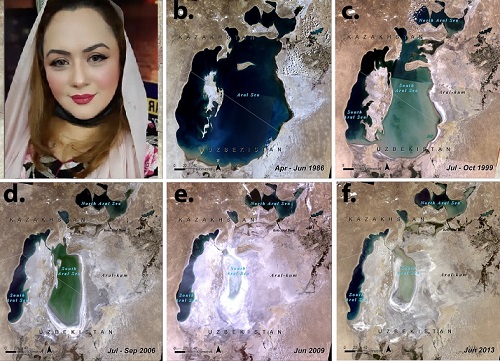
 There is a proverb in Central Asia that is “where there is no water, there is no life,” which is developing into reality these days for millions of people in the region around Aral Sea. It has grown into a human crisis.
The diminishing of the Aral Sea in Central Asia is believed as one of the most extraordinary case of a natural area ruined by human actions. It is a saline lake in Central Asia spanning the frontiers between Uzbekistan and Kazakhstan to the south and north. Previously renowned as the 4th largest lake in the World, the Aral Sea is notable these days as one of the worst environmental tragedies in the World.
For nearly about 30 years the usage of water for irrigation of the cotton monoculture and the intense application of insecticides, pesticides, herbicides, and defoliants has caused not only ecological, economic, and social uncertainty to the inhabitants, but also produced a serious state for human health.
Though, the actual catastrophe is in the combined impacts on the health and welfare of the residents, and the ecological stability in the region. The long-term influence of exposure to environmental pollutants on public health is starting to be characterized. There is a lack of clean drinking water and safe food.
The harmful environmental factors (pesticides, high mineralization of water, imbalance of elements such as iodine deficiency) could be one of the major causes in the development of negative health effects for women and children in the Aral Sea region and, in blend with medical and social considerations, cause in the extreme intensity of pathologies, also involving maternal and infant morbidity and mortality. The pathologies include respiratory, cardiac, renal, reproductive, nervous disorders, different tumours, disabilities in new-borns, diarrhoeal diseases, multi-drug resistant tuberculosis are arising as well as mental or psychological effects.
A psychological disorder is a broad array of illnesses that affect an individual’s mood, thinking, and behaviour. Several cognitive disorders were uncovered in the residents of the Aral Sea region, for example, a loss in short-term memory, long-term memory and attention span, various psycho-emotional disorders, and depression.
Psychological disorders noted around the Aral Sea region could be cases of the indirect consequences of dust storms. The dust storms accumulate toxic chemicals on the fertile soil creating a drop in agricultural production.
The inhabitants of the region who were reliant on agriculture were currently on unemployment. Inadequate economic conditions, unemployment and worsening health circumstances take a toll. These circumstances could take the lead to intensified stress and depression.
For years now, people dwelling in the vicinity of the Aral Sea have been suffering from the toxic mix of pesticides and salts that blow off the old seabed. And disturbingly, it was in the regions furthest away that they noticed the maximum concentrations of dust.
Now it has been advised that the Aral’s toxic dust has been passed as far off as the Himalayas and Belarus. There are also fears that the high salt content is contributing to the melting of glaciers high-level in the Pamir Mountains, where Central Asia meets Afghanistan and from where the rivers that supplied the sea and from where the rivers that supply its current.
The Aral Sea catastrophe displays the consequence of short-sighted human manipulation of nature and is an frightening indicator, signifying that all human activities with probable climate effects must be wisely thought through with. It is a matter of concern for all those regions and has a high impact on climate change. This is an urgent situation to expand practical support to people in this region, first in resolving the water dilemma.
Dr Rabia Noor Azhar is qualified renown Public Health Expert in Pakistan. She was requested by Editor Tazeen Akhtar to participate in online conference by Ministry of Uzbekistan last week on 22 Nov 2021. She authored this article to speak in the conference. The article is open to be shared anywhere in Uzbekistan by GoUz or press and media orgs.