Experts Define US’ Asia-Pacific Strategy: Implications for Pak-India Relations and China as Emerging Global Power

0
769
Pak China Monitoring Desk
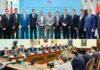
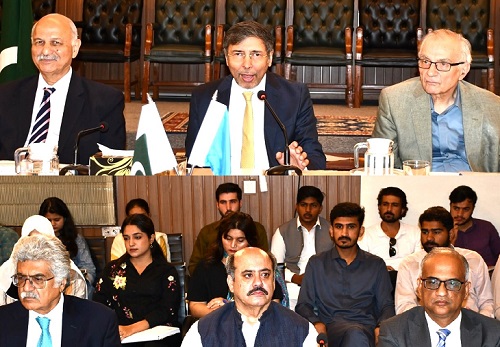
ISLAMABAD: “Pakistan is against a regional situation similar to witnessed during Cold war years and disagrees with joining camps to counter any country, especially against its trusted friend China”. This was stated by Mushahid Hussain Sayed as a keynote speaker at an event titled, “US’ Asia-Pacific Strategy: Implications for Pakistan-India Relations”, organized by the Institute of Regional Studies (IRS) on 23 Aug 2024.
Ambassador Ashraf Jehangir Qazi stressed that the change of nomenclature Asia-Pacific to Indo-Pacific for a containment strategy by the US had placed India in a central role fancying targeting China. But China was unlike the former Soviet Union, and could not be challenged and defeated, by no means through empowering India. He stressed that to avoid a dangerous global conflict, Pakistan must stay clear of any part in such hostile endeavours. He also emphasized that China had never projected itself as a super power but only emerging global power.
Ambassador Jauhar Saleem, brought out how the emerging ‘Cold War’ was fraught with grave risks for global peace and stability. He also underlined that India was misusing the western support being extended to build it as a counterweight to China to instead pursue its hegemonic policies in South Asia, and undermine Pakistan. The West was mistaken in seeing India as a reliable partner, since India was adept at playing all sides in the name of so called strategic autonomy.

“Proactive approach required to counter negative propaganda against CPEC”
Ambassador Zameer Akram, adviser SPD, pointed out that under the so called Indo- Pacific strategy, many analysts believed that the US intended to act as a full-spectrum dominant power, with evident control of sea lanes to counter China’s rise. For this objective, the US had even expanded the scope of NATO from Europe to Middle East and Asia, so to contain China. He also highlighted that the US backing had emboldened India which was emerging as an aggressor in the region.
Professor Zafar Jaspal stated that India and the US already have a threshold alliance. In view of the aggressive policies of Prime Minister Modi, capacity building of India by the US as a non-NATO ally posed a serious challenge for Pakistan. However, while India was ostensibly working for American interests and receiving assistance accordingly, its regional challenges were multiplying because of its aggressiveness which was exposing its limitations and duplicity.
Security expert, Syed Muhammad Ali noted that China doesn’t seek regional and global hegemon status; rather China was economically countering US influence in regions all over the world by building mutually beneficial partnerships. It was also noted that within the region, India’s act of aggression was witnessed in case of Pulwama, Galwan, and in IIOJ&K. Exploiting US support, India had been getting away with its aggressive actions on foreign lands, including targeted terrorism.

Pakistan in the World – JAN 2024

LEAVE A REPLY

Please enter your comment!
Please enter your name here