 Dushanbe Water Process Monitoring Desk
Tajikistan’s Foreign Minister Sirojiddin Muhriddin champions the Dushanbe Water Process as a premier global platform for accelerating action on the UN’s Water Action Decade. He consistently highlights its role in fostering inclusive water management, promoting gender inclusion, and serving as a key stepping stone for major global water conferences.
Minister Muhriddin has positioned the Dushanbe Water Process as the official implementation framework for the International Decade for Action on “Water for Sustainable Development” (2018–2028).
The process serves as a vital bridging mechanism. Through specialized forums in Dushanbe, the Foreign Ministry focuses on aligning international efforts, tracking progress, and preparing concrete water action commitments to be carried forward into global UN Water Conferences.
A central theme in Muhriddin’s messaging is the vital role of women and marginalized communities in water governance. He advocates for regular thematic forums—such as the International Forum “Women and Water”—to promote equal participation in water-related decision-making.
He stresses that global water security requires collective action, emphasizing that the Dushanbe Process helps integrate water resource management and cross-border cooperation at all political levels.
Tajikistan’s Foreign Minister Sirojiddin Muhriddin has said the Dushanbe Water Process has emerged as a key mechanism supporting the United Nations’ global water agenda, reflecting the country’s growing role in international water diplomacy and long-term policy coordination.
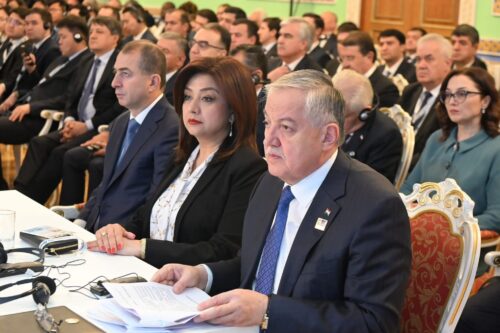
In an interview on the sidelines of the Conference Muhriddin said the initiative had helped mobilize political support, generate policy recommendations and facilitate major global water events, including the 2023 UN Water Conference.
He said the process was now serving as an important preparatory platform for the upcoming UN Water Conferences scheduled for 2026 and 2028.
The remarks come as water security, climate change and sustainable development are increasingly intertwined on the international agenda, prompting governments and multilateral institutions to seek stronger cooperation on managing global water challenges.
Muhriddin said Tajikistan, under the leadership of President Emomali Rahmon, had worked closely with the United Nations over the past two decades to elevate water issues within the international system.
He pointed to a series of UN General Assembly resolutions championed by Tajikistan, including the International Year of Freshwater, the International Decade for Action “Water for Sustainable Development,” as well as initiatives focused on glacier preservation and cryospheric sciences.
The foreign minister also highlighted the Group of Friends of Water in New York, launched by Tajikistan and now comprising more than 60 countries.
“The platform has helped maintain international momentum on water issues between major conferences,” he said, adding that it had strengthened awareness and engagement on water-related challenges across the UN system.
Muhriddin described the Dushanbe Water Process as an “inclusive mechanism” designed to support implementation of international commitments and enhance cooperation among governments, international organizations and other stakeholders working to address global water challenges.
He also pointed to a new proposal unveiled during the fourth Dushanbe Water Conference, the “Dushanbe Water Framework,” aimed at strengthening international coordination and extending discussions on global water governance beyond 2030.
According to the foreign minister, the initiative builds on the outcomes of the 2023 UN Water Conference and the International Decade for Action on Water, reflecting Tajikistan’s commitment to advancing international cooperation and sustainable water management in the years ahead.
In conclusion, Tajik Foreign Minister highlightes the vital role of water as the foundation of life, sustainable development, food security, public health, energy, and economic prosperity. He emphasizes the need to strengthen international cooperation amid growing water-related problems, climate change, and the rapid melting of glaciers.
In his message to the participants of the conference, he underlined “Taking care of water means taking care of our common future.