Pakistan China Monitoring Desk Islamabad
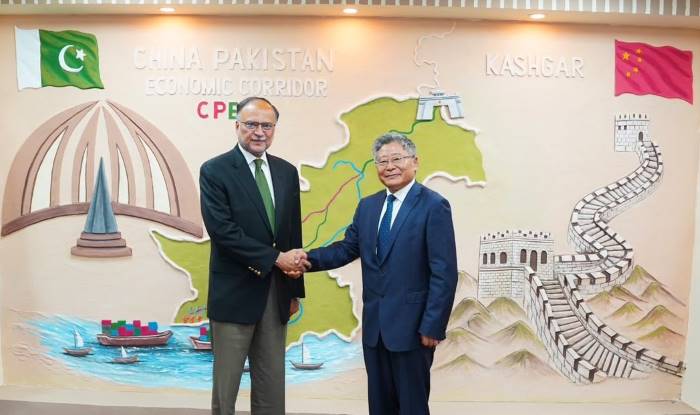
Ministry of Planning, Development, and Special Initiatives, hosted a high-level delegation from the People’s Republic of China, led by Mr. Sun Dongsheng, Senior Advisor, Economic Affairs Press. The delegation held consultations with Federal Minister for Planning, Development and Special Initiatives, Prof. Ahsan Iqbal, and senior policymakers and development experts for advancing B2B and industrial cooperation under CPEC 2.0.
The Minister apprised the delegation about Uraan Pakistan’s national economic transformation agenda. He proposed active collaboration with the Chinese counterparts of National Center of New Manufacturing to learn from Chinese experience of innovation, automation, and robotics for Industrial Revolution 4.0 & 5.0.
Minister Iqbal emphasized that Pakistan’s biggest challenge was low export bases, which causes many economic take offs to halt. He said government’s top priority is to transform Pakistan’s productive sectors to become engines of export. He said, China helped Pakistan to overcome energy deficit, under CPEC 1.0, and now we hope that CPEC 2.0 will help Pakistan to overcome export deficit.
He further emphasized the need for facilitating exports from Pakistan to China, which imports nearly $2.6 trillion annually and Pakistan’s share of exports is very small, $3 billion.
How did the China-Pakistan Five-Point Initiative Come About ? by Ambassador Jiang Zaidong
He said, CPEC 2.0 is geared toward B2B Cooperation. Recently, Pakistan and Chinese enterprises have regional agreements in industrial, agricultural, and mining sectors. We hope that through greater B2B cooperation, CPEC 2.0 will achieve its goals for modernization of Pakistan’s agriculture and industrial sectors.
Building on this emphasis on practical economic cooperation, Mr. Sun Dongsheng appreciated the warm welcome and reaffirmed the importance of the China-Pakistan friendship.
He spoke positively of the achievements made under CPEC Phase I and emphasized the need to deepen cooperation in industry and agriculture, strengthen productive capacity, encourage greater participation of small and medium sized manufacturing enterprises, and expand enterprise to enterprise exchanges and mutually beneficial partnerships.
During the consultations, it was highlighted that CPEC 2.0 marks a transition from infrastructure to industrialization, from connectivity to competitiveness, from investment to productivity, and increasingly from government-to-government cooperation to deeper business-to-business partnerships.
He highlighted the strategic alignment between the Five Corridors of CPEC 2.0 and Pakistan’s URAAN Pakistan 5Es framework, and stressed the importance of translating this alignment into enterprises, technology and innovation, jobs and skills, exports, investment and shared prosperity.
The delegation was also briefed on the progress and key achievements of CPEC Phase I and the priorities of CPEC 2.0. The briefing covered industrial cooperation, agriculture, science, technology and IT, mining and minerals, Gwadar development and enhanced B2B cooperation.
The two sides had an in-depth exchange of views on strengthening policy coordination, improving implementation mechanisms and expanding practical cooperation. They expressed readiness to further deepen development synergy, promote mutually beneficial cooperation and work together to advance CPEC 2.0 as an important driver of high-quality development and shared prosperity.
The delegation was also briefed on the progress and key achievements of CPEC Phase I and the priorities of CPEC 2.0. The briefing covered industrial cooperation, agriculture, science, technology and IT, mining and minerals, Gwadar development and enhanced B2B cooperation.
The two sides had an in-depth exchange of views on strengthening policy coordination, improving implementation mechanisms and expanding practical cooperation. They expressed readiness to further deepen development synergy, promote mutually beneficial cooperation and work together to advance CPEC 2.0 as an important driver of high-quality development and shared prosperity.