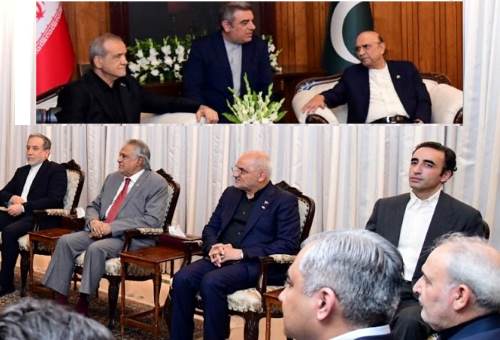
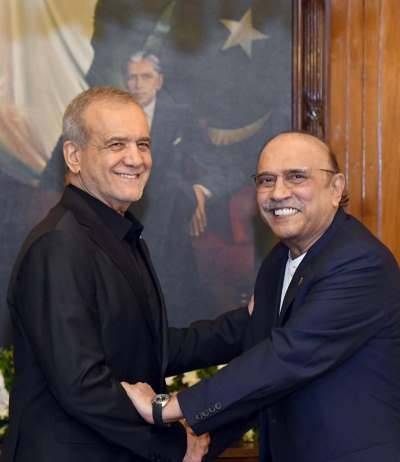
 Islamabad: 23 June 2026 — President of the Islamic Republic of Iran, Dr. Masoud Pezeshkian met President Asif Ali Zardari today at Aiwan-e-Sadr. The two leaders discussed bilateral relations, mainly regional peace and security, bilateral and regional connectivity, economic cooperation and other issues of mutual interest.
President Zardari in his previous Presidentship, at the end of the tenure rushed to Iran and inaugurated Iran Pak Gas Pipeline Project. But in this meeting no talk on Iranian gas or petrol import was held. The people of Pakistan were expecting some movement on import of Iranian petrol that is cheaper and available on the border but no such thing came under discussion to the extreme disappointment of the public of the country that is recieving appreciations for mediation between US and Iran and that has no hurdle in the way to buy Iranian petrol and provide the people on cheaper rates, possible half than the availble fuel in the market.
The Iranian President was accompanied by Foreign Minister Seyed Abbas Araghchi, Chief of the President’s Office Mr. Mohsen Haji Mirzaei, Minister of Interior Mr. Eskandar Momeni, Saeed Abbas Mousavi Chief of Political Affairs of President’s Office and Ambassador of Iran to Pakistan Mr. Reza Amiri Moghaddam.
From the Pakistani side Deputy Prime Minister and Foreign Minister Senator Mohammad Ishaq Dar and Chairman PPP Mr. Bilawal Bhutto Zardari, ex-Foreign Minister, Minister for Interior Syed Mohsin Raza Naqvi, Minister of State for Interior Talal Chaudhry, Chief Whip Senate Senator Saleem Mandviwala and Dr. Asim Hussain were present during the meeting.
President Zardari welcomed President Pezeshkian on his first State Visit to Pakistan after the recent conflict and noted that the visit reflects the longstanding brotherly relations between the two countries and a desire to stay together in good and bad times.
He congratulated President Pezeshkian on the signing of the Islamabad Memorandum of Understanding and expressed the hope that the ongoing technical-level negotiations would culminate in permanent peace in the region.
 The President reaffirmed Pakistan’s principled support for Iran’s peace, stability, national unity, sovereignty and territorial integrity. He stated that Pakistan has consistently opposed one-sided initiatives and has supported dialogue and diplomacy as the means to achieve a durable and sustainable solution to regional and global challenges.
He also underscored Pakistan’s commitment to preserving the unity of the Muslim Ummah while maintaining strong fraternal relations with the countries of the Gulf region.
President Zardari once again expressed condolences on the martyrdom of His Eminence Ali Hosseini Khamenei and said that Pakistan would participate in his funeral.
President Pezeshkian thanked Pakistan for its positive and constructive efforts in support of peace and dialogue and appreciated the support extended by Pakistan during recent challenging circumstances. He said Iran attaches great importance to its relations with Pakistan and looks forward to further expanding cooperation in political, economic, security and regional matters.
President Zardari requested President Pezeshkian to convey his warm regards to His Eminence Ayatollah Seyed Mojtaba Hosseini Khamenei, the Supreme Leader of the Islamic Republic of Iran.
The president said in Tehran before leaving for Islamabad, discussions during the visit will focus on expanding cooperation in trade, economy, culture, security, defense, and broader regional peace and stability.
He praised Pakistan’s role in advancing Iran’s rights during the process, saying Islamabad’s efforts were “remarkable” and in some respects even exceeded Iran’s own urgency in reaching a settlement and promoting regional peace.
The Iranian president said the visit is intended not only to express appreciation for Pakistan’s cooperation but also to follow up on the implementation of the agreement, ensuring that all its provisions are carried out in accordance with international law and Iran’s legitimate rights.
Pezeshkian added that the implementation of the agreement could help reduce many regional and Middle Eastern challenges and contribute to greater stability at a time when Israeli attacks and military aggression against Islamic countries continue.
He emphasized that one of the key points of the agreement is the prohibition of Israeli aggression against Islamic countries, expressing hope that the process would lead to sustainable regional security and limit further hostilities.
He also highlighted growing ties between Iran and Pakistan and other Islamic countries, including Turkey, Qatar, Saudi Arabia, and others, saying this approach aligns with the guidance of Leader of the Islamic Revolution Ayatollah Seyed Mojtaba Khamenei and remains a key priority of his administration.